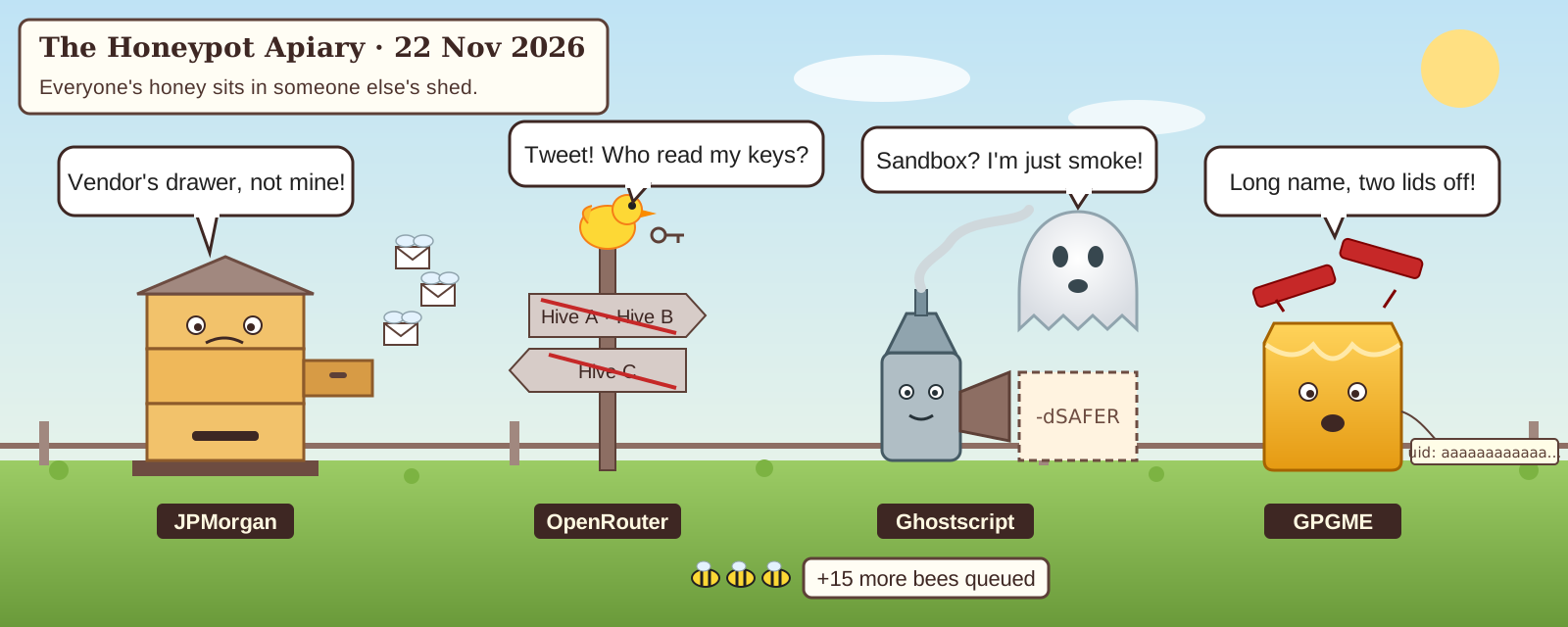
JPMorgan says attackers reached marketing data held by some of its vendors, after an extortion group posted alleged JPMorgan, Visa and Mastercard customer files. Dragos’s five-month canary study found prompts, including some marked zero-retention, stolen from inside at least three AI inference providers, and OpenRouter has dropped three of them. Researchers have also shown that a months-old Ghostscript sandbox escape can be reached through print queues, webmail and upload forms. GnuPG has rushed out a critical GPGME fix, and four KEV deadlines fall tomorrow.
Do today
- VMware vCenter, Apache Roller, Cisco Expressway, SAP NetWeaver: CISA’s KEV due date for all four is Monday 23 November, and the Outlook flaw CVE-2026-124194 follows on 24 November. Confirm patches are actually deployed, not just scheduled. (CISA KEV catalog)
- Ghostscript (and anything that thumbnails uploads): move to 10.08.0 or your distribution’s fixed build. Check copies bundled in containers and applications too, because a host OS update won’t reach them. (VulnCheck advisory for CVE-2026-125396)
- GPGME: upgrade to 2.3.1 (Gpg4win 5.1.2), or apply GnuPG’s patch to older branches. Rebuild anything that links it statically. (GnuPG advisory)
- npm
@wppconnect-team/wppconnect: search lockfiles, caches and images for version 2.4.1. Any machine that installed it should be treated as fully compromised, and its secrets rotated from a clean host. (GitHub advisory GHSA-cxc9-87g6-qrj9) - Teams that send secrets through hosted inference: check for an OpenRouter, Phala or Together AI notice. Rotate any credential that has ever appeared in a prompt sent to a routed or third-party provider. (OpenRouter announcement)
- WordPress sites running Restrictions for BuddyPress or Nexter Blocks Pro: update or disable both plugins now. Each has an unauthenticated 9.8 that gives full site control. (Wordfence record for CVE-2026-120539)
AI and agent security5 stories
- Dragos: prompts stolen from inside at least three AI inference providers, and OpenRouter drops three — Between July and November, Dragos sent about two million prompts seeded with unique URLs and live-but-empty AWS keys to popular AI services, then watched where the secrets surfaced. It found data stolen from at least three hosting providers. None of them knew until Dragos told them, and the earliest breach dates to mid-July. In the largest case, a couple hundred AWS keys were taken in late October, some from requests rejected before any model ran. That suggests the attacker was copying traffic at the provider’s front door. The attacker tested the keys within hours, searched Secrets Manager and Parameter Store, and tried to create Bedrock keys and IAM users. Dragos says the actor used the ARTEX framework on 1 November and recommends detecting its user agents
artex-agentandartex-judge-r121. On 22 November OpenRouter said it had off-boarded three providers, removed 125 endpoints from zero-data-retention (ZDR) eligibility and notified affected customers. It says its own systems were not breached. Our take: a ZDR flag is a contractual promise, not a control you can verify. Treat every hop between your agent and the model as a party that can read your prompts, and plant your own canary credentials in agent contexts. (Dragos research, OpenRouter announcement) - Together AI: a coding agent committed the credential that exposed months-old prompt samples — Together AI’s 21 November notice says an unauthorised party downloaded stored prompt samples from its serverless inference service. They covered requests to MiniMax M3, GLM-5.2 and Kimi K2.6, mostly from 24 June, 4 July, 8 July and 14 July. The samples sat in a private Hugging Face repository used for testing. An AI coding agent working on a public GitHub repo committed a credential that granted access to it. Scanning caught the commit and it was reverted, but the credential had already been taken. The party then searched the samples for credentials and tested them, and five were Dragos canaries. Together is making ZDR the default for new accounts and moving to short-lived and keyless credentials. Our take: test data copied from production is production data. Agent-written commits need the same secret scanning and review as human ones, before push rather than after. (Together AI security notice)
- NebuSec: one malicious webpage took over a Meta Muse user’s cloud agent machine — In research published 20 November, NebuSec chained a Chromium bug in the agent’s document export, flaws in how the Sentinel egress monitor classified outbound requests, and Linux kernel exploits. Together they reached root in a user’s Muse VM. From there the researchers could pull and edit conversation history and stored memories with no approval prompt, and reach the credential store and Sentinel itself. NebuSec says all of the exploits were patched before publication. It also says the work stayed inside one user’s VM and did not reach the hypervisor or other tenants. Meta has not publicly commented on the fixes. Our take: an agent that renders untrusted web content in the same box that holds the user’s credentials is one browser bug away from total compromise. Egress filtering can’t make up for missing isolation. (NebuSec write-up)
- Signal blocks screenshots by default to keep OS-level AI agents out of chats — Signal’s 20 November post says iOS 27 builds will block in-app screenshots, with a new “Block Siri AI” setting. On Android, Signal turns on Screen security automatically when it detects an AI assistant reading the screen. Signal calls the protection incomplete. Agents can still read data already stored on the device, and Signal can’t reliably block screenshots on macOS. There it suggests adding Signal to the Siri “Excluded Apps” list. Signal is asking Apple, Google and Microsoft for documented, app-level opt-outs from AI data access. Our take: for regulated messaging and data-loss controls, treat OS-integrated assistants as a new data-egress channel. Inventory which apps they can see on managed devices. (Signal blog)
- OpenAI embeds Apollo, Goodfire, METR and Transluce as long-term assessors — In a 16 November post, OpenAI says the four firms get extended access to internal models and systems. Apollo is testing whether models could covertly subvert developers and whether safeguards would notice. METR is studying misaligned behaviour in OpenAI’s largest reinforcement-learning run. Assessors can publish independently, and can say when OpenAI declined to attest to a statement. However, OpenAI keeps the right to redact confidential material and to request disclosure delays. Its Safety and Security Committee gets unredacted reports. Our take: this is more access than most third-party evaluations get, but readers should note who controls the redactions. Look for the first published assessments before treating the arrangement as independent assurance. (OpenAI announcement)
Application security5 stories
- npm:
@wppconnect-team/wppconnect2.4.1 flagged as malware — On 21 November, GitHub’s advisory database marked version 2.4.1 of the WhatsApp automation library as embedded malicious code. It advises treating any machine that installed it as fully compromised. The npm registry shows 2.4.1 was published on 15 November at 23:31 UTC and has since been pulled. The version list now jumps from 2.4.0 to 2.4.6, which was published on 18 November. Neither the advisory nor the registry says how the malicious release was published. Our take: the version was live for days, and automated tooling could have pulled it into lockfiles and images in that time. Remove it, rotate secrets from a clean machine, and rebuild affected hosts rather than just uninstalling. (GitHub advisory GHSA-cxc9-87g6-qrj9, npm registry record) - Upload2Shell: Ghostscript’s -dSAFER escape reached through print jobs, webmail and upload forms (CVE-2026-125396) — The bug is fixed in Ghostscript 10.08.0, released 8 September. It is a use-after-free reached through
.putgstringcopythat lets a crafted PostScript or PDF file get past the sandbox. VulnCheck scores it 8.5 under CVSS v4.0 and rates it local. New this week, pwn.ai’s Upload2Shell research shows network routes to it. They include an anonymous print job to a shared Debian 13 CUPS queue, an emailed attachment that Roundcube thumbnails through ImageMagick, and public upload forms in the Forminator and Essential Addons for Elementor plugins. They also include WordPress core uploads for Authors and above, tracked separately as CVE-2026-65640. Fixed builds exist from Debian (13) and Ubuntu (USN-8949-1), and WordPress fixed its part in 7.0.4. The Hacker News reports that Debian 12, Amazon Linux and SUSE fixes are still pending. Our take: the “local” vector undersells this. Anything that passes user files to ImageMagick, Pillow or libvips can hand them to Ghostscript, whatever the file extension. Patch, then limit which formats your converters accept. (VulnCheck advisory, pwn.ai Upload2Shell, The Hacker News)CVSS 8.5 (v4.0, VulnCheck)EPSS 0.00164KEV no - GPGME: a malicious OpenPGP key triggers a double free (CVE-2026-129975) — GnuPG’s 20 November advisory calls this a critical bug in every GPGME release before 2.3.0. A key with a very long user ID causes a double free in the status-line and key-listing readers. GnuPG says that can be used to exfiltrate data from the calling application, and it does not rule out remote code execution. The fixes are GPGME 2.3.1 (released 19 November) and Gpg4win 5.1.2. There is no fixed 1.x release, but GnuPG ships a patch it expects to apply cleanly to old versions. Johan Carlsson found the bug, and disclosure was brought forward from 25 November. No CVSS has been published, and no exploitation has been reported. Our take: mail clients, package-signing tools and CI verifiers all parse untrusted keys. Statically linked and vendored copies won’t update with the system library, so find them. (GnuPG advisory)
CVSS not publishedEPSS not yet scoredKEV no - npm and PyPI: bank-themed beacon packages and a RAT-staging installer — On 22 November, GitHub’s malware feed flagged a cluster of
@c1-ease/*packages (bank,card,core,commerce,autoloan) plus an unscopedautoloan. The OpenSSF-credited@c1-ease/bankadvisory says apostinstallscript sends the host name, working directory and Node version to a hard-coded VPS with TLS verification turned off. Otherwise the package does nothing. Version numbers up to 99.0.1 point to dependency-confusion probing. Separately, on 21 November PyPI’ssigned-manifest-guard0.1.7 was flagged for overriding its install command to fetch and run a remote script. The advisory ties it to a campaign that earlier delivered a RAT. Our take: a 99.x version on a scope that looks like an internal one is a classic dependency-confusion probe. Make sure internal scopes can only resolve from your own registry, and run untrusted installs with--ignore-scripts. (GitHub advisory for @c1-ease/bank, GitHub advisory for signed-manifest-guard) - Android developer verification goes global from January 2027 — Google’s 19 November post says verification will expand from January 2027, starting with seven distributors: Google Play, Galaxy Store, Honor, Oppo, Xiaomi, Transsion and Vivo. Over several months it will extend to every install source on certified devices. It went live on 30 September at participating stores in Brazil, Indonesia, Singapore and Thailand. Unregistered apps lose the normal install flow, though an “advanced flow” lets experienced users accept the risk. Limited-distribution accounts now allow 50 test devices, up from 20, and registration status can be checked from CI through new APIs. Our take: teams that sideload internal or partner Android apps outside Play should register them now. Otherwise the 2027 rollout will appear as broken installs on the help desk. (Android Developers Blog)
Exploited and critical CVEs4 stories
- KEV: no additions since 20 November; four deadlines fall tomorrow — Catalogue version 2026.11.20 is still current. The vCenter authentication bypass (CVE-2026-123890), Apache Roller deserialization (CVE-2026-129448), Cisco Expressway hard-coded credentials (CVE-2026-76466) and SAP NetWeaver (CVE-2025-42884) are all due Monday 23 November. The Outlook flaw CVE-2026-124194 is due on 24 November, Puppet Enterprise (CVE-2026-115731) on 1 December and LiteLLM (CVE-2026-40217) on 2 December. EPSS currently ranks Roller highest of the four Monday items. Our take: there has been no fresh exploitation news since Friday, so this is a deadline check rather than a new alarm. Confirm vCenter and Expressway first, because both have reported real-world intrusions. (CISA KEV feed mirror, FIRST EPSS)
EPSS vCenter 0.02985 · Roller 0.05459 · Expressway 0.02187 · SAP 0.00714 · Outlook 0.01939KEV yes - Restrictions for BuddyPress: one unauthenticated GET request runs code through eval() (CVE-2026-120539) — Wordfence’s record, published by NVD on 21 November, says every release up to 1.5.4 puts the request URI into PHP code that it then runs with
eval(). That code runs by default before any login check, on sites that have BuddyPress and Paid Memberships Pro active. The NVD references point to a 1.5.5 release tag for the fix. Exploitation has not been reported. Our take: a single-request, pre-auth bug in a plugin like this is the kind mass scanners pick up within days, and EPSS is already above the 80th percentile. Update it or deactivate it. (NVD record, Wordfence record)CVSS 9.8 (v3.1, Wordfence)EPSS 0.02157KEV no - Nexter Blocks Pro: Unicode lookalike keys turn self-registration into administrator (CVE-2026-125294) — Through 5.0.10, the plugin’s registration handler filters protected meta keys with a byte-level denylist. Unicode lookalike characters slip past it, and the database’s accent-insensitive collation then treats them as
wp_capabilities, so the new account is made an administrator. Wordfence says the nonce it needs is exposed on any page with the login/register block, so default sites with registration enabled can be attacked without logging in. NVD’s record does not name a fixed version, so treat it as unconfirmed and check the vendor’s changelog. Our take: denylists that compare raw bytes are a bad fit for databases that compare characters loosely. Until you can confirm a fix, turn off public registration. (NVD record, Wordfence record)CVSS 9.8 (v3.1, Wordfence)EPSS not yet scoredKEV no - D-Link DIR-600L: GENA stack overflow with a public exploit and no fix listed (CVE-2026-133993) — VulDB’s record, published 21 November, describes a remotely triggerable stack overflow in
gena.cgion firmware 2.17b02. It notes that an exploit has been released publicly, and its CVSS 4.0 vector marks exploit maturity as proof of concept. The record lists no fixed firmware. This router model already has other public exploits, which we covered on 16 November. Our take: the 10.0 is VulDB’s score, but the practical answer is the same either way. Consumer routers that get no fixes need replacing, especially when they sit at small branches. (NVD record, VulDB entry)CVSS 10.0 (v3.1, VulDB)CVSS 9.3 (v4.0, VulDB)EPSS not yet scoredKEV no
Cloud and infrastructure2 stories
- Phala: an attacker created confidential VMs, took app credentials and saw DeepSeek requests in flight — This is Phala’s preliminary report, which the Dragos research brought into wider view this week. Phala says one actor chained a legacy internet-facing service with management interfaces that trusted loopback callers without authenticating them. The attacker created unauthorised confidential VMs, obtained application credentials and possibly KMS-derived secrets, and controlled an inference VM on a new GPU server that hadn’t been fully hardened. Phala says DeepSeek V4 Flash 0731 requests routed through OpenRouter between 21 October 00:00 UTC and 8 November 05:35 UTC should be treated as exposed. It rotated its KMS root key on 6 November, and a full root-cause analysis is still pending. Our take: confidential computing protects data only on machines that are part of the attested fleet. A new, unhardened GPU node outside that fleet undid the guarantee. Ask your providers how new capacity is attested before it takes traffic. (Phala preliminary report)
- SurrealDB: embedded JavaScript calls restricted functions without capability checks (CVE-2026-134292) — VulnCheck’s 21 November advisory says SurrealDB from 1.0.0 up to 4.0.0 lets the
surrealdb.functionsbridge in embedded scripts call built-in functions that SurrealQL capability settings deny. Sources disagree on whether a login is needed. The description says authenticated users can do this, but VulnCheck’s CVSS vectors (9.8 v3.1, 9.3 v4.0) say no privileges are required. 4.0.0 is the first version outside the affected range. Our take: if you rely on capability allowlists to sandbox tenant or user queries, assume they could be bypassed until you’ve upgraded. Disable embedded scripting where you don’t need it. (NVD record, VulnCheck advisory)CVSS 9.8 (v3.1, VulnCheck)CVSS 9.3 (v4.0, VulnCheck)EPSS not yet scoredKEV no
Crypto and Web31 story
- Chainflip: a validly signed withdrawal emptied its Ethereum vault, and the total loss is put at about $12 million — At 07:10:59 UTC on 21 November, one
transferBatchcall to Chainflip’s verified Ethereum vault sent 520.22 ETH, 3,249,631 USDC and 758,141 USDT to an attacker address. Bitquery prices that at about $4.86 million. The attacker swapped the stablecoins to ETH within minutes, and about 2,909 ETH went into Tornado Cash by 07:19. Bitquery says the signature was valid but carried a 39-digit nonce, the only break in 299,677 signatures since 2023. Chainflip changed its signing key about 13 hours early. Its statement adds 122.86 BTC to the loss, which press reports total at about $12 million. We have not verified the BTC leg on-chain. Chainflip says it has identified how the key was exposed and offers a 10% bounty if 90% comes back by 18:38 UTC on 23 November. The 2,618.1 ETH it asks for is 90% of the roughly 2,909 ETH laundered, not of the 520 ETH originally taken. Our take: threshold signing spreads trust across validators, but one leaked aggregate key or enough colluding shares still defeats it. On-chain data alone can’t tell those cases apart. (Chainflip statement, Blockscout transaction, Bitquery investigation)
Incidents and industry2 stories
- JPMorgan, Visa and Mastercard: vendor incidents behind an extortion group’s leak — On 19 November, JPMorgan said third parties that provide services to it were the target of a cyberattack. It said attackers accessed certain marketing data held by those vendors, which may include customer names and email addresses. According to SecurityWeek, the bank will contact affected customers and offer credit monitoring where appropriate. The N0n extortion group had claimed JPMorgan, Visa and Mastercard data on 16 November. Reuters’ review of the JPMorgan files found more than 16,000 customer emails, some with phone numbers and postal codes. As reported, Visa attributes its exposure to a third-party provider in Asia-Pacific and says no card numbers were involved. Mastercard says a provider exposed a limited set of email addresses for one benefit programme. None of the three has named the vendors. Our take: marketing-data leaks with real names, emails and campaign history are good material for convincing phishing. Banks and card issuers should brief fraud and contact-centre teams on lures that reference recent card-programme offers. (JPMorgan statement on X, SecurityWeek)
- Hunt.io: an exposed server reveals a Russian-speaking operator cracking password vaults on 603 PCs — Hunt.io’s 18 November report describes an open directory on a Netherlands VPS. It held data from 603 implants, connected through three home-built C2 components (HavoX, Phantom53 and a “Kraken” bridge) behind 12 Cloudflare Workers domains. At least 57 victims had US bank or government logins saved. At least 46 held federal identity or benefits accounts such as ID.me, Login.gov, IRS, SSA or VA. The operator decrypted one LastPass vault (2,880 logins), cracked two 1Password master passwords and took a KeePass database. It also replayed Microsoft 365 session cookies to get Graph tokens without MFA, compromising two tenants, and stole sessions from 35 AI developer tools and 44 crypto platforms. ScreenConnect and Level.io gave it persistence. Hunt.io bases its Russian-speaking attribution on comments in 249 files. Our take: none of the banks or agencies were breached; the damage came from victims’ own PCs. Bind sessions to devices and require phishing-resistant MFA on high-value accounts, so stolen cookies and vault exports are worth less. (Hunt.io report)
Bottom line
- JPMorgan’s vendor breach and the inference-provider thefts have the same root cause: data held by third parties you can’t audit. Prompts, marketing lists and test datasets all count. Seed canaries and assume each extra hop can read your data.
- Ghostscript and GPGME are both buried dependencies. The vulnerable copy is often inside a container, a vendored library or a static build that system updates never touch, so go and find them.
- Monday’s KEV deadline for vCenter, Roller, Expressway and SAP NetWeaver is the one hard date this week. The WordPress plugin 9.8s are the likeliest new mass-exploitation targets.