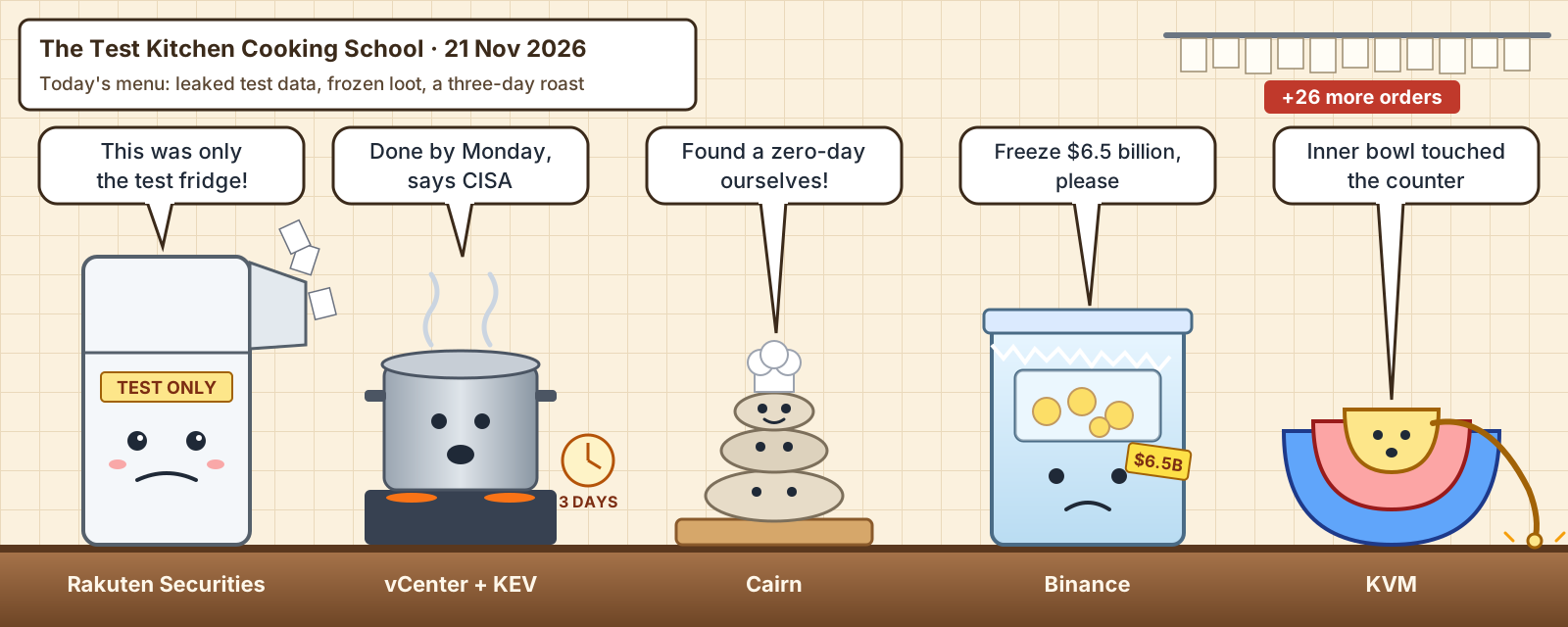
Rakuten Securities says information on up to 4.47 million accounts, including income and bank-withdrawal details, may have leaked from a test environment. Login IDs for up to 11.25 million accounts may also be exposed. Overnight, CISA added four exploited flaws to KEV with an unusually short deadline of Monday 23 November: VMware vCenter, Apache Roller, Cisco Expressway and SAP NetWeaver. Amazon describes Chinese-nexus operators whose Cairn AI agents found and used a zero-day without help, and Binance has an Abu Dhabi court order covering $6.5 billion of its stolen crypto.
Do today
- VMware vCenter, Apache Roller, Cisco Expressway, SAP NetWeaver: CISA’s KEV deadline for all four is Monday 23 November. Patch vCenter to the VMSA-2026-0009 builds, Roller to 6.1.6 and Expressway to X15.5.20, and apply SAP Note 3660969. Then hunt on vCenter and Expressway, because both were exploited before the fixes. (CISA KEV feed)
- Self-managed KVM hosts on AMD: install a kernel with the CVE-2026-99312 fix (7.3.5, 6.18.64 or 6.12.118) and reboot the host. If you can’t yet, set the
kvm_amdmodule optionnested=0. Updating guests does nothing. (DigitalOcean disclosure) - SonicWall Gen 6 and 6.5 firewalls: SonicWall won’t patch these again, even for critical flaws. Take them off the internet edge, or at least turn off WAN management and SSL VPN until you replace them. (SonicWall advisory)
- ASUS Control Center Express: upgrade servers and agents to v1.7.29. The worst of the three bugs lets an unauthenticated attacker forge an admin token. (ASUS security advisory feed)
- Systems that trust SSH keys from Fugaku users: RIKEN says 430 keys were taken from users’ home directories, 233 of them without a passphrase, and some were used to connect elsewhere. Revoke any key that a Fugaku user also registered with you. (RIKEN second report)
- Self-hosted MONAI Label servers: take them off untrusted networks. Amazon says a path-traversal zero-day in this tool was exploited, and no patched release exists yet. (GitHub advisory GHSA-qc22-rmgc-vg94)
AI and agent security6 stories
- Amazon: Cairn AI agents found a zero-day on their own and used it against two universities — Amazon Threat Intelligence says a Chinese-nexus operator ran the open-source Cairn framework from a publicly reachable server. The operator gave it IP addresses and a goal of getting shell access, and the agents chose their own steps. According to The Record’s account of the report, a 16-hour, 148-action attempt and a credential attack of more than 30,000 combinations both failed. The agents then succeeded through a path traversal in MONAI Label, an open-source medical imaging AI tool, and reused it against a second university. The maintainers’ advisory, published 18 November, rates the datastore upload bug critical. Version 0.8.5 and earlier are affected, authentication is off by default, and the fix is merged but not yet released. Our take: the agent didn’t need novel skills, only patience against a niche internet-facing AI tool. Inventory research and ML servers as carefully as you do VPNs. (AWS Security Blog: Cairn AI agents found a zero-day; MONAI Label advisory; The Record)
- OpenAI: GPT-6.2 Astra and Sol both reach its “Critical” cybersecurity threshold — OpenAI’s launch post says both models are better at finding and exploiting vulnerabilities, writing secure code and producing patches. Both meet the Critical cyber level of its Preparedness Framework, as GPT-6 Astra did. The models launched with tighter safeguards for higher-risk cyber requests, and OpenAI says these also restrict some legitimate research. Defenders get reduced-refusal access through its Daybreak programmes, and the 6.2 models will be added later. Press reports of a universal jailbreak found by the UK AI Security Institute before release rest on a social-media post; the launch page doesn’t mention it, so treat that as unconfirmed. (OpenAI: Introducing GPT-6.2 Astra and Sol)
- AWS document-loader MCP server: an unset base directory lets crafted documents reach outside it (CVE-2026-130901) — AWS bulletin 2026-195, published 20 November, covers awslabs.document-loader-mcp-server 1.0.10 to 1.0.20. If
DOCUMENT_BASE_DIRis empty and CI or test environment variables are present, the server skips its directory restriction. Anyone who can influence the documents an MCP client processes could then read files outside the intended directory. In 1.0.12 onwards, they could also write PNG slide images elsewhere. Upgrade to 1.0.21, or set the variable to a real document directory and never to/. (AWS bulletin 2026-195)CVSS not provided (AWS)EPSS not yet scoredKEV no - PIPETTE: prompt-injection red teams keep finding the same attack, which makes training against them weaker — In a paper submitted 18 November, researchers including N. Asokan show that two leading RL-based attack generators, RL-Hammer and PISmith, suffer mode collapse. They mostly rediscover variants of one trick. In three of four setups, the larger attack set produced the weaker defence. Their PIPETTE method rewards attackers for finding new techniques. It reports near-zero success for static attacks on AgentDojo and ASB while keeping benign task completion near baseline. The limits matter: only open-weight models from 4B to 27B were tested, and the adaptive attacks ran against a 4B model on 40 tasks. (arXiv: PIPETTE; Help Net Security)
- House committees publish a 50-page report on China-developed open-weight models in US business systems — The House Homeland Security Committee and the Select Committee on the CCP released a joint report on 20 November. According to The Record, it describes three named US companies using such models for customer support, coding and inventory, and cites investigators who say Chinese developers used proxies and fake accounts to harvest outputs from US frontier models. It makes 12 recommendations, including an AI bill of materials and a ban on China-developed models in federal contracts and sensitive critical infrastructure. Our take: whatever the policy outcome, a model inventory with provenance is cheap to build now and will probably be asked for. (Joint report, PDF; The Record)
- Varonis: TheMailer phishing kit has AI rewrite lures until they land in the inbox — The self-hosted kit has been advertised since March 2026. An “Inbox Loop” sends test messages, checks for spam placement and asks a commercial model to rewrite them until they get through. Every recipient can get a unique message and an attachment with its own hash. Operators plug in their own API keys, and the kit tells them to route through residential proxies where providers block cloud IP ranges. Lifetime licences reportedly sell for $3,000 to $6,000 in crypto. Per-message rewriting defeats template matching, so lean on DMARC at p=reject, lookalike-domain monitoring and checking the full redirect chain at click time. (Varonis: TheMailer)
Application security5 stories
- ASUS: a 10.0 hard-coded key in Control Center Express, plus router firmware fixes — ASUS’s 18 November advisories cover three flaws in Control Center Express before v1.7.29. CVE-2026-114202 lets a remote unauthenticated attacker forge an admin token with a hard-coded key. The other two let low-privileged users take over sessions or create admin accounts. The same day brought a 9.4 privilege escalation in Control Center (CVE-2026-126574) and router firmware fixes for five CVEs up to 8.7, including root command execution. ASUS suggests disabling the iTunes Server feature until routers are updated. The CVE records list affected versions only up to 1.7.27, so the status of 1.7.28 is unclear. Upgrade to 1.7.29 and push the agent update to managed devices. (ASUS security advisory feed; BleepingComputer)
CVSS 10.0 (v4.0, ASUS)EPSS 0.0038KEV no - WhatsApp fixes three bugs, one of them possibly abused with scam messages — CVE-2026-23871, fixed in Android 2.26.17.4, let a crafted Click to WhatsApp ad reply reveal the recipient’s IP address. WhatsApp says it may have been abused alongside specific spam and found it while disrupting a scam campaign. CVE-2026-102769 is a SQL injection, fixed in Android 2.26.35.74, that a crafted “order details” message could use to delete local files. WhatsApp says it saw no exploitation of that one. CVE-2026-44908 is a certificate-chain check flaw in the attestation verifier for Meta AI’s confidential computing backend. Exploiting it needed a position inside Meta’s infrastructure, and WhatsApp says its transparency ledger shows no rogue certificates. (WhatsApp security advisories 2026)
- devpi-web: unauthenticated path traversal can expose the password-hash database (CVE-2026-134167) — In devpi-web before 5.2.0, the
+docroute doesn’t confine requested paths to the documentation directory. A leading//or encoded..segments read arbitrary server files, including the keyfs SQLite store of password hashes. Private Python indexes often sit inside CI networks with broad trust, so upgrade to 5.2.0. Then rotate index credentials if the web plugin was reachable by anyone you don’t fully trust. (NVD: CVE-2026-134167; devpi advisory)CVSS 7.5 (v3.1, VulnCheck)EPSS not yet scoredKEV no - audio-separator: Demucs model files loaded with full pickle deserialization (CVE-2026-134172) — The popular Python stem-separation package called
torch.loadwithweights_only=Falsebefore 0.47.2. A malicious.thmodel therefore runs code when a user performs Demucs separation. Exploitation needs write access to the shared/tmp/audio-separator-models/directory or control of the model download source. That shared temp path is the weak spot on multi-user boxes. It’s another case for treating model files as executable code. (NVD: CVE-2026-134172; audio-separator v0.47.2 release)CVSS 7.8 (v3.1, VulnCheck)EPSS not yet scoredKEV no - Gladys Assistant 4.72.0 fixes command injection in backup restore (CVE-2026-133500) — In the open-source home-automation hub up to 4.71.0, the
file_urlargument to the backup restore endpoint reaches a shell. VulDB says a public exploit exists. The bug needs high privileges, which keeps it out of patch-now territory despite the 9.1 score. Hubs exposed for remote access with weak or shared admin passwords are the realistic risk, so upgrade to 4.72.0. (NVD: CVE-2026-133500; Gladys v4.72.0 release)CVSS 9.1 (v3.1, VulDB)EPSS 0.0366KEV no
Exploited and critical CVEs5 stories
- KEV: vCenter, Roller and Expressway added on 20 November with a three-day deadline — Catalog version 2026.11.20 adds the vCenter authentication bypass that Armory Castle used as a zero-day from September (CVE-2026-123890), the Apache Roller XML-RPC deserialization flaw (CVE-2026-129448) and the Cisco Expressway clustering flaw (CVE-2026-76466). All three are due Monday 23 November, much tighter than the usual two or three weeks. All are rated 9.8 by their vendors, and CISA’s SSVC rates exploitation active and impact total. F6’s report adds that in the Expressway case, attackers moved from two internet-facing nodes to two internal cluster nodes, then on to SMB, SQL Server and GitLab. Cisco names the flaw as persistent cookies and weak certificate validation, while KEV calls it hard-coded credentials. (CISA KEV feed; NVD: CVE-2026-123890; NVD: CVE-2026-76466; F6 report)
CVSS 9.8 (v3.1, VMware/Apache/Cisco)EPSS 0.0084 / 0.0119 / 0.0042KEV yes, due 23 Nov - SAP NetWeaver JNDI injection from November 2025 is now in KEV (CVE-2025-42884) — CISA added the year-old flaw on 20 November, also due 23 November. An unauthenticated attacker can inject JNDI environment properties or a lookup URL, reaching an unintended JNDI provider to read or alter server information. SAP’s own score is a medium 6.5, which is exactly why it probably sat unpatched in many landscapes. If SAP Note 3660969 isn’t in, it moves to the front of the SAP queue. (NVD: CVE-2025-42884; CISA KEV feed)
CVSS 6.5 (v3.1, SAP)EPSS 0.0028KEV yes, due 23 Nov - KEV deadlines fall today for REDCap, Apache Axis and Synology — Today, 21 November, is CISA’s due date for REDCap’s public-survey code injection (CVE-2026-90817), Apache Axis 1.x class instantiation (CVE-2026-90436) and the Synology DSM/BeeStation flaw (CVE-2024-10441). Axis 1.x has no fixed release coming, so the only full fix is removing it or isolating what embeds it. The LiteLLM guardrail escape is next on 2 December. (CISA KEV feed)
- SonicWall: Gen 6 firewalls will get no more patches, whatever the severity — SonicWall’s 18 November advisory says every Gen 6 and 6.5 model running SonicOS 6.x has reached end of support, from the TZ and SOHO lines to NSa, NSv, SuperMassive and NSsp. It expects internet-facing units to be actively targeted. SonicWall says interim steps such as disabling WAN management and limiting SSL VPN reduce exposure but don’t make the device safe. Treat the next SonicOS 6 CVE as a permanent zero-day for these boxes. (SonicWall advisory)
- D-Link DCS-935L camera: command injection with a public exploit and no fix listed (CVE-2026-133680) — VulDB’s record for firmware 1.10.01 describes OS command injection through the account and password arguments of the local-recording CGI. It’s reachable remotely by a low-privileged user, and a public exploit exists. The record lists no fixed firmware, and NVD has marked it “Deferred.” Until D-Link publishes a fix, keep these cameras off the internet and consider replacing them. (NVD: CVE-2026-133680)
CVSS 9.9 (v3.1, VulDB)EPSS not yet scoredKEV no
Cloud and infrastructure5 stories
- KVM CVE-2026-99312: a root user in a guest could read and write host memory on AMD hosts with nested virtualization — DigitalOcean’s 19 November disclosure says a stale page-table pointer after an INIT in a nested SVM guest let Terra Security’s Oren Yomtov reach physical host memory, which on shared hosts includes other tenants. The 2022 fix for CVE-2022-3344 missed this path, and Intel hosts aren’t affected. DigitalOcean has patched its fleet, and Droplet customers don’t need to act. Self-managed hosts need 7.3.5, 6.18.64 or 6.12.118 and a host reboot, or
nested=0. The kernel CNA scores it 8.8. Press reports a much lower preliminary Red Hat rating that we couldn’t confirm, and distro fixes were still pending at the time of reporting. The 0.0015 EPSS reflects the fact that it needs a foothold, not how severe it is for multi-tenant operators. (DigitalOcean disclosure; NVD: CVE-2026-99312; Terra Security analysis)CVSS 8.8 (v3.1, kernel CNA)EPSS 0.0015KEV no - RIKEN: the Fugaku intruder took 430 SSH keys and used some to reach other supercomputers and clouds — RIKEN’s second report, published 20 November, confirms access to registration data for 4,222 Fugaku users, now including addresses, affiliations and phone numbers. It also confirms that 430 private keys were taken from home directories, 233 of them without a passphrase. Some were used to connect to other institutions’ supercomputers and cloud services. According to earlier reporting, the way in was a public status dashboard. RIKEN has no restart date: it first wants to separate public services from the management network and rebuild servers. Research and cloud operators should look for Fugaku users’ keys in their own authorized-keys files now. (RIKEN second report; RIKEN incident page)
- AWS ssosync: reused email addresses or group names could inherit someone else’s IAM Identity Center access (CVE-2026-133199) — Bulletin 2026-194 says ssosync, which syncs Google Workspace users and groups into IAM Identity Center, fell back to matching on email address or group name when no immutable ID matched. A recycled address could therefore inherit a former user’s group memberships and permission sets. There’s no workaround. Upgrade to 2.9.5, patch any fork, and review current assignments, because the upgrade doesn’t undo a mismatch that already happened. (AWS bulletin 2026-194)
- OpenSCAP: offline scans of untrusted images can read host files through symlinks (CVE-2026-126631) — Red Hat says OpenSCAP doesn’t keep symlink resolution inside the target root when scanning container images or VM disks offline. A crafted image can make a privileged scan pull host files into its report, or skew compliance results. Pipelines that scan third-party images with root on a shared runner are the exposure. Run scans unprivileged or in a throwaway VM until fixed packages land. (NVD: CVE-2026-126631; Red Hat CVE page)
CVSS 7.1 (v3.1, Red Hat)EPSS not yet scoredKEV no - cozy-stack 1.6.69: a shared-drive move could copy and delete another instance’s files (CVE-2026-133172) — In the Cozy Cloud personal-cloud server from 1.6.62 to 1.6.68, an authenticated user who owns a shared drive could name another instance’s domain and any directory ID as a move source. They could then copy the victim’s file tree and delete it. Multi-tenant operators should upgrade to 1.6.69 and review move logs for cross-instance sources. (NVD: CVE-2026-133172; cozy-stack 1.6.69 release)
CVSS 8.8 (v3.1, VulnCheck)EPSS not yet scoredKEV no
Crypto and Web35 stories
- Binance wins a $6.5 billion worldwide freezing order in Abu Dhabi over the 29 October theft — Binance says the ADGM Courts granted it an order to help trace, freeze and recover assets from the attack, and to give issuers and exchanges a legal route to release frozen funds. The $6.5 billion figure comes from Binance’s counsel via press reports; Binance’s own post gives no amount. It is the scope of the injunction, not money recovered. Reports also describe delivery-up orders and a changing list of about 26,000 wallet addresses. Separately, trackers report that the attackers moved nearly $600 million in ETH through THORChain and Chainflip on 19–20 November. That claim rests on social-media trackers we couldn’t check on an explorer, so treat it as unconfirmed. Our take: services that hold frozen Binance-linked funds now have a court order to act on. (Binance: ADGM court order; The Block)
- XMR1 wrapped Monero on Hyperliquid: deployer tokens dumped for about $13.5 million — Bitquery’s on-chain reconstruction shows the token’s deployer account, which held 93% of supply, sent 5.2 million XMR1 to an attacker funded through Tornado Cash at 04:46 UTC on 20 November. The attacker then sold into resting bids from 420 buyers for $13.51 million as the price fell about 99.8%. $13.28 million in USDC went to Arbitrum, was swapped for 7,467 ETH, and most of it was bridged to Ethereum. The operator blames a breach at a hosting provider where the deployer key had been stored, but Bitquery says the chain can’t show how the key was obtained. Refunds are promised but unconfirmed. (Bitquery: XMR1 investigation)
- Fluidkey: about $1.58 million paid out through its own relayer in 36 minutes — Bitquery traces payouts to attacker-linked wallets from 17:28 to 18:05 UTC on 19 November, mostly on Base and Ethereum. 881.6 ETH then went into Tornado Cash. The stealth-address wallet took its services offline at 18:05 and has promised a post-mortem. Press reports say it blames a third-party logging tool and requires app version 1.79.22. Neither claim appears in a primary source we could load, so both are unconfirmed. Estimates run from $1.58 million to $1.64 million, because some outflows may have been users’ own withdrawals. Bitquery notes that a 2024 audit warned a server compromise could put users’ funds at risk. (Bitquery: Fluidkey investigation; SlowMist Hacked: Fluidkey)
- A Safe wallet loses about $6.45 million through an overly permissive Zodiac Roles policy — Blockscout shows that on 16 November at 11:35 UTC a single transaction through a Zodiac Roles contract withdrew 4,387,188 USDC from a Morpho vault position. It sent that, plus 1,717,919 syrupUSDC, to an EIP-7702 address. That matches the reported total of about $6.45 million. Zodiac’s co-founder says the module worked as designed: a long-standing role member’s key was probably compromised, and the custom policy allowed the transfer without meaning to. Our take: audit Roles policies for what a single compromised member can drain, not just what they were set up to do. (Blockscout transaction; Cointelegraph)
- Trezor: shipping partner Skladon breach exposed about 27,000 customers’ names and addresses — Trezor’s 16 November post says an intruder probably exported shipping data for orders placed from 9 August to 7 November. The data includes full names, phone numbers, delivery addresses, emails and what was bought. Wallet backups, PINs and passphrases were never held by either company. Cointelegraph counts this as the third partner incident affecting Trezor customers this year. A home address tied to a hardware-wallet purchase is exactly what scammers and physical attackers want, so expect convincing order-themed contact. (Trezor: Skladon data breach)
Incidents and industry5 stories
- Rakuten Securities: a test environment leaked data on up to 15.7 million accounts in two groups — Rakuten Securities’ 17 November notice says data in a test environment may have leaked on 11 November. It detected the access and blocked it on 16 November. For up to about 4.47 million accounts, including closed ones, the data covers names, addresses, dates of birth, employer, the bank account used for withdrawals, self-reported income and assets, and holdings by product. For up to about 11.25 million accounts, it covers branch and customer codes and login IDs. Passwords and PINs were not affected, and no fraudulent trading has been found. The cause is still under investigation. Our take: real customer data in a test environment turned a test-system intrusion into one of the year’s largest brokerage leaks. Income and asset figures also make the follow-on phishing very targeted. (Rakuten Securities notice)
- SBC Medical Group: about 1.6 million Japanese clinic customers’ records taken, plus a reservation-platform breach — The Nasdaq-listed company’s SEC exhibit says it detected the intrusion on 16 November. The attacker extracted databases behind a website system run by its Japanese subsidiary. That covered basic personal data and passwords for 1,624,000 people and reservation or inquiry records for about 470,000 more. A small number of people had treatment descriptions exposed. It also covered credentials for about 20,000 employees, 459 of whom had bank, pension and tax data taken. A separate breach of clinic admin accounts on the Tribeau booking service exposed about 19,000 users. How the attacker got in is still under investigation. (SBC Medical Group SEC filing, Exhibit 99.1)
- Skagerak Energi reports a possible attempted intrusion a day after Equinor — The Norwegian power company said on 18 November that it had detected activity that may be an attempted attack on some IT systems. It says operations and production were not affected and there’s no sign of data loss, and authorities have been notified. Equinor’s contained attack came the day before. Two Norwegian energy companies in two days isn’t proof of a single campaign, and neither company has suggested one. It’s still a good reason for Nordic utilities to review edge-device and remote-access logs this week. (Skagerak Energi press release)
- Blackpoint: ROMULUS ClickFix lures now deliver the CNCMachineRMS remote access trojan — Blackpoint’s Adversary Pursuit Group says the ROMULUS delivery service ran a fake-CAPTCHA chain from late September. A PowerShell stager pulls a hidden MSI posing as a Stardock tool, which sideloads a DLL through a signed executable. The resulting RAT offers remote desktop, camera and microphone capture, and file control, and finds its C2 over DNS over HTTPS. Blackpoint saw no hands-on activity after infection. Good detections are PowerShell launching silent msiexec, signed binaries running from user-writable paths, and DNS over HTTPS from non-browser processes. (Blackpoint: ROMULUS and CNCMachineRMS)
- ThreatFabric: Bazuka is a 23-module Android fraud kit with an LLM that scores victims — ThreatFabric’s 18 November report describes a dropper, core and modules for overlays, keylogging, SMS and 2FA interception, remote control and clipboard crypto-address swapping. It hides activity behind a screenshot of the user’s own home or lock screen. It can grant itself permissions through Accessibility and ADB, including turning on Wireless Debugging. The control panel uses an LLM to rank victims and suggest how to get them through permission prompts. Lures so far are sideloaded “premium” and IPTV apps. The droppers are designed to pass Play review, but ThreatFabric found no evidence they have. On managed fleets, blocking installs from unknown sources still stops this kit. (ThreatFabric: Bazuka)
Bottom line
- Patch the four 20 November KEV entries by Monday. vCenter and Expressway were both exploited before their fixes, so hunt for persistence after patching.
- Rakuten Securities and Fugaku show that test and public-facing side systems are where data and keys leak. Keep production data out of test environments, and don’t leave SSH keys without passphrases in research home directories.
- Amazon’s Cairn case and Bazuka’s victim-scoring panel show AI doing routine attacker work. The defences are unchanged: inventory niche internet-facing tools such as MONAI Label, and patch them quickly.