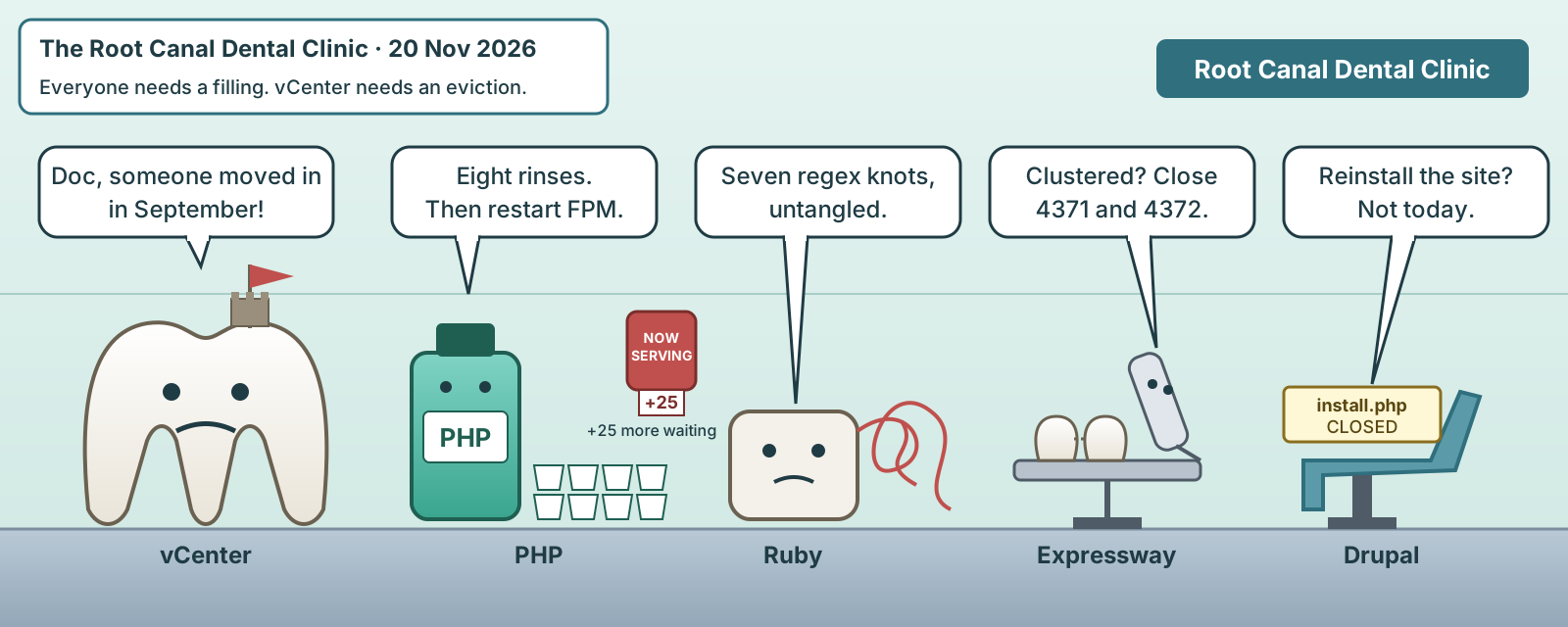
Broadcom has fixed a 9.8-rated vCenter authentication bypass, CVE-2026-123890. Google’s threat intelligence group says a suspected China-nexus espionage actor used it as a zero-day from early September to take over vCenter, forge SAML tokens and pull domain-controller secrets out of guest VMs. PHP and Ruby both shipped critical releases on 18–19 November, and Ruby’s maintainers say proofs of concept reach code execution. Separately, a Russian incident-response firm reports the first exploitation of a clustered Cisco Expressway bug, even though Cisco’s advisory still says it knows of no malicious use.
Do today
- VMware vCenter: install the VMSA-2026-0009 update (8.0 U3m on the 8.0 line) for CVE-2026-123890. Restrict TCP 2012, 443, 22 and 5480 on the appliance to admin allow-lists. Then hunt for the artefacts GTIG lists: a SUID
/bin/env, unexpectedsps-*SSO admins, SSH switched on through the VAMI API, and new keys in ESXi rootauthorized_keys. (GTIG, Broadcom VMSA-2026-0009 FAQ) - Confluence Data Center and anything else running Apache Axis 1.x: CISA’s KEV deadline for CVE-2026-90436 is tomorrow, 21 November, the same day as REDCap and Synology DSM. On Confluence, either upgrade to 9.2.28 or 10.x, or clear “Remote API (XML-RPC & SOAP)” now. Then rotate any credentials stored in Confluence. (Rapid7, CISA KEV)
- PHP: move to 8.5.13, 8.4.28, 8.3.37 or 8.2.36 and restart FPM pools. (PHP releases)
- Ruby: upgrade the interpreter, not just gems, to 4.0.10, 3.4.13 or 3.3.14. Rebuild container images and restart workers. (Ruby security announcement)
- Cisco Expressway clusters: upgrade to X15.5.20. Until you can, block TCP 4371–4372 except from your own cluster nodes, and check
erlang.logfor unexpected node-up entries. (Cisco advisory, F6) - Drupal: update to 10.6.22, 11.3.22 or 11.4.13, and deny web access to
/core/install.phpeven after updating. (Drupal SA-CORE-2026-017)
AI and agent security5 stories
- Microsoft Ignite: agent discovery for 60 local agent types, and Perception goes GA — Microsoft’s 17 November security post makes Perception generally available. It is the platform that coordinates its triage, investigation, detection-authoring, threat-intel, recon and posture agents. For defenders, the more useful part is still in preview: Agent 365 and Entra Suite will discover 60 types of local agents, naming Claude Code, OpenAI Codex and GitHub Copilot, as well as agents on AWS and Google Cloud. Each one gets an Entra Agent ID that Conditional Access can govern, and Intune can contain them on the device. Our take: an inventory of coding agents on endpoints is the gap most teams have today. Test discovery in preview, but don’t count containment as a control until it reaches GA and you’ve seen what it misses. (Microsoft Security blog)
- Gemini 4 Neon: strong vulnerability-finding scores, and a cyber build for vetted defenders — Google’s 18 November launch post claims 90.5% on SEC-bench Pro, 70.7% on CWE-bench v2 patching and 76% on the hard tier of the AutoBaxBench secure-coding benchmark. It says a cyber-focused version will reach vetted defenders through its Fairwind Program “over the next few days”. Google also reports zero successful attacks in Gray Swan’s indirect prompt-injection benchmark at the highest thinking setting. Our take: these are vendor-run benchmarks, and a 0% injection rate on one suite does not mean an agent built on the model resists injection. Keep tool permissions and output checks as if it didn’t. (Google)
- Citi makes customers liable for what third-party AI agents do in their accounts — Citi’s online banking terms, updated in November 2026 to add a new Section H, warn customers against using third-party AI agents. Actions taken by an agent holding the customer’s credentials count as authorised by the customer, including errors and actions beyond the authority the customer gave. Citi also says it has no duty to investigate whether an agent stayed within that authority, and it can cut off agent access without notice. Press reports note that US rules on unauthorised electronic transfers may still limit how far contract wording can shift liability. Our take: expect other banks to follow. Any agent product that asks users for banking credentials now carries the loss risk on the customer’s side. (Citi terms and conditions)
- jupyter-mcp-server: DNS rebinding lets any website repoint the notebook backend (CVE-2026-77359) — In standalone
streamable-httpmode,/mcpchecks Host and Origin, but thePUT /api/connectandDELETE /api/stopmanagement routes do not. A page the user visits can rebind to the listener and swap the active Jupyter backend for one the attacker controls, or stop the kernel. Versions up to 1.0.2 are affected, and 1.0.3 fixes it. A companion advisory, CVE-2026-77318, rates the unauthenticated management routes as High. Our take: the default bind is0.0.0.0, so a developer laptop on hotel Wi-Fi is exposed. Upgrade and bind local MCP servers to loopback. (GitHub advisory)CVSS 9.3 (v4.0, GHSA)EPSS not yet scoredKEV no - Splunk AI Assistant 2.0.0 fixes four flaws, rated up to 8.1 — Splunk’s SVD-2026-1111, published 18 November, covers CVE-2026-131302 to CVE-2026-131305 in the AI Assistant app, with individual scores of 4.3, 7.1 and 8.1. It arrived alongside the much larger Enterprise, ES and SOAR batch below. Our take: AI add-ons in a SIEM run with search-head privileges over all your log data. Patch them on the same schedule as the core product, not as optional extras. (Splunk SVD-2026-1111)
Application security6 stories
- PHP ships critical fixes for every supported branch, including “phpAfterShell” — The PHP project released 8.5.13, 8.4.28, 8.3.37 and 8.2.36 on 19 November, alongside the 8.6.0 GA. Press summaries of the GitHub advisories list seven bugs at 9.2 and one at 8.8. They include CVE-2026-115560 in session upload progress, CVE-2026-126714 (Depthfirst’s “phpAfterShell”, a race in session writes), CVE-2026-129289 (request desync behind front ends that reuse backend connections) and several use-after-frees. Coverage counts “seven critical” or eight CVEs depending on whether the 8.8 local escalation is included. Some fixes apply only to 8.3+ or 8.5+. No in-the-wild exploitation is reported. Our take: the desync bug needs no session tricks, only nginx, Apache mod_proxy_fcgi or HAProxy in front of PHP, which is the common deployment. Patch today rather than relying on the session-upload-progress workaround. (PHP releases, PHP security advisories, Depthfirst, The Hacker News)
- Ruby 4.0.10, 3.4.13 and 3.3.14 fix seven Regexp and String flaws, with RCE PoCs for some — The 18 November announcement covers heap overflows and a double free in the regex compiler, plus out-of-bounds reads in case-insensitive matching and case conversion. The maintainers say they know of PoCs that reach code execution “in some scenarios”. The highest risk is in apps that compile attacker-supplied patterns, or that upcase or downcase crafted strings in single-byte encodings. CVEs were requested but not assigned at publication. AWS’s bulletin 2026-193 already lists CVE-2026-132825 “and related issues”. Ruby 3.2 and earlier get no fix. Our take: bumping gems does nothing here. Find every Ruby binary in base images and CI runners. (Ruby, AWS security bulletins)
- Drupal core: an exposed installer can lead to site takeover (CVE-2026-132165) — SA-CORE-2026-017, dated 18 November, rates the issue Critical (18/25) and says a proof of concept exists. An unauthenticated visitor can reach
/core/install.php, which core’s default.htaccessdoes not block, and attempt a reinstall that can end in takeover or code execution. The advisory rates exploitation complex and the vulnerable configuration uncommon. Some paths fail when the web server cannot write tosettings.php. The fixed releases are 10.6.22, 11.3.22 and 11.4.13. Branches 11.2.x, 10.5.x and older get no fix. Anthropic’s OSS Scanner is credited with the finding. Our take: a read-onlysettings.phpand a deny rule on the installer are cheap hardening worth keeping after you patch. (Drupal)Drupal risk 18/25EPSS not yet scoredKEV no - WordPress 7.1.5 fixes 20 security issues, including an unauthenticated path to RCE — The 18 November release covers eight XSS bugs, two SQL injections (in
WP_Meta_Queryand the Customizer front-page setting), four information disclosures and an XML-RPC pingback DoS. It also fixes an unauthenticated privilege escalation through Template Part attributes that the release notes say could lead to remote code execution. Backports to every branch back to 4.7 are “in progress” and will ship as they are ready. Our take: auto-updates cover most sites on the current branch. Sites pinned to old branches should check that their backport has actually landed before assuming they’re covered. (WordPress) - Etherpad: pre-auth file read on default Linux installs (CVE-2026-114516) — A Windows-only backslash conversion in the
/static/*handler runs on POSIX after path sanitising, which reintroduces../. The route is registered before authentication. The advisory says the read can expose settings and credential files, which can lead to admin access and code execution through the plugin installer. A reverse proxy doesn’t help, because the encoded traversal passes through it. Versions 1.8.14 up to 3.3.2 are affected, and 3.3.3 fixes it. Our take: self-hosted Etherpad often sits on internal wikis with long-lived admin passwords insettings.json, so rotate those after upgrading. (GitHub advisory)CVSS 9.8 (v3.1, GHSA)EPSS not yet scoredKEV no - Depthfirst: low-privilege database roles reach engine memory bugs in PostgreSQL, MySQL, Oracle and ClickHouse — Zheng Yu’s 18 November write-up argues that SQL grants restrict access to tables but not to the C/C++ engine code that a session can still reach. It describes chains to command execution as the database service account. PostgreSQL CVE-2026-116331 needs only a default login role, MySQL CVE-2026-101786 only
CREATE TEMPORARY TABLES, and Oracle’s chain of CVE-2026-114819 with the ORDS GraphQL flaw CVE-2026-91609 needs no login on an exposed endpoint. ClickHouse has a similar flaw with no CVE. All are fixed in recent vendor updates, and no full exploit code was released. Oracle’s own ratings say the Oracle bugs need a login, which conflicts with the pre-auth chain. Our take: treat “read-only reporting user” as a code-execution boundary. Patch databases even when only trusted apps hold credentials. (Depthfirst)
Exploited and critical CVEs6 stories
- vCenter CVE-2026-123890: Armory Castle used it as a zero-day from early September — Broadcom’s VMSA-2026-0009, released 19 November, fixes an authentication bypass in vCenter’s directory service. GTIG describes it as an unauthenticated session-key disclosure on the
vmdirdDCE/RPC interface (TCP 2012) that yields anadministrator@vsphere.localsession. Google attributes the exploitation, with moderate confidence, to the suspected PRC-nexus actor it now calls Armory Castle (formerly UNC5221). The actor moved in from a BeyondTrust appliance, used the “BONESAW” exploit to create an SSO admin and steal the STS signing key, forged SAML assertions, and copied NTDS.dit from guest VMs through ESXi. Broadcom lists no workaround. Its FAQ warns that 8.0 U3m and 9.0.2.0200 block later upgrades to VCF 9.1.1 and that Quick Patch can’t apply the fix. The VMSA also covers four SDDC Manager and VMware Tools bugs (below). The CVE was not in CISA’s KEV at catalog version 2026.11.18. Our take: if your vCenter was reachable from any appliance that wasn’t patched this autumn, treat this as a compromise assessment as well as a patch. A stolen STS key survives patching, so rotate it after you hunt. (GTIG, Broadcom VMSA-2026-0009 FAQ)CVSS 9.8 (v3.1, Broadcom per press)EPSS not yet scoredKEV no - Cisco Expressway CVE-2026-76466: first exploitation reported, but Cisco’s advisory still says none — F6’s 18 November release describes an attack on a Russian organisation. The attacker took root on two internet-facing clustered X15.5.3 nodes, pivoted to two internal cluster nodes and ran Python tooling against SMB, SQL Server, WinRM and GitLab. F6 says the scripts’ comments suggest an AI assistant helped write them. F6 says the attack came shortly after a public PoC. Cisco’s advisory (21 October, version 1.0) is unchanged: X15.5.20 is the fix, there’s no workaround, and Cisco says it is unaware of malicious use. F6 publishes two IPs, 66.179.31[.]32 and 18.130.47[.]116, as indicators. Our take: only clustered deployments are affected. Clustering is the norm for Expressway-E at the edge, so assume yours qualifies. (F6, Cisco advisory)
CVSS 9.8 (v3.1, Cisco)EPSS 0.00417KEV no - Apache Axis CVE-2026-90436 in Confluence: from SOAP request to Microsoft 365 in 12 hours — New since yesterday’s KEV coverage, Rapid7’s write-up (updated 19 November) details a 13 November intrusion into Confluence Data Center. The exploit requests returned HTTP 500, but Confluence’s JVM still launched bash and curl. The attacker then queried MySQL for attachments and card numbers, reached a cloud data warehouse with a harvested service account after about four hours, and signed in to Microsoft 365 with an integration account over legacy authentication after about twelve. Only instances with the Remote API enabled are exposed. It has been off by default since Confluence 3.0, versions 10.x removed it, and 9.2.28 is fixed. A Metasploit module has been public since 17 November. Our take: HTTP 500s from
/rpc/soap-axisdon’t mean the attempt failed. Block legacy authentication for integration accounts. (Rapid7, CISA KEV)CVSS 9.8 (per Rapid7)EPSS 0.01773KEV yes (due 21 Nov) - Java4Shell CVE-2026-114938: probing begins, with no confirmed successful compromise yet — As of 05:48 UTC today, GreyNoise counts 197 Java4Shell-shaped requests from seven IPs since 17 November, carrying Base64 in HTTP Authorization headers. It has confirmed no successful exploitation. Press reports earlier counts and other vendors’ sightings, including Previdian’s nine attempts from six IPs on 18–19 November and Cloudflare scanners switching to a Chrome user agent. Vendor advisories are filling in exposure: SecurityWeek reports that Cisco has more than a dozen affected products with no fixes yet, and that Elastic says Elasticsearch RCE needs read credentials but unauthenticated DoS is possible. Our take: this is reconnaissance, not a wave. The CPU-dependent exposure still makes fleet inventory hard, so patch the JDK rather than trying to map which hosts have AVX-512 VBMI. (GreyNoise, SecurityWeek)
CVSS 8.8 (Amazon Linux rating)EPSS 0.00753KEV no - Splunk: about 140 fixes across Enterprise, Enterprise Security and SOAR, with critical scores up to 9.9 — Splunk’s 18 November batch includes SVD-2026-1103 for Enterprise (38 CVEs, top score 9.4), fixed in 10.6.1, 10.4.5, 10.2.9, 10.0.12 and 9.4.17. SVD-2026-1106 covers Enterprise Security 8.7.0 (42 CVEs, 9.1) and SVD-2026-1108 covers SOAR 8.8.0 (59 CVEs, 9.9). There are also third-party package updates and a Java4Shell notice that is still “under investigation”. Press summaries highlight an unauthenticated read and modify of clustering configuration when the shared secret is empty (CVE-2026-76536), and authenticated RCE in ES and SOAR. Splunk reports no exploitation. Our take: the empty-clustering-secret bug is a configuration finding as well as a patch, so confirm
pass4SymmKeyis set on every cluster member. (Splunk advisories, SecurityWeek) - KEV: no additions since 18 November; three deadlines fall tomorrow — Catalog version 2026.11.18 is still current. REDCap (CVE-2026-90817), Apache Axis (CVE-2026-90436) and Synology DSM/BeeStation (CVE-2024-10441) are due 21 November. Puppet Enterprise (CVE-2026-115731) is due 1 December and LiteLLM (CVE-2026-40217) 2 December. Neither the vCenter zero-day nor Expressway is listed yet. Our take: don’t wait for KEV to act on vCenter. Google has published the exploitation evidence, and KEV will likely follow. (CISA KEV JSON)
Cloud and infrastructure5 stories
- NGINX2Root: public PoCs, and AWS says WAF can’t block it — New since yesterday: Rapid7 and Censys have published PoC material for CVE-2026-123007. Rapid7 says its RCE needs roughly 128 GB of HTTP/2 traffic, while Censys says it reproduced the behaviour over cleartext HTTP/2 without that volume. Censys estimates about 9 million exposed services run an affected version with HTTP/2 enabled. AWS bulletin 2026-192 (19 November) says patched nginx packages are available for Amazon Linux 2, 2023 and 2027, and Elastic Beanstalk has a fix. Only Beanstalk environments where customers enabled HTTP/2 themselves are affected. AWS says WAF rules cannot detect these issues because they occur before a full request is formed. F5 says it has seen no in-the-wild exploitation. Our take: if you can’t restart nginx today, turning off HTTP/2 on listeners is the only reliable interim step. (AWS bulletin 2026-192, Censys, F5 K000164058)
- VMSA-2026-0009’s other fixes: SDDC Manager SQL and command injection, and a VMware Tools SAML bypass — The same advisory fixes CVE-2026-123891 (SQL injection), CVE-2026-123892 (authenticated command injection) and CVE-2026-123893 (local escalation to root) in SDDC Manager. Fixed versions are 9.1.1.0200, 9.0.2.0100 and 5.2.5. CVE-2026-123894 is a SAML token signature bypass in VMware Tools for Windows, fixed in 13.1.5.0 and 12.5.5, or 12.4.10 for 32-bit. Broadcom says disabling guest operations or uninstalling Tools is not a workaround, and none of the issues allows escape from a VM to the ESX host. Scores range from 6.7 to 9.8 across the advisory. Our take: SDDC Manager holds the credentials for the whole VCF estate, so patch it in the same change window as vCenter. (Broadcom VMSA-2026-0009 FAQ)
- AWS’s Java4Shell bulletin: Lambda Managed Instances and container images need action, and OpenSearch gets a mitigation — Bulletin 2026-189 names fixed Corretto builds 27.0.1.1.4, 25.0.5.1.2, 21.0.13.1.2 and 17.0.21.1.2. Affected CPUs are Intel Ice Lake and newer and AMD Zen 4 and newer, while Graviton is not affected. Default Lambda environments are unaffected, but Lambda Managed Instances may be. Container images must be rebuilt, and ZIP functions need a real runtime update, with phase 2 of the rollout ending 22 November. AWS is mitigating x86-64 OpenSearch domains through blue/green deployments. The KnownBadInputs rule group 1.28 adds partial protection. The interim JVM flag is
-XX:-UseBASE64Intrinsics. Our take: ZIP-packaged Lambdas whose last deploy was months ago are the easy ones to miss, so redeploy them. (AWS bulletin 2026-189) - Amazon S3 Encryption Client for PHP: missing GCM tag-length check (CVE-2026-132607) — AWS SDK for PHP 3.148.0 through 3.383.0 doesn’t validate the length of the AES-GCM tag stored in object metadata. An attacker with read and write access to an encrypted object, who knows or can guess the plaintext, can make repeated writes until the object decrypts to chosen plaintext of the same length. The plaintext and key are not exposed. 3.383.1 fixes it and there’s no workaround. Our take: client-side encryption is meant to guard against people who can write to your bucket, so this undercuts exactly that guarantee. Upgrade, and check vendored forks. (AWS bulletin 2026-191)
- FastUnlock: an unpatched Windows lock-screen bypass for someone holding the laptop — A researcher posted the technique on 19 November, and ThreatLocker confirmed it the same day. Using Narrator, the on-screen keyboard and a Microsoft account in the recovery flow, someone with physical access gets a desktop as the non-admin “WSIAccount”. ThreatLocker’s test loaded code from an external drive. It does not break BitLocker, but TPM-only BitLocker leaves a powered-on machine exposed. ThreatLocker says a pre-boot PIN helps only if the device was off or hibernating. Microsoft has no fix yet, and no in-the-wild use is reported. Our take: physical access plus a non-admin account is a narrow threat, but it does put kiosk and front-desk PCs at risk. Use pre-boot PINs and hibernate on lid-close for laptops that leave the building. (ThreatLocker, Microsoft BitLocker countermeasures)
Crypto and Web33 stories
- K3 Capital sBOLD: the drain was a share-pricing flaw, and a copycat bot took most of it (correction) — Early alerts, and our 19 November item, described self-liquidation with flash-loaned wstETH. Bitquery’s trace of the 18 November drain says no trove was liquidated. Instead, the vault’s share price ignored collateral it held below a set amount, so the attacker sent WETH directly in, called
swap()to turn it into counted BOLD, and redeemed shares at the higher price. ChainSecurity had flagged the issue in an earlier audit, and it is unclear whether its fix was deployed. The vault lost about 3,428,799 BOLD (about $3.42 million) in 97 transactions between 12:25 and 12:33 UTC. A copycat MEV bot took about $1.91 million of that and paid most of it to block builders, while the original attacker and a funded wallet kept about $0.52 million. Etherscan confirms the first attack transaction at 12:25:47 UTC from 0xDC0e…dAA. Our take: a public exploit transaction gets copied within minutes. Monitoring that only pauses the vault after the first drain is already too late. (Bitquery, Etherscan transaction) - Kava: governance vote to zero every Kava Lend borrow cap after the 53.9 million KAVA drain — New since the exploit was covered on 16 November: proposal 223, “Freeze Kava Lend Borrowing and Restore the USD 10 Minimum”, sets every Kava Lend borrow limit to zero while still allowing repayments. The on-chain record showed 100% Yes at the time of checking, and voting is reported to close 23 November. Kava puts the loss at about 53.9 million KAVA, which SlowMist values at about $3.76 million at pre-attack prices. Third-party tracing puts actual sale proceeds on BNB Chain nearer $2.09 million, so both figures circulate. The inactive BUSD market that was abused was still accepting borrows two weeks after an earlier proposal set a claims deadline for Lend. Our take: a market that is being wound down needs its borrow caps zeroed too, or it remains an attack surface. (Kava proposal 223)
- US Homeland Security Task Force opens a Threat Disruption Center built on TRM Labs — The 18 November announcement describes a hub inside the DHS- and DOJ-led National Coordination Center. It will triage scam and cybercrime complaints, map the networks behind them, and work with banks, payment firms, crypto providers, hosting and social platforms to pause victim payments and take down domains and accounts in near real time. TRM Labs built and runs the platform. Investigations and seizures stay with law enforcement. Our take: for exchanges and stablecoin issuers, expect more freeze requests that arrive faster, and make sure your law-enforcement intake can respond within hours. (HSTF)
Incidents and industry5 stories
- European Commission confirms an “AI-generated cyber campaign” took applications offline — At the 19 November midday briefing, spokesperson Thomas Regnier said the activity was detected on 22 October and confirmed on 26 October. Several applications were taken down as a precaution and most are back. He said there is no evidence so far of a breach affecting staff as a whole and he knows of no ransom demand. The Commission is working with CERT-EU and the EDPS. He described the campaign as misuse of a publicly available AI tool but declined to name it, attribute the attack or describe its scale. Press reports disagree on which tool was used. The Record, citing POLITICO, says CERT-EU identified ARTEX, while the briefing declined to address reports of a different tool. The Record also reports that payroll, leave and translation systems were disrupted for more than ten days, which the Commission did not detail. Our take: this is the first EU institution to publicly put an intrusion down to an AI-driven campaign. The defensive lesson is unchanged: autonomous tools find unpatched edge systems faster, so patch speed on internet-facing services matters more. (European Commission midday briefing, The Record)
- Ukraine arrests four over vishing-led ransomware that extorted $40.5 million from US firms — Ukraine’s National Police say 66 searches in Kyiv and 11 regions, run with the FBI after a two-year investigation, led to four suspects being held. Police say at least 28 companies paid more than $40.5 million. The group phoned staff posing as IT support, used an AI voice platform, obtained credentials or remote-access installs, then stole and encrypted data. Officers seized about $370,000 and €20,000 in cash. The Record, citing court records, names US victims in oil, tyres, energy services and healthcare and links the network to former Conti members. Our take: the way in was a phone call to the help desk, not an exploit. Make sure your help desk has callback verification and a block on unsanctioned remote-access tools. (Ukraine National Police, The Record)
- UK tribunal publicly confirms the Apple technical capability notice — The Investigatory Powers Tribunal lists a 19 November 2026 judgment in Apple Inc v Secretary of State for the Home Department. According to The Record, the tribunal rejected the government’s “neither confirm nor deny” stance and stated that the government has given Apple a technical capability notice. The ruling does not decide whether the notice is lawful, and a substantive hearing is expected in the first half of 2027. Apple withdrew Advanced Data Protection for UK users in February 2026. Our take: for UK organisations that relied on ADP for end-to-end encrypted iCloud backups, that is still unavailable. Plan for managed-device backups that don’t depend on it. (Investigatory Powers Tribunal judgments, The Record)
- Microsoft: outage-themed phishing followed the 22-hour Microsoft 365 disruption — Microsoft’s 16 November post describes a coordinated, high-volume campaign seen from 13 November. It used fake service-health emails with “Outage –” subjects, claiming held mail would be deleted in 24 hours, and a “RESTORE MESSAGES” link to a non-Microsoft site. Microsoft assesses it was likely credential phishing but saw no credential submission or account compromise, and messages were blocked where Defender for Office 365 was in place. Our take: every large outage now brings phishing that copies its status notices. Tell users ahead of time that real outage notices live in the admin centre, not in their inbox. (Microsoft Security blog)
- Symantec: typosquatters register lookalikes of new brand campaign domains within a working day — Symantec’s 16 November research found 25 lookalike domains shadowing 27 newly registered campaign sites run through the CSC and MarkMonitor registrars. Most dropped a plural “s”. They were registered through two Chinese registrars within one working day of the real domain. Targets were patient-savings, rebate, sweepstakes, claims and legal-settlement sites whose addresses people type from printed mailers. Brands named include Abbott, Bayer, CarMax, McDonald’s, Procter & Gamble and Sanofi. The lookalikes currently serve parked ads and scam redirects. Our take: register the obvious one-letter variants when you register the campaign domain itself, before it is printed on mailers. (Symantec)
Bottom line
- Patch vCenter first and hunt second. Armory Castle had two months with this bug, and a stolen STS signing key or a backdoored ESXi host survives the update.
- Interpreter and runtime patches dominate the week: PHP, Ruby, the JDK and nginx. None of them is fixed by updating application dependencies, so rebuild images and restart processes.
- AI-assisted attackers now appear in incident write-ups and official statements: in F6’s Expressway case, in Rapid7’s Confluence case and at the European Commission. Speed on internet-facing patches and on credential rotation is still the main defence.