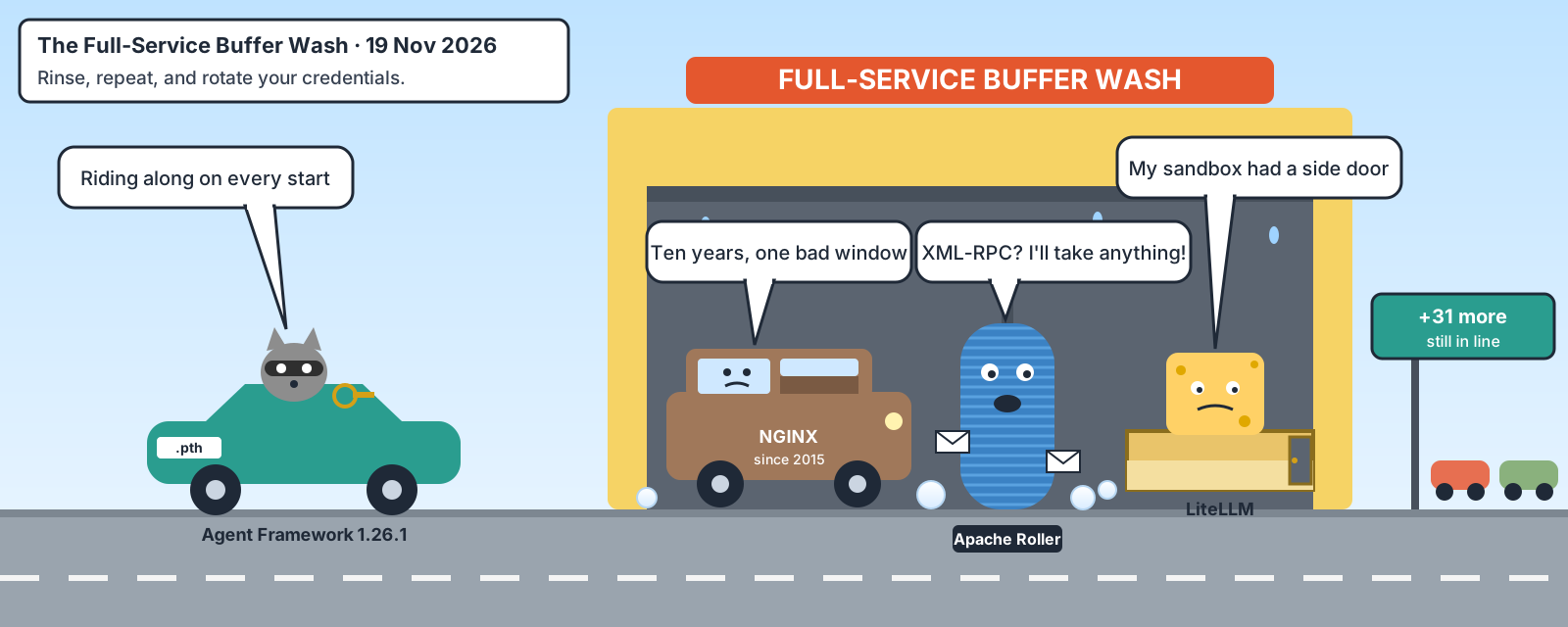
Two malicious releases of Microsoft’s agent-framework package sat on PyPI for about 45 minutes on 17 November, stealing Azure, CI and developer credentials and requesting fresh cloud tokens from any host that installed them. On the same day NGINX fixed nginx2root, a decade-old HTTP/2 flaw that public research turns into code execution, and CISA added four bugs to KEV, three of them due on Saturday. Apache also says an unauthenticated Roller RCE is being exploited, and Norway’s Equinor is still bringing IT systems back after an attack.
Do today
- Microsoft agent-framework (PyPI): search lockfiles, CI logs and images for versions 1.26.1 and 1.26.2. Pin 1.26.0, rebuild affected runners from clean images, and rotate Azure, GitHub, registry and cloud credentials from a clean machine. Revoke any tokens the stealer could have requested; don’t just rotate the stored secrets. (Socket analysis)
- NGINX with HTTP/2: upgrade to 1.31.9 or 1.30.7 (NGINX Plus 37.3.0.1 or 37.0.8.1), then fully restart or do a binary upgrade, because a reload leaves the old executable running. If you can’t upgrade yet, turn off HTTP/2. On hosts that don’t use SCTP, block the kernel module. (nginx.org security advisories)
- KEV deadlines on 21 November: REDCap (CVE-2026-90817), Apache Axis 1.x (CVE-2026-90436) and Synology DSM/BeeStation (CVE-2024-10441) were all added on 18 November with a three-day deadline. (CISA KEV catalog)
- Apache Roller: move to 6.1.6. Until you can, set
enabledForExtensionsto false or remove the/roller-services/xmlrpcmapping, because the admin-UI toggle alone doesn’t stop the bug. (CVE-2026-129448 record) - LiteLLM proxies: block
/guardrails/test_custom_codeat the edge and limit who holds API keys. Red Hat lists no workaround, and the CVE record names no fixed LiteLLM release. (Red Hat CVE-2026-40217) - PHP: releases for every supported branch land today between 14:00 and 14:30 UTC with at least one CRITICAL fix, so plan a same-day rollout. (PHP announcement)
AI and agent security7 stories
- Microsoft’s agent-framework on PyPI: two hijacked releases installed a credential stealer that runs on every Python start — Versions 1.26.1 and 1.26.2 of the Agent Framework meta-package were published 33 minutes apart on the evening of 17 November (UTC) and have since been quarantined. Each drops a
.pthfile, so the payload runs whenever Python starts, even if nothing imports the package. It collects environment variables and credential files (Azure CLI,.npmrc,.git-credentials, Docker, Hugging Face) and requests new Azure managed-identity and Azure DevOps OIDC tokens. Version 1.26.2 also requests GitHub Actions OIDC tokens. Socket reports that the data goes to a webhook[.]site endpoint. How the attacker got publishing rights is still unknown. SafeDep points to a maintainer account created on the day of the attack, but hasn’t confirmed it made the uploads. Our take: the stealer asks for new tokens, so rotating stored secrets isn’t enough. Review federated-credential sign-ins from CI identities across the exposure window. (Socket, SafeDep, Wiz, PyPI project) - LiteLLM guardrail sandbox escape enters KEV (CVE-2026-40217) — CISA added the bug on 18 November, with a 2 December deadline. X41 disclosed it in April: the
/guardrails/test_custom_codeendpoint tries to filter Python with regexes, and string tricks plus bytecode rewriting slip past the filter to run commands. In the default image those commands run as root. An API key is required, but on many deployments that key is shared widely or has leaked. X41’s advisory still listed no vendor patch, and the CVE record names no fixed LiteLLM version, so mitigation means blocking the endpoint and limiting who holds keys. Red Hat has shipped errata for affected Ansible Automation Platform and OpenShift AI images. (X41 advisory, Red Hat, CISA KEV)CVSS 8.8 (v3.1, CNA)CVSS 8.7 (v4.0, X41)EPSS 0.1702KEV yes - mssql-mcp: SQL injection in the write tools fires before the confirmation step (CVE-2026-63129) — The MSSQL MCP server packages inserted caller-supplied table names, columns and
whereClausetext straight into T-SQL. The preview and count queries ran before confirmation, so injected SQL executed on the first call, ahead of the preview, confirmation andmaxRowssafeguards. Thelist_databasespath can be reached even withREADONLY=true. A prompt-injected model is therefore enough to drop tables, or to run OS commands wherexp_cmdshellis enabled and the login is privileged. Upgrade core to 0.6.0 and the server to 0.6.0 (reader and writer to 0.5.0), noting that 0.6.0 removes the free-formwhereClause. (GitHub advisory GHSA-2m9m-6cr5-9x25)CVSS 8.8 (v3.1, GHSA)EPSS not yet scoredKEV no - LLMKube: a Model’s source path becomes a hostPath mount (CVE-2026-68903) — In the Kubernetes LLM operator up to 0.8.28,
Model.spec.sourceaccepts absolute host paths andfile://URIs. The controller opens those paths itself and mounts them into inference pods. Anyone who can create Model and InferenceService objects in a namespace can therefore read the controller’s service-account token or files on the node. Model caching, which enables the mount, is on by default in the CLI and Helm chart. Upgrade to 0.9.0, and treat CRD write access on AI operators as node-level access. (GitHub advisory GHSA-jw3m-8q7m-f35r)CVSS 7.7 (v3.1, GHSA)EPSS not yet scoredKEV no - AutoGluon MultiModal: dataset helper fetches over HTTP and extracts without checks (CVE-2026-130638) — AWS says the optional
prepare_detection_datasettool in AutoGluon MultiModal before 1.6.0 downloads archives over plaintext HTTP and extracts them without validating member paths. An on-path attacker could swap in an archive that writes files outside the output directory. The training and inference APIs are not affected. Upgrade to 1.6.0 or skip the utility. This is a narrow bug, but it’s a common pattern in ML tooling. (AWS bulletin 2026-188-AWS) - Palo Alto Networks to buy Applied Compute for $4.5 billion — In a filing on 18 November, Palo Alto Networks said it has signed a definitive all-stock agreement for Applied Compute, which builds a platform for post-training and running open-weight models. It plans to sell the platform to security customers in public-cloud and sovereign deployments. The deal is expected to close in the company’s fiscal third quarter of 2027, subject to regulatory clearance. Applied Compute’s CEO becomes co-chief AI officer. Our take: vendors now want to supply the models, not just guard them, so expect procurement questions about who controls model weights and training data. (Palo Alto Networks press release, SEC exhibit)
- Canonical opens an opt-in archive of AI-written Ubuntu security fixes — The Edge archive gives Ubuntu Pro users early access to userspace CVE backports produced by Surge, Canonical’s multi-agent remediation system. Cases where the judge models disagree or show low confidence go to Ubuntu security engineers. Canonical says stable security updates stay human-validated, kernel fixes are excluded, and Edge packages are previews, not stable releases. Our take: this is a reasonable place for AI patching, but keep Edge to test fleets until there’s data on regressions. (Canonical blog)
Application security5 stories
- PHP: critical security releases for all supported branches land today — On 18 November the PHP security team announced releases for 19 November, between 14:00 and 14:30 UTC, fixing issues in every supported version. The highest severity is CRITICAL. PHP says those issues need non-default configuration or uncommon setups, and it will publish details and version numbers with the releases. PHP 8.6.0 GA is scheduled for the same day, so confirm that your branch’s fixed version is actually in your package source before you call it done. (PHP announcement)
- WebKitGTK and WPE WebKit 2.54.3 fix 26 CVEs, including a sandbox escape (WSA-2026-0007) — The 18 November advisory lists seven bugs that can lead to code execution, mostly use-after-frees, and CVE-2026-113897, which may let web content escape the Web Content sandbox. The fix for that one removes the vulnerable code entirely. Most of the remaining CVEs crash the process. No in-the-wild exploitation is mentioned. Linux desktops, kiosks and embedded browsers built on WPE should move to 2.54.3. (oss-security: WSA-2026-0007)
- X.Org: a heap write in libfontenc and two out-of-bounds reads in libXfont2 — CVE-2026-109908 is a heap out-of-bounds write in the
.encencoding-file parser. Where the X server runs as root, a local user who can place files on its font path could escalate privileges. CVE-2026-109909 (crafted PCF fonts) can leak memory or crash the server, and CVE-2026-109920 lets an ordinary client crash it with a renamed vendor font. Fixes are in libfontenc 1.1.10 and libXfont2 2.0.10. (X.Org advisory on oss-security) - Apache Iggy 0.9.0 writes its generated root password to a log anyone with
read_serverscan download (CVE-2026-118493) — If the streaming server started without root credentials in the environment, it generated a password and logged it. The snapshot command then let a low-privilege user pull the logs and log in as root. Version 0.10.0 stops generating the password and requiresmanage_serversfor snapshots. Upgrading doesn’t change the existing root password, so change it yourself. (oss-security: Apache Iggy) - npm: a batch of WhatsApp “baileys” lookalikes flagged as malware — On 19 November, GitHub’s advisory database added malware advisories for dozens of npm packages with names close to the Baileys WhatsApp library, including
kevinx-baileys,@zaxius/baileysand a run of@bellaxchan/*scopes. The advisories say any machine that installed one should be treated as fully compromised, with secrets rotated from a different machine. These names usually reach developers through bot-building tutorials and forks, so checkpackage.jsonfiles in chat-bot repos. (GitHub malware advisories, GHSA-m4p3-qr69-gqjp)
Exploited and critical CVEs5 stories
- Apache Roller: unauthenticated XML-RPC deserialization RCE, exploited (CVE-2026-129448) — The ASF’s record, published 17 November, says the XML-RPC endpoint deserializes vendor extension types before it checks who is calling. It also says the flaw is being actively exploited. The sources disagree on versions. The record lists 4.0.0 through 6.1.4 as affected and 6.1.5 as the first fixed release, but the advisory text recommends 6.1.6, and the earlier CVE-2026-82384 for the same issue listed only 6.1.5 as affected. Go to 6.1.6. If you’re stuck, disable extensions in
web.xmlor remove the servlet mapping, because the admin-UI toggle runs too late. As of the 18 November catalogue it is not in KEV. (CVE-2026-129448 record, ASF announcement)CVSS 9.8 (v3.1, ASF)EPSS 0.0164KEV no - REDCap: unauthenticated code injection via a public survey, now in KEV (CVE-2026-90817) — An attacker who knows a valid public survey hash can reach the Data Import controller through survey passthrough routing and supply a crafted file-path or stream parameter. That can run code on the server. REDCap 13.3.0 and later are affected. Fixes are in 16.0.49 LTS, 17.3.10 LTS and 17.4.4. The CVE dates from September, but KEV listing on 18 November is new, and the deadline is 21 November. Research and hospital REDCap servers often publish survey links openly, so assume the hash isn’t secret. (CVE-2026-90817 record, CISA KEV)
CVSS 9.8 (v3.1, CNA)EPSS 0.0375KEV yes - Apache Axis 1.x: SOAP fault class instantiation, exploited, and no release coming (CVE-2026-90436) — Axis loads whatever class a SOAP fault’s
exceptionNamenames, before service-level authentication handlers run. With a suitable class on the classpath, that becomes unauthenticated code execution. Every 1.x release through 1.4 is affected and the line is end-of-life. Apache’s options are to migrate to Axis2 or apply commit41f3b4e. CISA added it on 18 November with a 21 November deadline. Hunt for Axis 1.4 jars bundled inside old vendor appliances and middleware, because most Axis 1 exposure is like that. (CVE-2026-90436 record, oss-security disclosure)CVSS 9.8 (v3.1, CISA ADP)EPSS 0.0113KEV yes - Synology DSM and BeeStation: a 2024 Pwn2Own RCE added to KEV (CVE-2024-10441) — The output-escaping flaw in the system plugin daemon was fixed in late 2024 (DSM 7.2.2-72806-1, 7.2.1-69057-6, 7.2-64570-4, 7.1.1-42962-7 and BeeStation 1.1-65374). What’s new is CISA’s 18 November listing, with a 21 November deadline, which means someone is exploiting NAS boxes that never took those updates. Check internet-exposed DSM and BeeStation units for build numbers, not just major versions. (Synology-SA-24:20, Synology-SA-24:23, CISA KEV)
CVSS 9.8 (v3.1, CNA)EPSS 0.0125KEV yes - nginx2root: a decade-old NGINX HTTP/2 flaw becomes code execution in public research (CVE-2026-123007) — Memory corruption in HTTP/2 flow control affects open-source NGINX 1.9.5 through 1.31.8 and is fixed in 1.31.9 and 1.30.7. The same release fixes four more bugs in HTTP/2, HTTP/3, the resolver and the mail proxy, plus three others. F5 says code execution needs ASLR disabled or bypassed. Wiz bypassed ASLR in its tests, and Rapid7 published an analysis and a PoC. The scores differ: F5 rates it 8.1 under v3.1 and 9.2 under v4.0, while nginx.org calls it “Major”. Root on the host needs a separate, still-unpatched Linux SCTP bug, which Rich Felker raised on oss-security, so blocking the
sctpmodule is a sensible extra step. No exploitation reported, and it isn’t in KEV. (nginx.org advisories, CVE-2026-123007 record, Wiz, Rapid7, CIRCL guidance, oss-security on SCTP)CVSS 8.1 (v3.1, F5)CVSS 9.2 (v4.0, F5)EPSS not yet scoredKEV no
Cloud and infrastructure5 stories
- F5 BIG-IP: six critical iRule and APM overflows, fixed only through engineering hotfixes — F5 published 22 advisories on 18 November. The six critical ones are stack overflows in TMM, the data plane, triggered by specific setups: iRules that use
MR::message route,PSC::ip_address,GENERICMESSAGE::route,DNS::scrapeorPEM::subscriber, and certain APM per-request policies. An unauthenticated attacker can crash TMM, and F5 says code execution may be possible. For CVE-2026-120292 the CVE record lists ENG hotfix builds for 21.1, 17.5 and 17.1 and EHF1 builds for BIG-IP Next for Kubernetes. F5 doesn’t regression-test engineering hotfixes the way it tests scheduled releases. Grep your iRules for those commands first, so you know which boxes need a hotfix now and which can wait. (CVE-2026-120292 record, F5 K000163940)CVSS 9.8 (v3.1, F5)CVSS 9.3 (v4.0, F5)EPSS not yet scoredKEV no - Miren Runtime: any self-signed client certificate gets cluster admin (CVE-2026-75521) — The Miren platform’s RPC server on port 8443 asked for client certificates but never checked that they chained to the cluster CA. It then took the CommonName as the caller’s identity and skipped RBAC. Anyone who could reach the port could take over the cluster. Upgrade to 0.11.1. Miren says misuse can’t be detected after the fact, so redeploy apps and rotate secrets held in environment variables. (GitHub advisory GHSA-8fh7-7q4q-cq52)
CVSS 10.0 (v4.0, GHSA)EPSS not yet scoredKEV no - AWS Private CA Connector for Kubernetes: namespace issuers could borrow other credentials (CVE-2026-130622, CVE-2026-130623) — In aws-privateca-issuer before v1.12.0, a namespace-scoped AWSPCAIssuer could reference an AWS credentials Secret in another namespace. One with no credentials fell back to the controller’s own AWS identity. Either way, a tenant could get certificates signed by a CA it shouldn’t use. Version 1.12.0 (EKS add-on v1.12.0-eksbuild.1) closes both paths and will stop issuers that relied on them, so list those issuers before upgrading. Until then, only cluster admins should be able to create issuers. (AWS bulletin 2026-187-AWS)
- Chainguard Go SDK: unsigned audience headers let a SigV4 token be replayed elsewhere (CVE-2026-71861) —
auth/aws.VerifyTokentrusted theChainguard-AudienceandChainguard-Identityheaders without requiring them in SignedHeaders. An attacker holding a victim’s freshly signedGetCallerIdentityrequest could change the audience and replay it to another verifier within about 15 minutes. Only services that verify tokens are affected, not token generators. Upgrade to 0.1.107. If you built the same STS-based identity pattern yourself, check that you require these headers to be signed too. (GitHub advisory GHSA-wq26-3j2m-4hvv)CVSS 7.4 (v3.1, GHSA)EPSS not yet scoredKEV no - Firmware TPM lockout rollback: short Windows Hello and BitLocker PINs fall in hours to days — A paper posted on 13 November and publicised this week shows cheap flash interposers rolling back TPM state, including the lockout counter, on AMD, Intel and Pluton systems. The routes are Winbond RPMC flash leaking its HMAC key under glitching, AMD firmware that doesn’t verify RPMC increments, and some AMD boards with no rollback protection at all. The authors recovered a 4-digit Hello PIN in about 40 hours instead of 69 days, and estimate about 20 days for a 6-digit BitLocker TPM+PIN. The attack needs physical access, and vendor responses vary, from firmware fixes to statements that it is out of scope. Raise minimum PIN lengths through policy, especially on laptops that travel. (arXiv paper, AMD-SB-7079)
Crypto and Web37 stories
- K3 Capital sBOLD vault drained of about $3.43 million — SlowMist records that on 18 November an attacker used flash-loaned wstETH to self-liquidate Liquity V2 troves. A flaw in the vault’s
totalAssetsaccounting then let them redeem other depositors’ BOLD from the ERC-4626 vault. K3 paused the contracts. The vault had published audits, which shows again that share-price maths around external pools is where vault audits miss things. The loss figure comes from SlowMist’s ledger, and we haven’t reconciled it on-chain. (SlowMist Hacked: K3 Capital) - LUKSO: a recovery-service backend flaw put attacker keys on about 300 Universal Profiles — SlowMist’s entry says that overnight on 17–18 November an attacker took over the email recovery service’s own recovery profile. From there they added controller keys to roughly 300 profiles and took about 1.4 million LYX. The figures conflict: SlowMist lists the loss as $95,000, which matches reports that the LYX was bridged and sold for about 50 ETH, not the tokens’ quoted market value, and one tracker counts 279 profiles instead of 300. LUKSO shut the service down and says the chain and contracts weren’t affected. Attacker keys stay valid until removed, so affected users must remove the added controllers, not just revoke permissions. (SlowMist Hacked: LUKSO, The Defiant)
- Gonka AI bridge: a rotated BLS group key drained reserves and minted unbacked WGNK — On 18 November an attacker rotated the Ethereum bridge’s epoch BLS group key. They drained about $884,800 of USDT and USDC reserves and minted unbacked wrapped tokens, about $1.05 million in total across roughly five transactions, according to SlowMist. We report both figures: $884,800 is the stablecoin drain and $1.05 million is SlowMist’s headline total. Gonka says network consensus was unaffected. Key-rotation logic is part of the bridge’s attack surface, and it needs the same quorum checks as withdrawals. (SlowMist Hacked: Gonka AI)
- RNT Lend: an admin key upgraded stablecoin proxies to drain about $955,000, and MEV bots took half — SlowMist says on 18 November an authorised admin key on Polygon upgraded the USDT0 and USDC proxy contracts to code that allowed unrestricted withdrawals. About $500,000 went to the keyholder and $454,825 to two MEV bots that front-ran them. About $49.34 million in property tokens was also moved but clawed back by Reental within about two hours. Some press reports this as a $454,000 Reental loss, which is only the MEV bots’ share, so expect differing headlines. (SlowMist Hacked: RNT Lend)
- B18 TimeBank on Base: signed reward vouchers redeemed for about 404,540 USDC — SlowMist’s 17 November entry, sourced to Blockaid, says one transaction redeemed level-reward vouchers and emptied the settlement contract. A later check showed about 106,785 USDC back in the contract, and SlowMist couldn’t confirm containment. Signed-voucher systems need replay and amount limits enforced on-chain, not just in the signer. (SlowMist Hacked: B18 TimeBank)
- Peapods Finance: a leaked deployer key minted L2 PEAS that was bridged to mainnet and sold — According to SlowMist, on 18 November the attacker set themselves as minter on the L2 PEAS contracts, minted tokens, bridged them to Ethereum and sold them. The team pulled 98–99% of L2 liquidity. No loss figure has been published, so treat any number you see as unconfirmed until the post-mortem. (SlowMist Hacked: Peapods Finance)
- Paytaca: backend abuse produced fake P2P orders, but no funds moved — The Bitcoin Cash wallet’s P2P Ramp and other backend systems were abused on 17–18 November to generate fraudulent orders and unsolicited payment requests, SlowMist records. Keys stay on user devices and transfers still need user signatures, so the team reports no loss. Users should ignore unexpected orders and never sign a transaction they didn’t start. (SlowMist Hacked: Paytaca)
Incidents and industry6 stories
- Equinor contains a cyberattack on its IT systems; production unaffected — Equinor detected an ongoing attack on certain IT systems on the evening of 17 November. In an 18 November update it said it now understands how the attack was carried out and which systems were hit. The company says it isn’t a virus and won’t spread, that production and operations are unaffected, and that it has seen no sign of data theft. It hasn’t said how long restoration will take, and it is working with Norway’s national security authorities. Neither the attacker nor the entry point has been named. (Equinor statement, The Record)
- GTIG: COLD RELIC used one victim’s stolen mailboxes to phish the next — Google’s 17 November case study describes the Russia-linked group (COLDRIVER, Star Blizzard). In late 2025 it got into a US organisation’s Google Workspace with stolen Super Admin credentials and MFA push fatigue. It then ran a domain-wide Takeout, deleted Alert Center notifications, and stayed in through passkeys and OAuth mail sync that survived password resets. In 2026 it posed as that victim’s staff to phish an Entra ID user at a second organisation. Google’s checklist is the useful part: revoke sessions, OAuth grants and passkeys during incident response, and alert on
Customer Takeout Created. (Google Threat Intelligence) - Bitdefender: EggStreme rebuilt within weeks of exposure, now with a passive variant — Bitdefender’s 18 November update says the suspected Chinese operators changed EggStreme’s encryption 12 days after the 2025 report, then rebuilt the loader. The agent moved from gRPC to raw TCP with mutual TLS. A new passive build listens on TCP 5060 behind a firewall rule named “Core Networking - SIP”, and the keylogger has been dropped. Philippine government bodies are still the main targets, and Bitdefender rates Taiwan as a possible target with low to medium confidence. A listening implant doesn’t beacon out, so look for new inbound firewall rules rather than egress beacons. (Bitdefender)
- Unit 42: TGR-STA-0049 adds two HTTP/3 RATs against Southeast Asian governments — The cluster, also tracked as Earth Alux, REF7707 and Ink Dragon, gets in mostly through unpatched Exchange and web servers with web shells. It then deploys PerfectPioneer (Go) and KUKURAT (C++). Both use QUIC for C2, and KUKURAT generates decoy activity to muddy telemetry. Unit 42 recommends blocking outbound UDP 443 where you can, so the traffic falls back to inspectable TCP, and auditing logon scripts in SYSVOL. (Unit 42)
- ReversingLabs: BubbleLoader hides payloads in PNGs inside patched copies of real software — Seen since February 2026, with clusters in September and October, BubbleLoader patches the entry point of legitimate programs such as WinRAR, x64dbg and Windows Media Player. A real gradient PNG serves as the XOR key for code hidden in a malformed second PNG. The payload’s in-memory hash changes on every run, so hash-based hunting won’t work. A cheap static check is a PNG whose IHDR width field starts with 0x55. Allowlisting and signature verification catch the patched binaries because the patch breaks the original vendor signature. (ReversingLabs)
- IIHF website defaced over Russia’s exclusion — The International Ice Hockey Federation says its site was defaced on 17 November with a pro-Russian image, shortly after it confirmed Russia won’t play in the World Junior Championship. The site went offline and was still under maintenance on 18 November. No group has claimed it and there is no public attribution. Sports bodies making political eligibility decisions should expect this kind of nuisance attack and keep a static fallback page ready. (IIHF statement, The Record)
Bottom line
- Package registries are still the fastest way into cloud tenants. The agent-framework stealer requested fresh managed-identity and OIDC tokens, so incident response has to cover what those identities did, not just which secrets were stored on the runner.
- Three KEV items fall due on Saturday, and one of them (Synology) has had a fix for two years. The quickest win this week is finding forgotten REDCap, Axis 1.x and NAS hosts, not the newest CVE.
- nginx2root and the F5 hotfixes both depend on configuration. Check whether HTTP/2 is actually on and which iRule commands you use; that tells you which hosts to patch today and which can wait for the normal cycle.