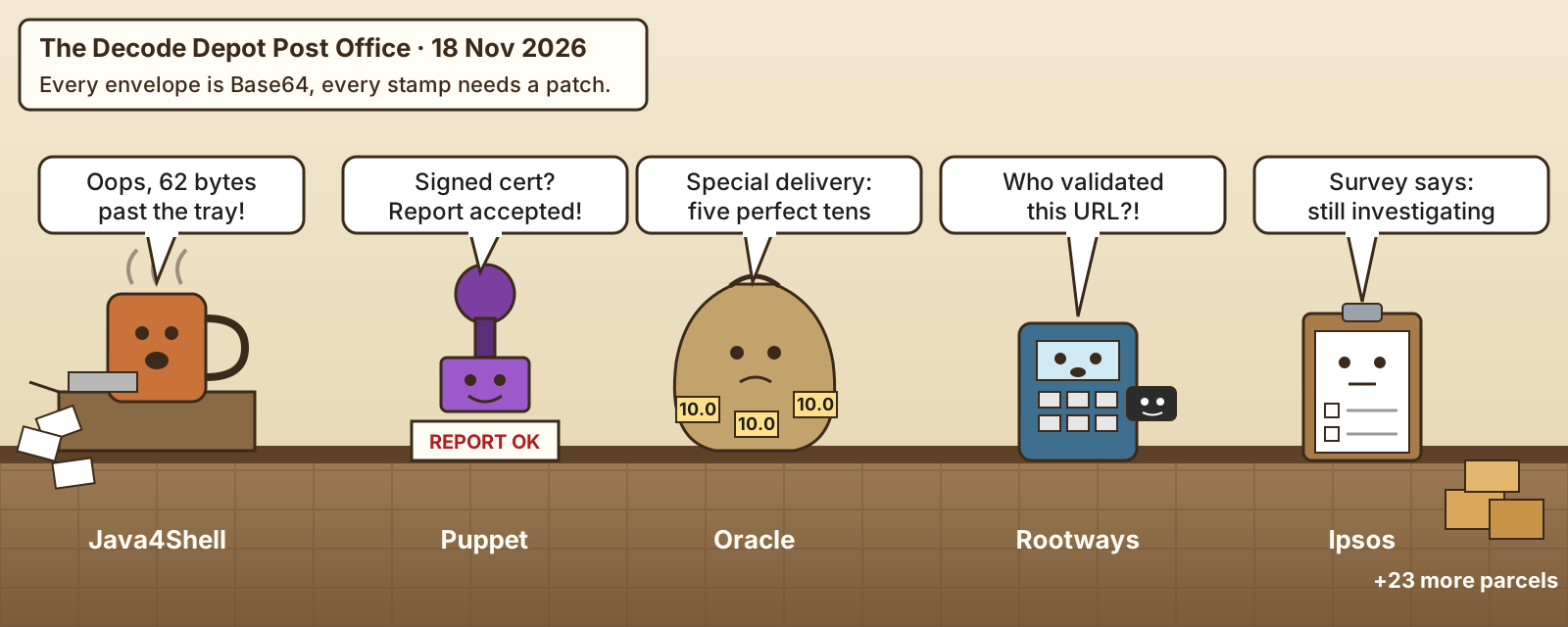
Java4Shell (CVE-2026-114938) is the patch of the day. A memory-corruption bug in the JVM’s hardware-accelerated Base64 decoder gives researchers pre-auth code execution in Keycloak, Jira, Jenkins and other apps, but only on x86-64 CPUs with AVX-512 VBMI. CISA added Puppet Enterprise’s report-deserialization RCE to KEV, Oracle’s November monthly release carries several 10.0-rated Access Manager and WebLogic fixes, and Sansec caught a Magento Apple Pay plugin being exploited to plant a card skimmer.
Do today
- Java 17, 21, 25 and 27 (Oracle, Corretto, Zulu, GraalVM and bundled runtimes): move to 17.0.21.1, 21.0.13.1, 25.0.5.1 or 27.0.1.1 (or your vendor’s equivalent), restart, and rebuild container images. Do internet-facing Keycloak, Jira, Confluence, Jenkins, Artifactory and PingFederate first. Where you can’t patch yet, run x86 JVMs with
-XX:-UseBASE64Intrinsics. (CISA alert, Canadian Centre for Cyber Security AL26-029) - Puppet Enterprise: upgrade to 2026.0.1, 2025.12.1 or 2023.8.13. Check whether your CA autosigns agent certificates, and review unexpected report PUTs and unknown agent certs. The KEV deadline is 1 December. (CISA KEV addition, Perforce CNA record)
- Magento stores with Rootways Authorize.net CIM Pro: update to 4.1.5, or turn off Apple Pay until you can. If Apple Pay was on, assume compromise and rotate the
env.phpsecrets. (Sansec research) - Oracle Access Manager and WebLogic Server: apply the November monthly patches for the unauthenticated 10.0-rated flaws. Put OAM authentication endpoints and WebLogic admin and T3/HTTP listeners at the front of the queue. (NVD CVE-2026-91500, NVD CVE-2026-91569)
- ScreenConnect: confirm that technician clients, not just servers, are on 26.6.5 or later, and that RMM+-family extensions are disabled on-premises. (ConnectWise Trust Center advisories)
AI and agent security5 stories
- Arize Phoenix: a format-string flaw in
applyChatTemplateleaks the JWT signing secret (CVE-2026-53998) — The GitHub advisory rates this LLM-observability platform bug 10.0. A crafted chat template sent to the GraphQL endpoint can read environment variables and the secret that signs JWTs and derives the key for stored provider credentials. Authentication is off by default, so an exposed instance needs no login. Versions 13.0.0 through 15.6.x are affected and 15.7.0 fixes it. Our take: Phoenix instances often sit next to production LLM keys. If one was reachable, rotate the signing secret and every provider key stored in it, not just the binary. (GitHub advisory GHSA-gfv3-m769-5xm3)CVSS 10.0 (v3.1, GHSA)EPSS 0.00356KEV no - BISHENG: a hard-coded JWT secret lets anyone forge an admin token (CVE-2026-130840) — VulnCheck’s record for the open-source LLM application platform says versions before 3.0.0 ship a default
jwt_secret. An unauthenticated attacker can mint an admin token and take over users, workspaces, knowledge bases and workflows. Version 3.0.0 fixes it. Our take: a knowledge base usually holds the most sensitive documents an organisation has fed to an LLM. Upgrading isn’t enough on its own: set your own secret and invalidate sessions. (NVD CVE-2026-130840, VulnCheck advisory)CVSS 9.8 (v3.1, VulnCheck)EPSS not yet scoredKEV no - 53AIHub: an unauthenticated
/api/initcall re-installs a live AI hub (CVE-2026-130856) — Before 0.5.5, the AI-agent hub’s setup endpoint stayed public after installation. A remote attacker could re-run it to reset an existing password, take the top creator role and get an admin token. The fix commit and 0.5.5 release gate the endpoint. Our take: a setup route left open after installation is the most common way AI platforms built quickly get taken over this year. Check every self-hosted agent platform for install or init endpoints that still answer. (NVD CVE-2026-130856)CVSS 9.8 (v3.1, VulnCheck)EPSS not yet scoredKEV no - Apple splits macOS “control” permissions because of AI agents — In macOS 27.3 beta 2, Apple splits the broad device-control setting into “System & App Protection Override” and Accessibility. Users choose specific apps or folders, can require a prompt every time, and see an indicator when one app is driving another. Existing grants stay in place, and backup and assistive-tech developers can request entitlements to keep the old behaviour. Our take: this is a vendor admitting that agentic apps make Full Disk Access too blunt. Fleet admins should inventory which agents hold these grants now, because the old grants carry over. (Apple Developer news)
- Hudson Rock: a stealer-log market now writes an AI profile of each victim — Hudson Rock describes a forum marketplace that attaches an AI-generated summary to each infected machine, covering the likely owner, their employer and which accounts are worth buying. Buyers can search in plain language. Logs start at $0.25 and accounts are funded in crypto. Some logs matched Hudson Rock’s own data and came from infections within the previous day. Hudson Rock says it has not verified the seller’s inventory claims or any completed sales. Our take: triage that used to need a skilled broker is now a search box, so stealer infections on staff home devices become targeted intrusions faster. (Hudson Rock research)
Application security5 stories
- Anthropic cuts its disclosure deadline to 30 days for serious bugs — From 1 January 2027, Anthropic will publish high- and critical-severity bugs it reports 30 days after notice, down from 90. Other bugs get 45 days, escalation to a coordinator moves to 15 days, and full details follow 30 days after a patch. The seven-day window for actively exploited bugs doesn’t change. Maintainers of older overdue reports get 30 more days. Our take: together with Project Zero’s move earlier this week, the gap between report and public disclosure is shrinking fast. Open-source maintainers who depend on volunteers should arrange triage cover now. (Anthropic research post)
- Telegram widgets: researchers claim two seccomp bypasses on Android, and Telegram says the issue is fixed server-side — NebuSec says a malicious widget can get code running outside the new seccomp sandbox around Telegram’s Android widget engine, demonstrated only on a test server. Telegram’s published source shows the filter in audit mode for most listed calls. Pavel Durov replied that a user first had to start a third-party service and that the issue is fixed server-side. Kaspersky separately warned of suspected widget abuse that delivers the WebRAT stealer. The claims are unverified, there is no CVE, and no fixed client version is listed. Our take: treat widgets as untrusted code until Telegram ships a client-side fix, and tell high-risk users not to start unknown bots. (Durov’s Telegram post, Telegram Android seccomp source)
- OwnTracks Recorder 1.0.5 fixes a stored format-string bug that can lead to code execution (CVE-2026-131852) — An unauthenticated client can publish a location with a malicious
tidvalue over HTTP or MQTT. When that value is read back through the API, the format-string bug leaks and writes memory. The 1.0.5 release shipped on 17 November. Our take: self-hosted location recorders are often left internet-facing for phones to reach. Upgrade, and put the publish endpoint behind authentication. (NVD CVE-2026-131852, OwnTracks 1.0.5 release)CVSS 9.8 (v3.1, VulnCheck)EPSS not yet scoredKEV no - BZFlag 2.4.32: a heap write in the game server’s TCP handler (CVE-2026-130849) — A message body of exactly 1,024 bytes drives the receive offset negative, which gives a remote, unauthenticated attacker a controlled write before the buffer in
bzfs. The maintainers’ 16 November release fixes several remote-crash bugs and tells both players and server operators to upgrade. Our take: this is a hobbyist server, but long-lived community servers are exactly the kind of box that stays unpatched for years. (NVD CVE-2026-130849, BZFlag 2.4.32 release)CVSS 9.8 (v3.1, VulnCheck)EPSS not yet scoredKEV no - go1cms: a guest-whitelisted
update_docroute lets anyone edit any document, including users (CVE-2026-130071) — The Frappe-based CMS saved attacker-supplied fields with permission checks switched off, so an unauthenticated visitor could change User records and business data. The fix is commitead8da3, and no tagged release is named. Our take: if you build on Frappe, search your own apps for guest-allowed methods that callignore_permissions=True. That is the whole bug class. (NVD CVE-2026-130071, fix commit)CVSS 9.8 (v3.1, VulnCheck)EPSS not yet scoredKEV no
Exploited and critical CVEs5 stories
- Java4Shell: a pre-auth heap overflow in the JVM’s AVX-512 Base64 decoder (CVE-2026-114938) — Calif disclosed a bug in OpenJDK’s x86-64 Base64 intrinsic. Malformed input makes the decoder write 62–63 bytes past its buffer before it rejects the input. Calif says it has working pre-auth RCE chains against default Keycloak, Jira, Confluence, Artifactory, Jenkins and PingFederate, plus post-auth chains for Kafka, Solr, Elasticsearch and others. It is holding those chains back but has published a bounded trigger. Only hosts whose CPUs support AVX-512 VBMI are exposed: Intel Ice Lake and later Xeons, and AMD Zen 4 and later. ARM64 is not affected, and Java 8 and 11 are not affected except Oracle’s 8u511b33-perf build. Fixed Oracle builds are 17.0.21.1, 21.0.13.1, 25.0.5.1 and 27.0.1.1. Amazon Linux has shipped Corretto fixes, and Red Hat’s bulletin rates it Critical with errata still pending. Scores disagree: Calif gives 9.2 (CVSS 4.0), Oracle 8.1 with high attack complexity, and Amazon 8.8. The Canadian Cyber Centre knows of no exploitation, and it is not in KEV. Our take: the 8.1 shouldn’t make you wait. CISA is already calling for immediate patching, and if you can’t patch today,
-XX:-UseBASE64Intrinsicsis the targeted stopgap. (Calif write-up, CISA alert, NVD CVE-2026-114938, Canadian Centre for Cyber Security AL26-029)CVSS 9.2 (v4.0, Calif)CVSS 8.1 (v3.1, Oracle)EPSS not yet scoredKEV no - Puppet Enterprise: report deserialization to RCE on Puppet Server, now in KEV (CVE-2026-115731) — CISA added the flaw on 17 November with a 1 December deadline. Perforce published its CNA record on 3 November. Any client with a CA-signed agent certificate can send a crafted report and run code as the Puppet Server service user. Where the CA autosigns without strong checks, an outsider can simply request a certificate. Fixed releases are 2026.0.1, 2025.12.1 and 2023.8.13. Third-party write-ups also list Puppet Core 9.1.3 and 8.22.2, but we could not confirm the Core fixes against a vendor page. Our take: the configuration server pushes code to every managed node, so compromising it compromises the fleet. Patch, turn off naive autosigning, and review the certificate inventory. (CISA KEV addition, Perforce CNA record, Perforce advisory)
CVSS 9.4 (v4.0, Perforce)EPSS 0.00366KEV yes - Rootways Authorize.net CIM Pro for Magento: an Apple Pay SSRF exploited to plant a WebSocket skimmer (CVE-2026-130583) — Sansec found an attacker abusing the extension’s Apple Pay merchant-validation endpoint on 15 November. The attacker read
app/etc/env.php, created an admin account, got code execution and injected a card skimmer. All versions before 4.1.5 are affected. NVD lists 9.3 (v3.1) and Sansec quotes 9.2 (v4.0). Sansec reports one confirmed victim store and gives no count of exposed stores. Our take: this is the second checkout-script compromise this week after Optimizely. Payment-page script monitoring would have caught both. (Sansec research, Rootways security update, NVD CVE-2026-130583)CVSS 9.3 (v3.1, VulnCheck)EPSS not yet scoredKEV no - Oracle’s November monthly patches: 10.0s in Access Manager, WebLogic, BI and Platform Security, and 9.9s in the Database — NVD received Oracle’s records on 17 November. Unauthenticated HTTP flaws in the Access Manager Authentication Engine (CVE-2026-91500 and CVE-2026-91510, versions 12.2.1.4.0 and 14.1.2.1.0) and in WebLogic’s TopLink integration (CVE-2026-91569, versions 12.2.1.4.0 to 15.1.1.0.0) are rated 10.0. So are flaws in BI Enterprise Edition and Platform Security for Java. Oracle Text and RDBMS flaws rated 9.9 need only low privileges. Oracle’s own advisory page refused our requests, so these details come from the NVD copies of Oracle’s records. Our take: no exploitation is reported. But OAM sits in front of SSO and WebLogic has a long history of being exploited soon after patch day, so put both ahead of the normal cycle. (NVD CVE-2026-91500, NVD CVE-2026-91569)
CVSS 10.0 (v3.1, Oracle)EPSS not yet scoredKEV no - KEV: one addition since 13 November, and an Apple deadline falls due today — The 17 November catalogue (version 2026.11.17) added only Puppet Enterprise. Apple’s CVE-2024-27834, added on 4 November, falls due today. SonicWall SonicOS SSLVPN (CVE-2026-19868) falls due on 20 November. On 24 November, the Outlook NTLM leak, Chromium CVE-2026-125350, Cisco BroadWorks and Openwave all fall due. Our take: federal teams that cleared last week’s queue should spend today on Puppet. Everyone else should treat the 24 November group as the week’s real deadline. (CISA KEV feed mirror)
Cloud and infrastructure5 stories
- Java4Shell in cloud fleets: the same image can be vulnerable on one instance type and safe on another — Exposure depends on the host CPU, not the container. An image that is safe on Graviton or older Xeons becomes vulnerable when rescheduled onto Ice Lake, Sapphire Rapids or Zen 4 nodes. Amazon Linux has fixed Corretto 17, 21, 25 and 27 on AL2, AL2023 and the AL2027 preview, and scores the bug 8.8 with low privileges required. Red Hat lists RHEL 8, 9 and 10, its OpenJDK builds, UBI images and layered products such as OpenShift as affected, with no errata yet. Our take: scanners that check the image alone will miss this. Pair JVM version inventory with node CPU flags, and pin the
-XX:-UseBASE64Intrinsicsflag in base images until rebuilt. (Amazon Linux security center, Red Hat RHSB-2026-018) - Kaspersky: BlackNevas wiped ESXi through vCenter’s own Host Profiles, with no hypervisor exploit — In a ten-day intrusion, the attacker used vCenter Host Profile remediation to turn on SSH across four ESXi hosts. They planted MeshAgent and a Ligolo-ng tunnel on the vCenter appliance, disabled backup antivirus days in advance, and then stopped VMs on the DR host within 23 seconds before overwriting virtual disks. Kaspersky’s attribution to BlackNevas rests on ransom notes and command-line style, at medium confidence, because the binary wasn’t recovered. Our take: alert on Host Profile changes that enable TSM-SSH, and treat vCenter as Tier 0 with its own identities. Backups need a management path that doesn’t depend on production AD or vCenter. (Securelist report)
- ScreenConnect: ConnectWise completes its investigation, and Huntress sees a new SCKit wave — ConnectWise marked its investigation complete on 16 November and says partner action is still required. It also says completing the investigation does not mean any given environment is clean. It disabled RMM+-family extensions in about 400 cloud environments, but on-premises partners must disable them themselves. Technician clients must be on 26.6.5, which fixes CVE-2026-84869, because updating the server alone does not update clients. Huntress recorded another spike on 13 November from new infrastructure, hitting 205 hosts at 41 organisations. Our take: neither updating nor disabling extensions removes access an attacker already has. MSPs should hunt their customer endpoints for rogue ScreenConnect clients. (ConnectWise Trust Center advisories, Huntress SCKit analysis)
- GeoVision VMS: internet-exposed camera software gave cryptominers SYSTEM on 13 organisations — Huntress traced intrusions on 8–10 November to
GeoStartupAgentService.exe. The attackers loaded a known-vulnerable driver to kill Defender, set IFEO hijacks against security tools, and ran a Go loader that fetches payloads over BitTorrent DHT before installing XMRig. Huntress hasn’t identified which GeoVision flaw was used. Our take: video-management servers are rarely in patch scope and often run as SYSTEM, so take them off the internet and put them behind a VPN. (Huntress threat advisory) - AWS Advanced JDBC Wrapper: the remote query cache plugin deserializes whatever is in Redis (CVE-2026-14265) — From 3.3.0 up to 4.0.1, the optional
RemoteQueryCachePlugindeserializes cached query results without class filtering. Anyone who can write to the shared Redis or Valkey cache can get code execution on every application server that reads it. The plugin is off by default, and 4.0.1 fixes it. Our take: a shared cache is a trust boundary. If you enabled the plugin, upgrade and restrict cache write access to the applications that need it. (GitHub advisory GHSA-c5q4-97jw-jggh)CVSS 7.7 (v4.0, GHSA)EPSS not yet scoredKEV no
Crypto and Web33 stories
- Judge acquits the Peraire-Bueno brothers over the $25 million MEV-Boost relay exploit — Judge Jessica Clarke of the Southern District of New York entered a judgment of acquittal on 16 November on the wire-fraud and money-laundering conspiracy counts, after last year’s mistrial. She found the government never identified a material misrepresentation. The brothers’ bait transactions were in fact executed, and the relay never checked the zeroed parent and state roots. The opinion recounts that the April 2023 attack took about $25 million from three sandwich-bot operators in one block. One wallet holding $3 million was frozen, and Flashbots patched relays within 24 hours. The judge also noted “serious due process concerns” in the prosecution. Our take: for protocol teams, the legal backstop for exploits of “code as written” is now weaker in this district. Rely on validation in the relay and contract, not on prosecutors. (SDNY opinion and order)
- Trigram: about 50 fake AI and blockchain brands lure developers into running a wallet-stealing command — Stormshield describes fake recruiter, conference-invitation and parcel-tracking lures, a supply-chain compromise and trojanised repositories. All of them lead to a “technical check” command that installs the
install_guard.jsstealer, which takes browser credentials, crypto wallets, SSH keys and.envfiles. A back-office tool called rms-platform scrapes GitHub profiles and sends the phishing emails. Stormshield links Trigram with high confidence to the UNK_DeadDrop cluster, which overlaps with Kimsuky. It gives only low-to-moderate confidence to an aim of moving victims’ funds. Our take: never run a one-line “check” from a recruiter or event, and keep wallet keys off developer laptops. (Stormshield CTI report) - Chainalysis: Eastern Europe’s crypto ATM volume nearly doubled while Poland still has no MiCA law — Chainalysis’ regional report says ATM volume grew from $17.3 million to $33.9 million in the year to June 2026, with Poland and Romania accounting for 92% of the rise. Ninety per cent of Polish ATM transactions involved stablecoins. Poland’s president has vetoed the MiCA implementing law three times, and Romania had not named a competent authority as of October. Chainalysis says its data cannot prove causation and reports no scam figures. Our take: cash-in kiosks in a gap between regulatory regimes are the usual off-ramp for fraud proceeds, so expect enforcement to follow. (Chainalysis report)
Incidents and industry5 stories
- Ipsos investigates a breach of one internal system after filing a criminal complaint — The Paris-listed market-research firm says it found an incident affecting one internal information system and filed a complaint with authorities on 11 November. It says operations and client delivery were not affected and that it will contact clients, projects or partners directly if their data turns out to be involved. Ipsos has not said whether data was taken, and no group has claimed the attack. Our take: a research firm holds survey respondents’ personal data on behalf of thousands of clients, so procurement teams should ask now which datasets sat on that system. (Ipsos press release)
- Access Dental Management: SSNs and health data copied in a four-day intrusion — The dental-practice operator’s notice says intruders were in its network from 1 to 4 May 2026, and that the review of affected files finished on 21 October. Names, addresses, birth dates, Social Security numbers, medical and insurance details may have been viewed and copied. SecurityWeek, citing a Texas filing, puts the count at 341,049 people. The notice itself gives no number, and WorldLeaks claimed the attack in June. Our take: five months of file review before notification is still normal for healthcare breaches, and it is where most of the identity-theft risk builds up. (Access Dental notice, SecurityWeek report)
- Kaspersky’s Operation ShadowCloud: GitDoor and GraphDoor hide C2 in GitHub and SharePoint — Kaspersky describes an espionage campaign, mainly against governments in Asia and Africa, that starts by abusing a MeshCentral agent. GitDoor reads commands from a public GitHub repository and writes results to a private one. GraphDoor stages data in SharePoint through Microsoft Graph and can tunnel traffic over Ably. Kaspersky notes overlaps with China-nexus clusters but says they do not prove a direct link. Our take: blocking known C2 domains won’t help when the C2 is GitHub and SharePoint. Baseline which hosts may call the Graph API and GitHub, and alert on unexpected MeshAgent installs. (Securelist GitDoor report, Securelist GraphDoor report)
- Suspected “8-Digits Team” member extradited from Italy over INC and Lynx extortion — The Justice Department says Roman Khlynovskiy, a Kazakh national, appeared in court in Knoxville, Tennessee. He is accused of belonging to a crew linked to INC and Lynx that stole data from schools, hospitals and healthcare providers in at least six states. The FBI says the campaign made more than $500 million in ransom demands, and the group claimed 50 TB of data, including over 70 million health records. The charges include a TAKE IT DOWN Act count, and he is presumed innocent. Our take: arrests of affiliates are increasing, but the INC/Lynx tooling remains in use, so keep your detections for it. (Justice Department release)
- California’s privacy regulator fines Hertz $1.55 million for ignoring opt-out signals — CalPrivacy says Hertz didn’t honour browser opt-out preference signals, didn’t explain how it handled them, and added friction to opt-outs. The order requires quarterly testing, an inventory of trackers and reporting on signal-based opt-outs. Separately, retailer C.C. Filson must pay $217,987 and stop sharing device data with ad-tech firms until it certifies compliance. Our take: tag managers are now a compliance surface as well as a security one. Test that opt-out signals actually suppress third-party tags in production. (CalPrivacy announcement)
Bottom line
- Java4Shell is a hardware-dependent RCE in the standard library. Inventory JVMs together with the CPUs they run on, patch internet-facing identity and CI services first, and use the Base64-intrinsic flag as a stopgap only.
- The day’s exploited bugs, in Puppet Server, a Magento payment plugin and ScreenConnect extensions, all hit tools that push code or scripts to many machines at once. Those control planes belong at the top of the patch queue.
- With Anthropic and Project Zero both shortening disclosure windows, expect more full bug details to be public within a month of a vendor being told. Plan patch cycles around that.