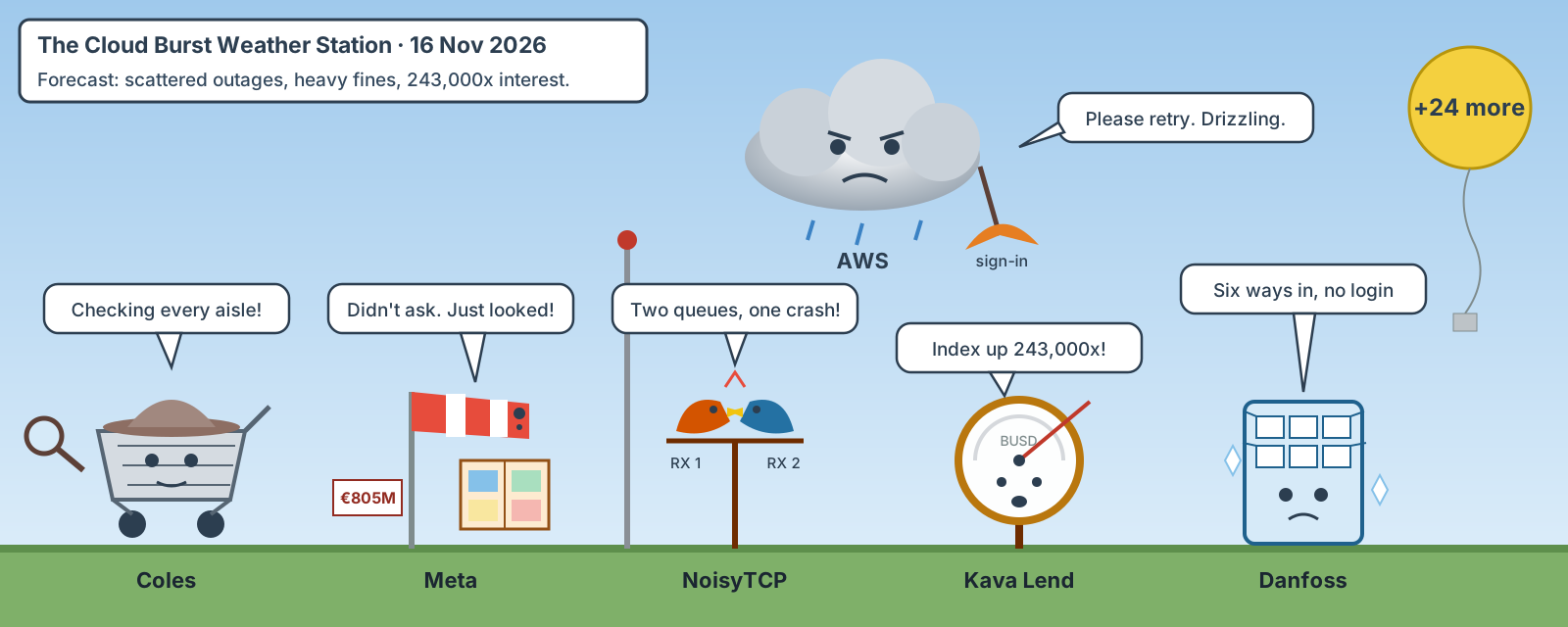
Sunday’s big event was operational, not malicious. For about three hours AWS US-EAST-1 failed IAM Identity Center sign-ins and new sign-ups, and a subset of Network Load Balancers stayed broken longer. Australian supermarket group Coles disclosed a weekend intrusion, Italy’s privacy regulator fined Meta €805 million over Facebook’s Android gallery access, and the NoisyTCP write-up showed that a pre-auth Linux TCP race can crash most multi-queue servers. Kava Lend lost about $3.7 million through a market nobody had used since BUSD stopped minting.
Do today
- Check Point gateways and UnrealIRCd: today is CISA’s KEV deadline for CVE-2026-123039 and CVE-2026-114713. Confirm the Jumbo Hotfix and the 6.2.7.1 hot-patch are actually installed, not just scheduled. (CISA KEV feed)
- Linux servers with multiple RX queues (NoisyTCP, CVE-2026-99288): pick up distribution kernels that carry upstream fix 4e2b3ef19e0e. Container hosts come first, because one panic takes every tenant down. (NoisyTCP write-up, kernel stable commit)
- Danfoss AK-SM800A refrigeration controllers: put every unit behind a VPN or private APN, including units reached through an integrator’s 4G modem. Six pre-auth RCEs are unpatched and the details are withheld for now. (Midnight Blue)
- Cyrus SASL servers: if SRP appears in your mechanism list, remove it. A reported flaw lets anyone log in as any user without a password. (NVD CVE-2026-129483)
- AWS NLBs in use1-az1: if a load balancer misbehaved on Sunday and has targets in only one AZ, follow AWS’s advice: recreate it with targets spread across several AZs. (AWS Health Dashboard)
- Tor relay operators: upgrade to 0.4.9.17. It fixes IPv6 handling in the relay DoS defences while a circuit flood is ongoing. (Tor Project forum)
AI and agent security5 stories
- Forescout: off-the-shelf models found 66 new bugs in embedded TCP/IP stacks for about $2,000 — Forescout’s Vedere Labs re-ran its 2020–21 Project Memoria stack audit using Claude models plus Joern rules. In roughly 90 hours of machine time and human validation it confirmed 99 bugs across 10 stacks. Sixty-six were new, and 52% of the new ones are rated high or critical. Model spend was put at $1,200–$2,300, against about nine months of manual analysis last time. Siemens has issued SSA-333035 for Nucleus NET in building-automation products. Fixes or advisories also exist for Contiki, FNET, PicoTCP, wolfIP and lwIP, Ethernut has not responded, and three proprietary stacks are still under disclosure. The report states its limits: precision ranged from 11% to 70% per stack, logic and state-machine bugs were mostly missed, dynamic testing was supervised, and the time comparison leaves out harness building. Our take: the cost figure matters most for OT owners. Old devices whose vendors no longer exist are now cheap to audit, for defenders and attackers alike. (Forescout research)
- Flowise: subpath imports slip past the Custom Function SSRF guard (CVE-2026-127214) — In Flowise 3.1.4 and earlier, a user who can create or edit chatflows or agentflows can import an allow-listed package by subpath. That yields an HTTP client which skips the deny list, so the user can reach loopback, internal services and cloud metadata endpoints. The VulnCheck advisory names no fixed version. Scores disagree: NVD lists 8.5 (CVSS 3.1, scope changed), while VulnCheck rates it 6.3 under CVSS 4.0. Our take: in most deployments “can edit a flow” covers far more people than “can reach the metadata service”. Block 169.254.169.254 and internal ranges at the egress layer, not in the sandbox. (VulnCheck advisory, NVD CVE-2026-127214)
CVSS 8.5 (v3.1, NVD)CVSS 6.3 (v4.0, VulnCheck)EPSS 0.0019KEV no - agent-device: a
file://URL turns the webopencommand into a file reader (CVE-2026-129130) — Callstack’s agent-device runs a daemon that agents drive over RPC. Up to 0.21.36, the remote input policy did not check URL schemes. An authenticated caller could open a local file in the managed browser and then read it back withsnapshot. The fix is in 0.21.37. The advisory rates it 7.7 High. Our take: this is a common pattern in agent tooling. A “browse” primitive that accepts any scheme is a file-read primitive, so allow-list http and https in every browser-automation tool you expose to a model. (GitHub advisory GHSA-g87j-p64h-w8wc)CVSS 7.7 (v3.1, GHSA)EPSS 0.0034KEV no - pgEdge RAG Server and Go LLM library return pieces of provider API keys in error messages (CVE-2026-125326, CVE-2026-125328) — GitHub reviewed two Moderate advisories on 12 November. When an upstream LLM call fails, both pgEdge components could pass part of the configured provider credential back to the API caller. Neither advisory as listed confirms a fixed version, so check each one before you upgrade. Our take: key fragments help attackers confirm a guess and identify the account. Treat any exposed provider key as rotated-on-suspicion, and set provider-side spending caps. (GHSA-68g8-gh8f-7rhg, GHSA-8835-xmqj-354h)
- IBM App Connect: the operator’s “AI Agent” can log environment details in error messages (CVE-2026-109158) — NVD published the record on 13 November with a 7.5 rating (network, no privileges, confidentiality impact only). It covers App Connect Operator and App Connect Enterprise certified container operands up to 12.21.0, 12.0.28 and 13.6.0, plus several operand builds. IBM’s bulletin is very long and bundles dozens of third-party CVEs. We could not pin down the fixed operator release from the visible text, so treat the fixed version as unconfirmed. Our take: wherever these logs are shipped, check them for secrets before the next upgrade window. (NVD CVE-2026-109158, IBM security bulletin)
CVSS 7.5 (v3.1, NVD)KEV no
Application security5 stories
- Project Zero drops “90+30” and will move to 30-day full disclosure by 2028 — Announced on 13 November, the policy is “Full 90” now, “Full 60” from 2 February 2027 and “Full 30” from 3 January 2028. Each deadline runs from the report date, whatever the patch status. The grace period and the variant rules go, severity no longer affects timing, and Project Zero will no longer wait for vendors to confirm a fix. Bugs exploited in the wild still follow Google’s separate policy. The stated reasoning is AI: attackers now rediscover bugs and diff patches so quickly that patch soak time gives little cover. Our take: the patch gap is now your problem rather than the vendor’s. Time to deploy for browser, mobile and OS updates needs to be days, not a monthly cycle. (Project Zero policy)
- Cyrus SASL: the SRP mechanism reportedly accepts a forced zero secret (CVE-2026-129483) — A researcher’s write-up says the SRP server plugin in cyrus-sasl 2.1.28 and master fails to reject certain client public values. An unauthenticated client can then authenticate as any existing user. SRP is a build-time option and only exposed where the mechanism is offered. Upstream’s response is a commit that deletes the SRP plugin outright, but we could not confirm a tagged release that includes it. Scores differ: VulnCheck’s CNA rating on NVD is 9.1, and the researcher’s own is 9.8. Our take: most distributions don’t ship SRP enabled, but mail and LDAP stacks built from source sometimes do. Check what your servers offer to clients, not just what is installed. (NVD CVE-2026-129483, researcher write-up, cyrus-sasl commit removing SRP)
CVSS 9.1 (v3.1, VulnCheck)EPSS not yet scoredKEV no - Dokploy: ten advisories and a 9.9 command injection that runs as root (CVE-2026-129433) — Dokploy, a self-hosted PaaS, published ten advisories on 12 November. The critical one is an incomplete earlier fix that lets organisation members reach any container through Docker WebSocket handlers. Others cover cross-organisation authorisation gaps, a world-writable
/etc/dokployfrom the installer, and secrets sent in plain text to failure notifications. NVD separately lists CVE-2026-129433: command injection throughserviceNamein scheduled backups, which run as root, fixed in 0.31.1. Our take: on Dokploy, an “organisation member” can become root on the host. Upgrade, then fix the permissions on/etc/dokployand rotate the secrets that went to notification channels. (Dokploy security advisories, NVD CVE-2026-129433)CVSS 9.9 (v3.1, VulnCheck)EPSS 0.0240KEV no - WordPress: AutomatorWP Webhooks and Shipo both let unauthenticated visitors become admin (CVE-2026-126173, CVE-2026-19907) — Wordfence reported both on 14 November and rates each 9.8. AutomatorWP Webhooks up to 1.4.4 can reset any account’s password, including an administrator’s, but only on sites with a particular automation setup. In Shipo 1.6 to 1.8.0 the login cookie’s signature isn’t checked, so knowing a username is enough to impersonate that user. The records don’t state fixed versions, so confirm with the plugin pages. Our take: the AutomatorWP precondition limits exposure. The Shipo bug needs nothing but a username, so patch or deactivate that one first. (NVD CVE-2026-126173, NVD CVE-2026-19907)
CVSS 9.8 (v3.1, Wordfence)EPSS 0.0054 (AutomatorWP)KEV no - Cloud Storage Manager for Fluent Forms: unauthenticated file write to RCE (CVE-2026-120522) — Versions up to 1.2.0 have REST endpoints with no authorisation checks and a path traversal in the Google Drive download routine. Together they let an unauthenticated attacker write a PHP file into the web root. The NVD record links to a plugin changeset but doesn’t name the fixed version. Our take: form plug-ins that talk to cloud storage keep shipping REST routes with no permission callback. Search your plugin directory for
permission_callback => '__return_true'as a quick audit. (NVD CVE-2026-120522, plugin changeset)CVSS 9.8 (v3.1, Wordfence)EPSS 0.0079KEV no
Exploited and critical CVEs5 stories
- KEV: no additions since 13 November; Check Point and UnrealIRCd fall due today — The catalog is still at version 2026.11.13. Today’s deadlines are the Check Point Gaia permission flaw (CVE-2026-123039) and UnrealIRCd delimiter injection (CVE-2026-114713). Both were added with a three-day window. Next come SonicWall SSLVPN CVE-2026-19868 on 20 November, then Outlook, Chrome, Openwave and Cisco BroadWorks on 24 November. Our take: a quiet weekend in the catalog doesn’t mean a quiet weekend for exploitation. Check Point gateways were hit in destructive attacks this month, so verify the hotfix level on every gateway, including lab and DR units. (CISA KEV feed)
- Danfoss AK-SM800A: six pre-auth RCEs in the supermarket controllers attacked across Europe — Midnight Blue found six pre-auth stack overflows in firmware up to and including 5.3.2. They come from unchecked
strcpycalls, and a further overflow in the session-control binary still works with strict mode enabled. CVEs are pending, and the researchers are withholding details during coordinated disclosure with Danfoss. Midnight Blue also argues that patching or strict session control is the wrong first step: the device lacks secure boot, so it says removing exposure matters more. These are the controller types targeted in the October European attack waves. Our take: inventory before patching. Look for units reached through an integrator’s 4G modem, and treat IP allow-lists as a stopgap, which is also how CERT-FR describes them. (Midnight Blue) - DrayTek Vigor2960: six authenticated bugs with public write-ups, fixed in 1.5.1.7 — VulDB published six CVEs for the Vigor2960 on 15 November (CVE-2026-129449 to -129453 and related). They cover command injection, path traversal and a heap overflow in
mainfunction.cgi, scored 9.1 to 9.9. All need a login, and one needs high privileges. The researcher’s case studies are public, and DrayTek’s 1.5.1.7 firmware is listed as the fix. Our take: “authenticated” on an edge router often means the default or a reused admin password. Upgrade, and keep the management interface off the WAN. (NVD CVE-2026-129449, NVD CVE-2026-129453)CVSS 9.9 (v3.1, VulDB)EPSS not yet scoredKEV no - End-of-life routers with public exploits: TRENDnet TEW-657BRM and D-Link DIR-600L and DSL-6740C — VulDB assigned 10.0-rated CVEs over the weekend. They cover two unauthenticated buffer overflows in the TEW-657BRM web server (CVE-2026-129351, -129352), two in the DIR-600L login and HNAP handlers (CVE-2026-129353, -129354) and hard-coded FTP credentials in the DSL-6740C (CVE-2026-129444). Public exploits are noted for most. TRENDnet says the TEW-657BRM is end-of-life. Our take: none of these will be fixed. Replace them, and check guest Wi-Fi and branch closets where old consumer routers tend to survive. (NVD CVE-2026-129351, NVD CVE-2026-129353, NVD CVE-2026-129444)
CVSS 10.0 (v3.1, VulDB)EPSS not yet scoredKEV no - Edimax BR6478ACV2 and Tenda AC18: an unanswered overflow and unsigned firmware updates — CVE-2026-129250 is a remotely triggerable overflow in the Edimax BR6478ACV2’s PPTP setup handler, rated 9.9. A public exploit exists and VulDB says the vendor didn’t respond. CVE-2026-129258 says the Tenda AC18’s
/cgi-bin/upgradeaccepts firmware without checking its authenticity, rated 9.1. Our take: unsigned updates turn any admin-panel compromise into permanent implant persistence. If you can’t replace these devices, at least block admin access from the LAN side for anything but a management VLAN. (NVD CVE-2026-129250, NVD CVE-2026-129258)CVSS 9.9 / 9.1 (v3.1, VulDB)EPSS not yet scoredKEV no
Cloud and infrastructure5 stories
- AWS US-EAST-1: three hours of sign-in, sign-up and load-balancer failures — From 03:05 to 06:10 PST on 15 November, AWS reported errors in IAM Identity Center authentication and AWS Sign-Up. Amazon Connect, Kiro, CloudWatch, Step Functions, NAT Gateway, VPC Lattice, IoT Device Management, OpenSearch and Elastic Load Balancing were all listed as affected. Authentication recovered at 05:20 PST. A subset of Network Load Balancers in one cell of use1-az1 didn’t recover until 06:21 PST, and AWS advised recreating those NLBs with targets in several AZs. AWS has not published a root cause and has given no sign of malicious activity. Our take: if your break-glass path into AWS runs through Identity Center in US-EAST-1, Sunday showed that it can fail. Keep a tested out-of-band admin path, and audit for single-AZ NLBs. (AWS Health Dashboard)
- NoisyTCP: an 11-year-old Linux TCP race lets a remote client panic the kernel (CVE-2026-99288) — Hyunwoo Kim’s write-up describes a lockless established-socket lookup that can return a request socket after it has been freed and reused in another RX context. The result is a NULL dereference and a kernel panic, and a harder variant can produce a use-after-free. The bug dates from a 2015 commit. It hits plain TCP listeners on servers with two or more RX queues or RPS enabled, and in a container it takes down the host. The researcher’s VM tests triggered it in seconds to minutes, against about 14 hours on a quiet bare-metal box. He has only a limited, lab-specific exploit and calls it remote DoS, not RCE. The fix (4e2b3ef19e0e) is in stable trees. NVD hasn’t scored it, and EPSS is low. Temporary mitigations are to turn off SYN cookies per namespace or drop to one RX queue with RPS and RFS off, and both cost something. Our take: hosting providers and Kubernetes nodes have the most to lose. Track your distribution’s kernel advisory rather than using the mitigations. (NoisyTCP write-up, NVD CVE-2026-99288, oss-security post)
CVSS not yet scored (NVD)EPSS 0.0016KEV no - Tor network under a circuit-flood DDoS; 0.4.9.17 hardens relay defences — The Tor Project says a large flood of client circuits has affected most relay operators. Version 0.4.9.17, released 13 November, carries several security fixes, the most important of them for IPv6 handling in the relay DoS defences. Tor is testing further defences and expects more releases. Our take: if your organisation runs relays or onion services, upgrade and watch memory and CPU. If you depend on Tor reachability for research or whistle-blowing intake, expect degraded service this week. (Tor Project forum)
- Istio 1.31.4 and 1.30.8 fix nine mesh bugs, and Google updated its GKE bulletin — ISTIO-SECURITY-2026-009 (6 November, overall 8.2) is headed by an ambient-mode bug that ignored port-level STRICT PeerAuthentication, so plaintext could reach an mTLS-only port. Other fixes cover case-sensitive host conditions in AuthorizationPolicy, a sidecar bypass through a stale conntrack entry,
ipBlocksmatching the internal listener rather than the client IP, and two istiod crash loops. Google updated GCP-2026-080 on 12 November. Our take: theipBlocksissue means DENY rules may have been failing open. Switch toremoteIpBlocksandremote.ipeven after you upgrade. (Istio advisory, Google Cloud security bulletins) - Microsoft Entra Hard Deletion Protection: a seven-day window before key identities can be purged — Now in preview, the feature blocks permanent deletion of protected users, cloud-only groups, applications and service principals for seven days after a soft delete. Agent ID objects are covered through their underlying types. It needs the Entra Backup Administrator role and covers up to 20 objects per operation, and once enabled it can’t be switched off. Our take: this answers the destructive-admin scenario in recent intrusions. Protect break-glass accounts, federation apps and the service principals your CI depends on, and alert on soft deletes in the audit log. (Microsoft Learn)
Crypto and Web35 stories
- Kava Lend: an idle BUSD market turned into about $3.7 million of KAVA borrowing — On 14 November, starting around 04:01 UTC, an attacker pushed Kava Lend’s dormant BUSD market to a near-zero supply. That inflated its interest index about 243,000-fold. The attacker then took 127 KAVA loans in 98 minutes against the inflated collateral, liquidating each one from a second account to dodge the borrow cap. Bitquery counts 55.2 million KAVA borrowed, and DefiLlama, as cited by 0xCERT, counts 53.9 million kept. Both put it near $3.7 million before the price fell. About 49.2 million KAVA was bridged to BNB Chain and sold for roughly $2.09 million. Bitquery says that was about 3,333 BNB plus USDT, while 0xCERT gives 3,006.5 BNB and 231,557 USDT. Relay blocked 612,416 USDT, which is not confirmed as recovered. Kava says the incident is confined to Kava Lend and is not an infinite mint, and has paused its Axelar bridge. No post-mortem or official loss figure has been published. Our take: guard index maths against near-zero denominators, not just zero, and retire markets for dead assets instead of leaving them open. (Bitquery investigation, 0xCERT advisory)
- Pool Party: a snapshot-contract flaw drained 15 pools for about $215,000 — Between 01:34 and 03:38 UTC on 13 November, an attacker altered their recorded position in Pool Party’s snapshot contracts, deposited 10 USDC and withdrew far more. Twelve pools on Arbitrum and three on Base were hit, while Polygon and Robinhood Chain were not. The project says the fix is live on all chains and has offered a 10% bounty, and reports say the proceeds went to XMR. No post-mortem has been published yet. Our take: if your protocol keeps accounting state in a separate contract, test that contract on its own. Any write path a user can reach is part of the attack surface. (SlowMist Hacked database, PandaSecurity write-up)
- Edel Finance: about $300,000 of EDEL tokens stolen and sold — SlowMist’s 12 November entry says roughly $300,000 worth of the project’s own token was taken and dumped on the market, by a method not yet stated. Edel says it is working with authorities and exchanges, some tokens are frozen, and a post-mortem is due. This is separate from Edel’s July lending-protocol exploit, which left about $403,000 of bad debt. Our take: when the root cause isn’t known, assume a key or admin-path compromise, and avoid adding liquidity until the post-mortem is out. (SlowMist Hacked database)
- Luxor: unauthorised access to its fleet software redirected client hashrate — Bitcoin mining firm Luxor says attackers got into its Commander fleet-management software on 14 November and pointed more than a dozen client accounts’ hashrate at another pool. It says it patched within about two hours, restored pool settings and will fully compensate clients. Pool and LuxOS services were unaffected. SlowMist lists the loss as $10,500. Luxor calls the attack AI-enabled but hasn’t explained how AI was used, so treat that as a claim. Our take: the tell for this attack type is a pool-URL change. Alert on configuration drift in miner fleets the way you would on DNS changes. (SlowMist Hacked database, The Block)
- MapleStory Universe: an off-chain server intrusion exposed user data and 328 builder apps — SlowMist records an unauthorised access on 12 November to part of the project’s off-chain server infrastructure. Some user data and information from 328 Builder apps was exposed. The project says contracts and on-chain assets were untouched. It has blocked the access path, replaced the servers and plans to rotate operational keys. Our take: “no assets lost” isn’t the same as “no risk”. Builders whose app data was exposed should rotate their own credentials and expect targeted phishing. (SlowMist Hacked database)
Incidents and industry5 stories
- Coles investigates a weekend cyber incident and says it has found no sign of data theft so far — Coles Group’s update, current as of 8:30am on 16 November, says it is investigating an incident with outside experts and the Australian Cyber Security Centre. It has not identified evidence that customer, team or supplier data was compromised or removed. Stores and online shopping are running, and Flybuys, Coles Plus and gift cards are reported unaffected. A small number of Liquorland click-and-collect orders are failing. Our take: “no evidence so far” in the first 48 hours often changes. Retail and loyalty programmes are prime targets for scams that cite real incidents, so warn customer-facing teams now. (Coles incident update)
- Italy fines Meta €805 million over Facebook’s Android gallery suggestions — The Garante said on 14 November that the Facebook Android app accessed Italian users’ photos, videos and metadata without specific consent. It did so to power a gallery-suggestion feature that was on by default, behind a single bundled permission and a vague notice. The regulator estimates about 20 million affected users. It applied Article 122 of Italy’s Privacy Code (ePrivacy) and rejected Meta’s argument that the Irish authority should lead. Meta says it will appeal and calls the fine disproportionate. Our take: the ruling is that reading on-device data needs consent even when nothing is uploaded. Any mobile app that bundles broad storage permissions should review its consent flow. (Garante press release)
- Keihan: a LINE marketing SaaS breach exposed up to about 224,000 registrations across group accounts — Keihan Holdings said on 14 November that Sonicmoov, which runs the COMSBI SaaS behind several of the group’s official LINE accounts, told it on 11 November about unauthorised access. LINE display names, profile-image URLs and LINE user IDs are exposed for up to about 224,000 registrations, which may include duplicates. Up to 28,000 Keihan Department Store members may also have lost name, phone, email, address, birth date or gender. Card data is not held in the service. Our take: on 5 November ScanNetSecurity reported that a Sonicmoov COMSBI platform had been accessed on 23 October. Whether that was the same SaaS edition Keihan names is unconfirmed, but if it was, Keihan was told nearly three weeks later. Other COMSBI customers may still disclose. (Keihan Holdings notice (Japanese PDF), ScanNetSecurity on the COMSBI intrusion)
- Coinone: intruders reached the exchange’s outsourced customer-support provider — SlowMist records that on 12 November attackers accessed a server at MetaM, which runs Coinone’s customer support. Personal data of users who had contacted support may have been exposed, with the fields varying by person. Coinone says its membership, trading and wallet systems were not affected. It has blocked the related IPs, reported to the authorities and is investigating with the contractor. Our take: support-desk data is ideal for impersonation scams, so Coinone users should expect convincing “support” calls. (SlowMist Hacked database)
- Cynet: fake GTA 6 PC downloads deliver WARDEN Stealer through a Google Colab lure — Ahead of the game’s 19 November console launch (there is no PC version), Cynet followed a Colab notebook advertising a “GTA 6 EXE” to a ZIP. It held a 796 KB loader instead of a 72 MB game, and a README telling users to run it as admin and add an antivirus exclusion. WARDEN steals browser passwords and cookies, Steam and Roblox logins and wallet data, and swaps copied crypto addresses. Cynet lists uroker[.]casa as the probable C2. Our take: block executable downloads from notebook and file-share domains on unmanaged and gaming-adjacent endpoints, and remind staff that any instruction to add an AV exclusion means stop. (Cynet research)
Bottom line
- Resilience was this weekend’s story. An AWS sign-in outage, a Tor DDoS and a remote kernel panic all test the same thing: whether your admin paths and critical services survive one region, one AZ or one kernel bug. Test the break-glass route before you need it.
- Cheap AI auditing and Project Zero’s shorter deadlines point the same way. Bugs in old and embedded code will surface faster than vendors can patch them, so cut exposure first (Danfoss, end-of-life routers) and shorten your own patch gap.
- Third parties keep carrying the breach. Keihan through a LINE marketing SaaS, Coinone through its support contractor, Kava through a market nobody watched. Map which vendors hold customer contact data, and make them tell you within days, not weeks.