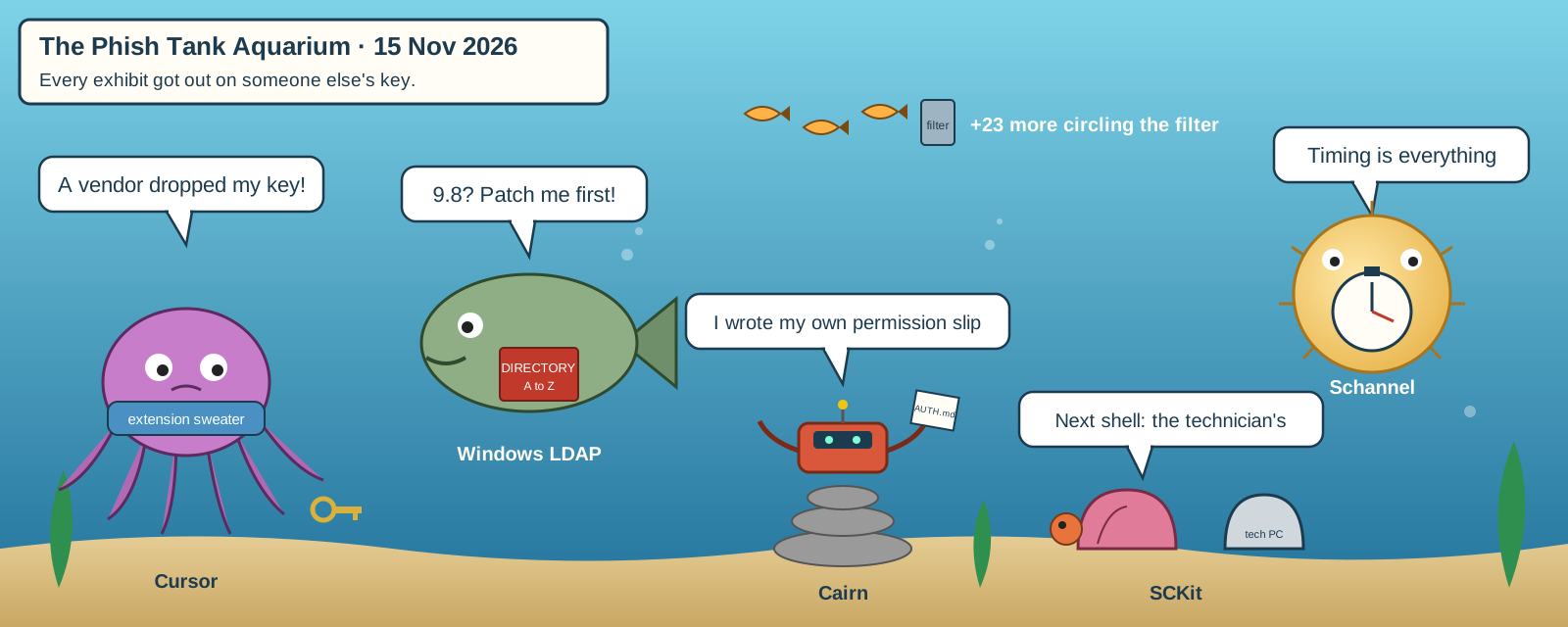
Cursor’s 13 November post-mortem traces the malicious Claude Code extension in its marketplace back to an access key exposed by Fireworks AI, and puts the exposure at up to 5,000 users. November’s Patch Tuesday is still under-read. Its 9.8-rated Windows LDAP bug and a group of unauthenticated network RCEs in Schannel, CredSSP, IIS and Message Queuing aren’t in KEV, but they are what to patch after this week’s exploited items. Unit 42 and Cloudflare both published data this week showing autonomous attack frameworks scanning and breaking into real organisations, mostly through weak identity controls rather than novel exploits.
Do today
- Cursor users of the Claude Code extension: if you installed or updated to Anthropic.claude-code 2.1.312 or 2.1.313 from Cursor’s marketplace on 29 October, follow Cursor’s remediation steps; uninstalling alone may not be enough. Rotate any credentials Cursor told you were exposed. (Cursor incident update)
- Windows domain controllers and LDAP-exposed servers: deploy the 10 November updates for CVE-2026-119958 first. Then do IIS, Message Queuing and RDP/CredSSP hosts. (CVE-2026-119958 record)
- Check Point gateways and UnrealIRCd servers: CISA’s deadline for CVE-2026-123039 and CVE-2026-114713 is tomorrow, Monday 16 November. (CISA KEV feed)
- ScreenConnect MSPs investigating SCKit: include every technician workstation that connected to an affected endpoint, check technician client versions separately from the console, and revoke sessions as well as changing passwords. (Microsoft Threat Intelligence on SCKit)
- Public GitHub repositories using
pull_request_target: GitHub’s second brownout runs Monday 16 November, 16:00–18:00 UTC. Workflows without an allowing event policy will fail then, and from 2 December for good. (GitHub changelog) - Developer machines: search lockfiles and global installs for
zread_cliand@zread/cli-*. Treat any machine that has them as compromised. (GitHub advisory GHSA-3429-mj25-c5wf)
AI and agent security5 stories
- Cursor post-mortem: a Fireworks-exposed key led to agent traces, SaaS data and a backdoored Claude Code extension — Cursor’s 13 November report is new since the initial notices of 29–30 October, and it gives the first full chain. An attacker used an access key that Cursor had issued to Fireworks, and that Fireworks exposed, to copy a read-only bucket of coding-agent traces, mostly from 2025. Some traces held unredacted credentials, which led into SaaS tools holding archived non-production repositories, support data and secrets that customers had sent to support. On 29 October a stolen credential let the attacker place malicious copies of Anthropic.claude-code 2.1.312 and 2.1.313 on the cache behind Cursor’s VS Code marketplace for about 11 hours. Up to 5,000 users may have received them. Cursor says the flaw was not in Anthropic’s product, Open VSX was never affected, last attacker activity was on 1 November, and inference has moved off Fireworks. Our take: agent traces are a credential store nobody planned for. Scrub secrets from prompts and traces before they leave the developer, and don’t rely on telemetry opt-outs alone. (Cursor incident update; Wiz on the wider “Black October” campaign)
- Unit 42: a China-nexus cluster ran the open-source Cairn framework against 19 organisations and got into 10 — Unit 42’s 12 November report tracks CL-STA-1238, assessed with moderate confidence as China-nexus intelligence collection, across 25 operations in August and September. Targets were in semiconductor supply chains, defence and policy, and civil society. A customised Cairn fork chose and executed each step with Zhipu GLM 5.2 or DeepSeek V4. A Chinese-language authorisation preamble and a generated AUTHORIZATION.md file meant neither model refused. Initial access came from password spraying, default credentials, IDOR, mass assignment, exposed cloud APIs and old CVEs, not new exploits. Unit 42 lists 154.44.31[.]4 (Cairn hosting) and 82.29.129[.]54 (staging and egress) as indicators. Our take: AI raised the volume of attacks, not their difficulty. Identity hygiene and attack-surface reduction still stop most of this. (Unit 42 report)
- Microsoft: poisoning about 1% of post-training data plants a backdoor in coding agents — Two Microsoft studies published 12 November show models that behave normally until a benign trigger, such as a request to write project documentation, makes them misuse a command-execution tool. Mixing 90 poisoned examples into about 9,000 terminal-agent conversations gave unsafe actions in about 78% of trials on harnesses seen in training. In poisoned open-weight Qwen3.5 checkpoints, attack success on unseen repositories reached 84–95%, and it transferred across agent harnesses. Microsoft also found rows in a popular public dataset that pair benign requests with tool calls that fetch and run remote scripts; their intent is unknown. Our take: treat fine-tuning datasets and checkpoints as dependencies. Pin them by hash, test in the exact production harness, and enforce authorisation at the tool layer, because benchmarks won’t reveal conditional behaviour. (Microsoft Security blog)
- Unit 42 counts 609 internet-facing ARTEX hosts and 1,323 running CyberStrikeAI — Following the FBI flash covered yesterday, Unit 42’s 11 November defender guide adds measurements. Counts are as of October; it analysed 14 tools in this ecosystem. In some cases operators went from public password-reset pages and exposed APIs to cloud access in under a day without exploiting a vulnerability. Behavioural tells include bursts of requests that pause while the model thinks, about 200 client secrets validated in roughly three minutes, and pivots within a minute of a credential download. Our take: hunt on behaviour, such as a cloud key’s first use from a new IP or write-then-delete storage tests. ARTEX forks rotate infrastructure faster than indicator feeds update. (Unit 42 guide)
- Wiz Cyber Model Arena: the harness moves agent scores as much as the model does — Wiz’s 10 November benchmark covers 59 agents built from 26 models and four general-purpose harnesses, run on 327 offensive challenges. Average pass@1 was 78% on API security, 65% on web, 57% on cloud and 38% on code vulnerabilities. One agent scored 72% on API tasks but 10% on code. The same model averaged a 5.1-point gap between harnesses. Wiz lists its own limitations: only four simple harnesses, string-match grading, possible training-data contamination and no published confidence intervals yet. Our take: when you evaluate AI security tooling, test the full system on your own task mix. Headline leaderboard numbers come from a vendor and have wide error bars. (Wiz benchmark post)
Application security5 stories
- npm:
zread_cliand six@zread/cli-*platform packages flagged as malware — GitHub’s advisory database markedzread_cliand its Linux, macOS and Windows binary packages as malicious on 13 November. Every version is listed as affected and none is patched. The advisories don’t say whether a legitimate tool was hijacked or the packages were malicious from the start, and they don’t describe the payload. Their guidance is the standard one: treat the machine as fully compromised, and rotate secrets from a different machine. Our take: per-platform binary packages are an easy hiding place, because developers rarely inspectoptionalDependencies. Include them in allowlists and SBOM review. (GHSA-3429-mj25-c5wf; GHSA-rmrw-hx84-5hgq for the linux-x64 package) - OpenTelemetry Python and Go: denial-of-service bugs in trace-context and baggage parsing (CVE-2026-126360, CVE-2026-128086) —
opentelemetry-api1.45.2 fixes quadratic-time regex backtracking inTraceContextTextMapPropagator.extract(). The advisory says the payload can also arrive in carriers that aren’t HTTP headers, such as MCPparams._meta. OpenTelemetry-Go 1.47.0 stops the baggage parser from building property objects up front; an 8 KB header caused about 778 KB of allocation per parse. That advisory calls it allocation amplification and doesn’t claim a confirmed out-of-memory or denial of service. Both were published by the projects in late October or early November and reached GitHub’s database on 13 November. Our take: propagation parsing runs before authentication on almost every instrumented service, so roll these into the next dependency bump. They are moderate-severity bugs, not emergencies. (GHSA-mf5v-w3w3-f6cg; GHSA-rrfc-gjm9-cgrj)CVSS 5.3 (v3.1, GHSA, both)EPSS 0.00519 / 0.00436KEV no - Soup Sieve 3.0.2: a 57-byte CSS selector takes about 10 seconds to compile (CVE-2026-126191) — Soup Sieve’s identifier regex backtracks exponentially on long runs of digit escapes. The regex runs before the selector-length guard, so
soupsieve.compile()and BeautifulSoup’s.select()can both reach it. Versions 2.10 and earlier are affected. The first fix, 3.0.0, was yanked from PyPI, so the target is 3.0.2. Our take: this only matters if users can supply selectors, as in scraping-as-a-service or rule builders. If they can, upgrade, and put a timeout around selector compilation as well. (GHSA-6655-6qjp-jx7x)CVSS 7.5 (v3.1, GHSA)EPSS 0.00434KEV no - AutoMapper: MaxDepth is ignored when mapping through constructors (CVE-2026-128082) — Deeply nested input mapped into positional records or other constructor-mapped types recursed without limit and crashed .NET processes with a stack overflow. That also defeated the earlier fix for CVE-2026-32933. Versions 16.3.0 and 15.1.4 count depth before construction. There is no workaround for positional records other than upgrading or capping input depth. The project published the fix on 5 November and GitHub added it on 13 November. Our take: if you map request DTOs with AutoMapper, upgrade. Process crashes in .NET APIs are a cheap denial of service. (GHSA-6vhm-j9h7-f9gh)
CVSS 7.5 (v3.1, GHSA)EPSS 0.00663KEV no - Tornado 6.6.1: the 6.6.0 open-redirect fix missed triple-slash paths (CVE-2026-126347) —
RedirectHandlerin Tornado 6.6.0 and earlier can still send browsers off-site, because browsers parse a three-slash path differently from Python’surllib. Version 6.6.1, published 9 November, tightens the check and fixes a regression introduced in 6.6.0. Our take: the severity is low, but open redirects are popular in OAuth and phishing chains. If Tornado sits in front of a login flow, upgrade. (GHSA-5cjw-f85j-cv6r)CVSS 3.1 (v3.1, GHSA)EPSS 0.00163KEV no
Exploited and critical CVEs5 stories
- KEV: no additions since 13 November, and four deadlines this week — The catalog is still at version 2026.11.13. Check Point CVE-2026-123039 and UnrealIRCd CVE-2026-114713 are due Monday 16 November. Apple CVE-2024-27834 is due 18 November and SonicWall SSLVPN CVE-2026-19868 on 20 November. Outlook CVE-2026-124194, Chromium CVE-2026-125350, Cisco BroadWorks CVE-2026-20320 and Openwave CVE-2026-111793 follow on 24 November. Our take: the Check Point root escalation is the urgent one, because it is being chained with PHP2Shell to wipe ESXi hosts. A gateway still unpatched on Monday should be assumed compromised and checked for compromise, not just patched. (CISA KEV feed)
- Windows LDAP: unauthenticated out-of-bounds write rated 9.8 (CVE-2026-119958) — Fixed on 10 November, this bug lets an unauthenticated attacker reach code execution over the network through LDAP. Microsoft’s CVE record scores it 9.8 with low attack complexity. It is not in KEV. Its EPSS of 1.3% is the highest of this month’s network-reachable Windows criticals that we checked. Sources disagree on the size of the release (Tenable counts 1,093 CVEs, other tallies 1,094 or 1,235), but not on this one. Our take: every domain controller exposes LDAP. Patch DCs in this cycle, and keep LDAP and LDAPS off the internet and away from untrusted segments. (CVE-2026-119958 record; MSRC entry)
CVSS 9.8 (v3.1, Microsoft)EPSS 0.01279KEV no - Schannel and CredSSP: two unauthenticated network RCEs rated 8.1 (CVE-2026-119952, CVE-2026-119962) — Microsoft describes the Schannel bug as an observable timing discrepancy (CWE-208) that can lead to code execution. Weakness and impact rarely pair like that, so read the MSRC entry before ranking it. The CredSSP flaw is a double free in the protocol used by RDP and other delegated logons. Both are rated high attack complexity, and fixed builds start at 10.0.26100.9974 for Windows 11 24H2 and 10.0.20348.5870 for Server 2022. Neither is in KEV. Our take: Schannel sits behind nearly every TLS listener on Windows, and CredSSP behind every exposed RDP host. They belong in this month’s cycle, not an emergency window. (CVE-2026-119952 record; CVE-2026-119962 record)
CVSS 8.1 / 8.1 (v3.1, Microsoft)EPSS 0.00877 / 0.00857KEV no - IIS and Message Queuing: unauthenticated RCEs that need a race or a double free (CVE-2026-119961, CVE-2026-119963) — The IIS bug is a race condition leading to use-after-free. The Message Queuing bug is a double free reachable without authentication, and Qualys lists a sibling, CVE-2026-119964, that we didn’t check separately. Both are rated 8.1 for high attack complexity, and neither is in KEV. Our take: MSMQ keeps turning up on servers that don’t need it. Find TCP 1801 listeners and disable the service where nothing uses it, then patch IIS front ends in the normal cycle. (CVE-2026-119961 record; CVE-2026-119963 record; Qualys Patch Tuesday review)
CVSS 8.1 / 8.1 (v3.1, Microsoft)EPSS 0.00554 / 0.00857KEV no - Office and Outlook: heap overflows that need a user to open a file (CVE-2026-120003, CVE-2026-110043) — Both are rated 8.8 with user interaction required. The CVE records don’t say whether the preview pane is an attack vector, so we can’t confirm that. They are separate from the exploited Outlook NTLM-leak zero-day (CVE-2026-124194) covered on 11 November, which is due in KEV on 24 November. Our take: the Office build that fixes the zero-day also fixes these, so one Microsoft 365 Apps rollout covers all three. Check that update rings have actually moved. (CVE-2026-120003 record; CVE-2026-110043 record)
CVSS 8.8 / 8.8 (v3.1, Microsoft)EPSS 0.00977 / 0.01079KEV no
Cloud and infrastructure5 stories
- Microsoft confirms SCKit and shows it spreading to technicians who connect for support — Following up on the ScreenConnect story covered on 13 November, Microsoft Threat Intelligence’s 13 November write-up confirms ConnectWise’s report and adds detail. A component called RelayTrap reuses each endpoint’s ScreenConnect client to push the launcher to technicians who connect in. The toolkit steals
.ASPXAUTHsession cookies from Chromium-family browsers and uses the ScreenConnect Shared Toolbox to reach other sessions. It also adds Defender exclusions, and its own cleanup script can reinstall it. Microsoft lists ns.mo7sen[.]dev, sc.payproofkit[.]com and cdn007-digitaldownloads[.]com among its indicators and publishes six hunting queries. ConnectWise says client 26.6.5 and later blocks the transfer to technicians, but console updates don’t update technician clients. Our take: the incident scope is the MSP’s technician fleet, not only customer endpoints. Rebuild where integrity is in doubt, and don’t use the attacker’s cleanup script. (Microsoft Threat Intelligence on SCKit) - Cloudflare: AI pentest orchestrator traffic is up about 30-fold since 1 October, and stolen CI tokens carry it into accounts — Cloudflare saw more than 50 framework families scan its customers in three days. ARTEX and its forks made up over 60% of known orchestrator traffic, despite the original repository being withdrawn on 8 October. In incidents it investigated, long-lived CI/CD tokens let attackers move from a hyperscaler environment into Cloudflare accounts. One unrestricted account-level API token produced about 400 database dump requests in an hour and new Worker scripts prefixed “artex-”. Our take: give every API token an expiry, IP restrictions and the narrowest scope it needs. Alert on bursts of newly created Worker scripts. (Cloudflare blog)
- Apple documents Secure Exclaves, the isolated runtimes behind camera and microphone indicators — Apple Security Research’s 12 November post describes runtimes built on a capability-based L4-derived microkernel. They process ambient-sensing audio and video and pass only results, such as a person identifier, to the main OS. A dedicated exclave releases full sensor data only after the recording indicator has been visible long enough, and on iPhone another exclave checks the indicator pixels that were actually drawn. Apple says formal verification in Isabelle/HOL found flaws that could have led to full kernel compromise, but it does not claim complete coverage. Our take: this moves the privacy indicator outside a compromised kernel’s reach on supported devices. That raises the bar for camera and microphone spyware, though vendor architecture papers aren’t independent assurance. (Apple Security Research)
- Windows Server: SQL Server linked-server connections leak after the October updates, and an out-of-band fix is coming — Microsoft’s release health page, updated 11 November, confirms that after KB5127648 and later updates, OLE DB linked-server queries to Oracle, PostgreSQL and other external databases can leave connections open until the server slows down. The affected list runs from Windows Server 2012 to 2025. Mitigation goes through Microsoft Support for business, and an out-of-band update is promised “in the next few days”. Our take: this isn’t a vulnerability, but it can push database teams to defer security updates. Watch connection counts and don’t roll back the November security fixes. (Windows release health)
- Cloudflare adds hard spending caps for Workers and Durable Objects — Spend Management, in beta for pay-as-you-go accounts since 13 November, adds alert thresholds and a hard limit that pauses the product when reached, with an audit log of changes. Cloudflare’s stated reason is runaway usage, including AI agents stuck in loops, not stolen credentials. Our take: a cap can’t stop a token being abused, but it limits the bill when one is. That matters now that LLMjacking-style cost attacks are routine, so set limits on any account that runs agents. (Cloudflare blog)
Crypto and Web33 stories
- South Korea will let exchanges freeze withdrawals on suspicion of a hack — The Financial Services Commission said on 12 November that it will issue a no-action letter. Exchanges could then suspend deposits and withdrawals pre-emptively when a hack is suspected; current law allows this only once a hack is evident. Exchanges that can’t monitor around the clock must limit transfers to staffed hours and tell users in advance. Hot-wallet balances should be kept minimal and spread across wallets, and insurance and reserves increased. The FSC also notes that only 5 of 28 operators belong to the Financial Security Institute. No losses are involved. Our take: freezing transfers before a breach is confirmed is the control that might have limited several of this year’s hot-wallet drains. Expect other regulators to copy it. (FSC press release)
- MEXC: FinCEN’s transfer ban is published and takes effect around 10 December — New since we covered the order on 7 November: the Section 9714 order was scheduled for Federal Register publication on 10 November, as document 2026-22962. That fixes the effective date about 30 days later. Chainalysis gives 10 December, a date we couldn’t confirm in the order text itself. Treasury’s findings are unchanged: at least $16 billion of illicit-linked flows from May 2021 to May 2026, about $1.5 billion of it Russia-linked and about $1 billion with more than 40 Iranian exchangers. US-based MEXC entities are outside the order. Our take: US-connected exchanges, OTC desks and payment firms have under four weeks to stop processing transfers to and from MEXC Global. (Treasury release; Federal Register public-inspection copy; Chainalysis summary)
- PyPI: Gate.io-style SDK names and a Trezor-themed package flagged as malicious — OpenSSF’s malicious-packages feed, mirrored in GitHub’s advisory database on 14–15 November, flagged
gateio-v4,gateio-client,gateio-ws,gateio-sdkandtrezortranslate. Each runs code at install time that sends host details such as IP and username. The entries classify them as probable pentest or dependency-confusion probes, not wallet stealers, and none of them claims a link to Gate or Trezor. No loss is reported. Our take: trading bots and wallet tools are what these names target. Pin exchange SDKs to the vendor’s documented package name, and blocksetup.pyinstall hooks in CI where you can. (GHSA-8chm-xj53-hg7h for gateio-v4; GHSA-9fc6-4mrc-h6pp for trezortranslate)
Incidents and industry5 stories
- KrebsOnSecurity names a suspected Qilin administrator — The 11 November investigation ties the administrator handle “Haise” to a 36-year-old Russian national. It uses a 2022 RAMP forum application, reused handles and email addresses, a leaked government-services database, and stylometric analysis by a third-party firm. Krebs says the named man couldn’t be reached and that this is not a law-enforcement finding. NCC Group calls Qilin the most active ransomware-as-a-service operation, with at least 365 claimed victims in three months. Our take: attribution like this rarely stops an operation, but it can come before sanctions or indictments. Don’t let a named operator change your Qilin playbook, which still starts with VPN and edge-device credentials. (KrebsOnSecurity)
- Vanderbilt forces a university-wide password reset as most systems return — New since the incident was covered on 10 November: on 12 November Vanderbilt required every community member to reset their password. By 13 November, Oracle, Salesforce and most other systems were back, but OneDrive, SharePoint and Box were still disabled. The university still says only that it is working out what data, “if any,” was accessed. It also confirmed that the 12 November Microsoft 365 outage was unrelated. Our take: a forced reset of all passwords plus disabled cloud storage suggests the university assumes credentials and tokens are compromised. Peer institutions should check for the same identity exposure. (Vanderbilt incident updates)
- Bundestag gives German intelligence agencies hacking and sabotage powers — Passed on 13 November by 308 votes to 190, with 71 abstentions, the law lets the BND act against foreign threats, including shutting down servers run by state hacker groups. The BfV gets narrower covert intervention powers. Both agencies can access threat actors’ IT systems, use AI and biometric matching, and order telecom providers to preserve traffic data. Hacking operations need prior approval from an expanded Independent Control Council. Our take: this is one of the clearest legal bases in Europe for state-led disruption of attacker infrastructure. Expect more takedowns of infrastructure aimed at Germany, and more legal challenges. (Bundestag report)
- UK ICO data: a record quarter for reported cyber incidents, while ransomware reports fall — The ICO’s incident dataset, updated to Q3 2026 on 26 October, underlies The Record’s 13 November analysis. That analysis finds 1,371 cyber incidents reported in July–September, the most in any quarter, against 102 ransomware reports. Most of the growth is in the catch-all “other” category, which fits a shift to data-theft extortion. Retail and manufacturing rose from 205 to 296 reports, and charities from 79 to 145. The ICO opened investigations into 18 of the 1,371. Our take: reported ransomware is falling while extortion without encryption rises. Detecting exfiltration is now worth as much as backups. (ICO incident trends; The Record analysis)
- New York City Council bans surveillance pricing — Introduction 891-A bars companies from using New Yorkers’ personal data and algorithms to set individual prices. The Department of Consumer and Worker Protection can fine up to $1,000 per violation, counting each affected consumer or transaction separately. Transparent discounts and loyalty programmes are exempt. The Record reports a 44–5 vote on 12 November, which makes New York the second US city with such a ban after Seattle. Our take: rules like this turn pricing models into regulated personal-data processing. Privacy and data teams should map which customer attributes feed price-setting systems. (NYC Council release; The Record)
Bottom line
- Cursor’s post-mortem shows that coding-agent traces and vendor-held keys are now part of the software supply chain. Scrub secrets before they reach an AI vendor, and check marketplace extension versions against the publisher’s.
- November’s Windows patches contain more network-reachable RCEs than the Outlook zero-day suggested. Patch domain controllers for the 9.8 LDAP bug in this cycle and clear Monday’s Check Point and UnrealIRCd KEV deadline first.
- Unit 42 and Cloudflare data agree that autonomous attack frameworks mostly win through exposed APIs, weak resets and long-lived tokens. Shorter token lifetimes, phishing-resistant MFA and behaviour-based hunting do more than any AI-specific product.