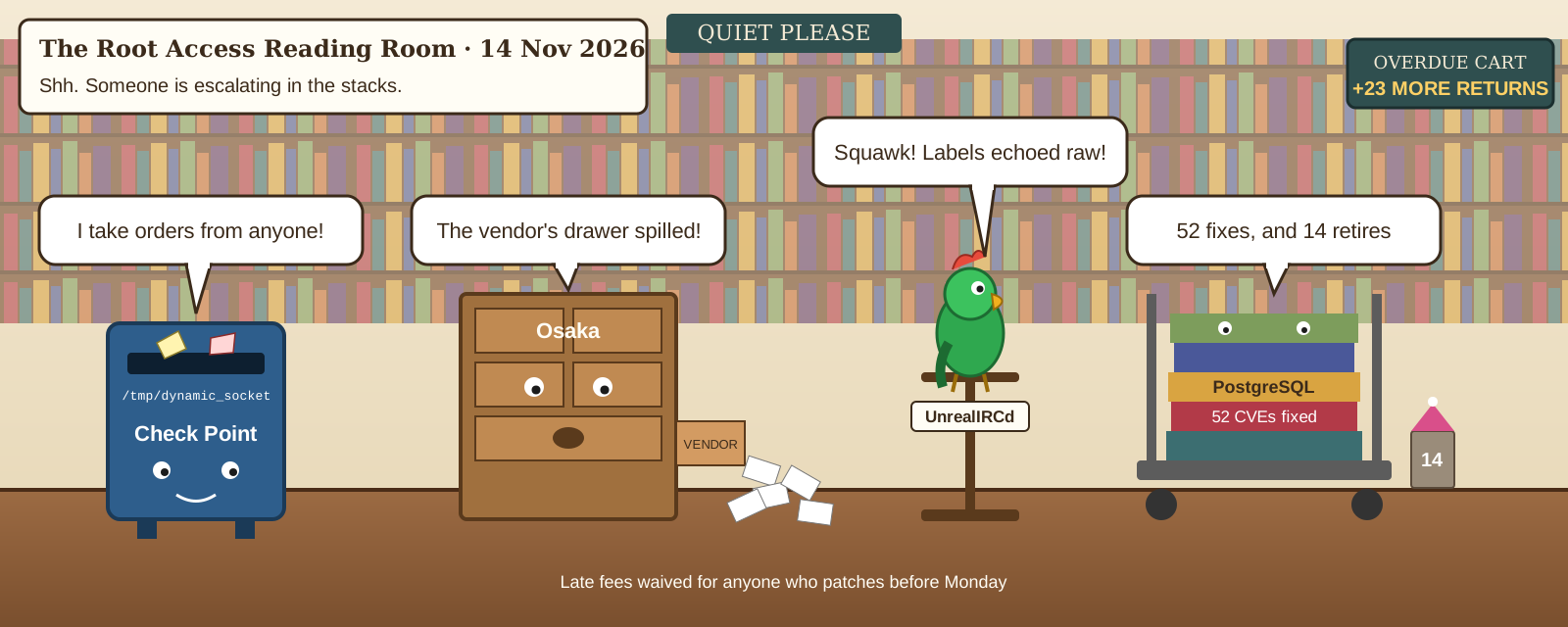
Check Point has patched a Gaia OS root escalation that attackers chained with PHP2Shell to take over Mobile Access gateways and wipe VMware ESXi hosts, and CISA put it in KEV on Friday alongside an UnrealIRCd bug, both due Monday 16 November. Osaka says more than 1.07 million email addresses leaked through a vendor’s mail service, PostgreSQL shipped 52 fixes and retired version 14, and Trezor confirmed hardware implants in wallets from a former Southeast Asian reseller.
Do today
- Check Point Security Gateway and Management (R81.20–R82.20): install the Jumbo Hotfix take listed in sk1000362 for CVE-2026-123039. Where you can’t patch yet, use Check Point’s workaround and disable the
dynamic_serverprocess. Then hunt Mobile Access portals for the webshells, TSGA and TSProxy implants Check Point describes. (Check Point sk1000362, Check Point Research) - UnrealIRCd 6: apply the 6.2.7.1 hot-patch or upgrade. CISA lists CVE-2026-114713 as exploited and due 16 November. (UnrealIRCd, CVE record)
- PostgreSQL: move to 18.7, 17.12, 16.16 or 15.20, and rebuild C-language extensions at the same time. Version 14 has had its last release. (PostgreSQL release)
- Visual Studio Code: update to 1.145.3 or later for CVE-2026-120779, a 9.6 code-injection bug. (CVE record)
- Trezor wallets bought from CryptoBilis: update to firmware 2.13.1, then move funds to a new wallet with a new recovery phrase. The update can’t protect a phrase that was already captured. (Trezor investigation)
AI and agent security5 stories
- FBI issues a FLASH on the ARTEX autonomous attack framework — IC3 published FLASH-20261113-001, “Threat Overview of ARTEX Autonomous Penetration Testing Framework”, on 13 November with an IOC file. ARTEX has appeared on this page all week, and this is the first formal FBI alert about it. The Record reports the alert says some intrusions reached privileged access in under three hours and that DeepSeek models dominate in attacker-run instances. We couldn’t extract the PDF’s text, so treat those details as unconfirmed. Exposure counts differ by source. Censys counted 1,465 hosts with an exposed console in early November, and The Record cites more than 1,600. Our take: load the FBI IOC file and add Censys’s console fingerprints (default port 8787) to your hunts. Partner portals and legacy integrations are the soft targets named in reporting. (IC3 FLASH-20261113-001, IC3 IOC file, Censys ARC, The Record)
- Visual Studio Code: 9.6-rated code injection fixed in 1.145.3 (CVE-2026-120779) — Microsoft’s CVE record, published 10 November, covers VS Code from 1.0.0 up to 1.145.3. It describes unauthenticated network code execution that needs user interaction, with a scope change. The record says the exploit maturity is unproven. Secondary reports tie this CVE to connecting to a malicious remote MCP server. Microsoft’s record doesn’t say that, so treat the MCP angle as unconfirmed. Our take: editors now auto-update in most fleets, but pinned or offline installs, and forks that lag upstream, deserve a check.
CVSS 9.6 (v3.1, Microsoft)EPSS 0.0064KEV no(CVE record) - MCP Server for WordPress plugin: subscriber-to-admin privilege escalation (CVE-2026-121576) — Patchstack’s record, published 9 November, says the AtlasAiDev “MCP Server for WordPress” plugin (
ai-workflow-automation-ai-agent-hub) assigns privileges incorrectly up to 2.0.1. Any authenticated low-privilege user can escalate, and 2.0.2 is unaffected. Plugins that bolt an agent interface onto a CMS are a new class of privileged endpoint, and they inherit WordPress’s habit of open registration. Our take: update, and look for MCP-style plugins that site owners installed without review.CVSS 8.8 (v3.1, Patchstack)EPSS 0.0031KEV no(CVE record) - Darktrace: shared agent memory as a covert C2 channel — In a lab, Darktrace used Claude’s memory stores as a dead drop. A compromised Claude Code session read queued jobs from one memory file and wrote results to another, and data left through the Files API, so every packet went to the AI vendor’s API. The test agent mapped a simulated AD network and sprayed a password against the domain controller. Darktrace says the technique needs an existing foothold plus the user’s Claude Console credentials. It relies on no platform vulnerability and hasn’t been seen in the wild. Our take: this is living off the land for agents. Egress allow-lists won’t catch it, so baseline what your agent harnesses run and how much data they upload, and treat AI API keys as remote-access credentials. (Darktrace)
- Anthropic offers self-hosted Claude Managed Agents in private beta — Announced 12 November, the option moves the harness, sandboxes, credential vaults and session history into the customer’s cloud or data centre. Model calls can still go to Anthropic, a cloud provider or a customer gateway. Credentials stay outside the sandbox and are attached by a proxy for MCP and supported API calls. Every tool call is logged and can be exported over OpenTelemetry. Our take: vendor architecture claims, not an audit. The useful part for defenders is per-step logs you own, which helps with exactly the agent-abuse pattern Darktrace describes above. (Claude announcement)
Application security5 stories
- Nuxt: a leading
//bypasses server middleware and route rules on page routes (CVE-2026-128077) — From 4.6.0, a request such as//x/adminrenders the/adminpage, while Nitro’s route rules andserver/middlewaresee a different path and skip their checks. GitHub’s advisory says this is an incomplete fix for GHSA-9v7c-q64q-vv33, which covered dot segments in 4.6.3.@nuxt/nitro-server4.6.4 fixes it. API handlers,definePageMetamiddleware and Nuxt 3.x are not affected. Our take: if auth guards live in server middleware, patch now or collapse repeated slashes at the proxy.CVSS 6.5 (v3.1, GHSA)EPSS not yet scoredKEV no(GHSA-r99w-jh2x-3mg9) - NLTK: a batch of DoS and sandbox-escape advisories, with a fix status in question — GitHub reviewed about ten NLTK advisories on 13–14 November. Most are quadratic-time CPU denial of service in parsers and tokenizers. The most serious, CVE-2026-126304, lets a symlinked
psdorposdirectory in a crafted YCOE corpus read other content inside the NLTK data sandbox. The advisory header lists 3.10.4 as patched, but a note in the same advisory says a related fix was still an open pull request. Our take: NLTK often sits in RAG and data-prep pipelines that process untrusted text. Upgrade, and don’t load corpora from untrusted sources.CVSS 7.5 (v3.1, GHSA, CVE-2026-126304)EPSS 0.0052KEV no(GHSA-qg35-44qx-7vrr, GitHub reviewed advisories) - SvelteKit adapters: four advisories, including redirect-rule injection on Cloudflare (CVE-2026-128122) — If an attacker can influence the links crawled during prerendering,
@sveltejs/adapter-cloudflarecan write their entries into the generated_redirectsfile. It’s fixed in 7.2.10 and 8.0.2. The same batch fixes prerendered paths being read as regular expressions in Vercel route config (CVE-2026-128121) and two adapter-node crashes (CVE-2026-128117, CVE-2026-128123). Our take: the build pipeline is the attack surface here. User-controlled content that gets prerendered can change your edge routing.CVSS 5.9 (v3.1, GHSA, CVE-2026-128122)EPSS not yet scoredKEV no(GHSA-5wg4-q3ww-283h) - OpenTelemetry JS: inbound spans exported signed-URL secrets in plaintext (CVE-2026-128080) —
@opentelemetry/instrumentation-http0.204.0 to before 0.222.0 redacted sensitive query parameters only on client spans. Server spans wrote the raw query string, including S3 presigned signatures, Azure SASsigvalues and GCS signatures, tourl.query. 0.222.0 redacts them by default and addsredactedQueryParamsServer. Our take: anyone with read access to your tracing backend may have live cloud signatures. Upgrade, then purge or restrict historical spans.CVSS 5.8 (v3.1, GHSA)EPSS not yet scoredKEV no(GHSA-3v2p-hm54-8qcq) - dnspython 2.9.2: a crafted WKS record can exhaust memory (CVE-2026-128089) —
from_text()never checked that a WKS service number fits in 0–65535, then used it to size a bitmap. A malicious zone file can therefore force huge allocations and crash the process. It only matters where untrusted input controls zone-file text, such as DNS management panels or tooling that imports customer zones. Our take: routine upgrade unless you parse customer zone files.CVSS 7.5 (v3.1, GHSA)EPSS not yet scoredKEV no(GHSA-vvf4-9x63-8xvv)
Exploited and critical CVEs5 stories
- Check Point Gaia: exploited root escalation via the DynamicCLI socket, now in KEV (CVE-2026-123039) — The
dynamic_serverdaemon runs as root and accepts commands on the world-writable/tmp/dynamic_socketwithout authenticating the caller. Any local foothold therefore becomes root. Check Point says it has seen active exploitation against “a couple of dozen customers.” The fixes are Jumbo Hotfix R82.20 Take 14, R82.10 Take 52, R82 Take 132 and R81.20 Take 174 or later. R81.10 and R81 are end of support with no fix listed, and Spark and Smart-1 Cloud are not affected. The CVE record’s affected-take ranges don’t line up exactly with those fixed takes, so go by sk1000362. CISA added it to KEV on 13 November with a 16 November deadline. Our take: on its own this is “only” a local bug, but it was the second stage of the PHP2Shell chain below. EPSS badly understates it.CVSS 7.8 (v3.1, Check Point)EPSS 0.0127KEV yes (due 16 Nov)(Check Point sk1000362, CVE record, CISA KEV feed) - Check Point Research: PHP2Shell, root, then an ESXi wiper on Israeli targets — Check Point Research says that from 30 October, attackers used the PHP2Shell bugs (CVE-2026-109618/109619) against unpatched Mobile Access portals, apparently on R81.20. They escalated to root with CVE-2026-123039 and planted PHP webshells plus the TSGA backdoor and its TSProxy library. They then moved to a VMware ESXi host over SSH as
vpxuserand ran thedestroy_v6wiper. A first wave hit Israeli organisations, some destructively. A second wave on 2 November spread across countries and sectors without destruction. Check Point links the implants to the PhiliKit family, which ESET ties to China-nexus UNC5221. It explicitly declines a confident attribution and lists a false flag or a smokescreen among the possibilities. Check Point published SHA-256 hashes and the IPs 130.94.19[.]204 and 130.94.19[.]168. Our take: if your gateway’s Mobile Access portal was exposed and unpatched in late October, assume compromise, and check ESXi hosts reachable withvpxusercredentials. (Check Point Research) - UnrealIRCd: label-tag injection gives any user server authority, now in KEV (CVE-2026-114713) — The labeled-response module echoed the IRCv3
labeltag into replies without escaping it. On networks with two or more linked servers, any user could inject server-to-server commands. UnrealIRCd 6.2.7.1, released 7 November with a hot-patch, fixes this and eight other issues. CISA added it to KEV on 13 November, due 16 November. The CVE record says the bug starts at 6.0.0, but its structured version data has no lower bound. The project calls it critical, while the CVE record scores it 8.6. Our take: niche, but IRC still runs botnet C2, open-source communities and some internal ops chat. The hot-patch applies without a restart.CVSS 8.6 (v3.1, MITRE CNA)EPSS 0.0030KEV yes (due 16 Nov)(UnrealIRCd, CVE record) - PostgreSQL closes 52 CVEs and ends version 14 (CVE-2026-6460 and more) — Released 12 November, 18.7, 17.12, 16.16, 15.20 and 14.25 fix 52 CVEs, most of them 8.8. They include a type confusion after
ALTER ... SET DATA TYPEthat runs code (CVE-2026-6460), several heap overflows in text-search functions, and code execution inpg_restoreand in psql viapg_dumptar output. 14.25 is the last 14.x release. Some fixes need follow-up work: reindex GIN,gist_trgm_opsandbpcharB-tree indexes, and take a new full base backup if you use incremental backups. Our take: an authenticated user who can create objects becomes the OS user, which matters most for multi-tenant and managed-database operators. Plan C-extension rebuilds into the same window.CVSS 8.8 (v3.1, PostgreSQL, CVE-2026-6460)EPSS 0.0059KEV no(PostgreSQL release, CVE-2026-6460 advisory) - KEV: two additions on 13 November and a busy week of deadlines — Catalog version 2026.11.13 adds Check Point CVE-2026-123039 and UnrealIRCd CVE-2026-114713, both due Monday 16 November. Apple CVE-2024-27834 is due 18 November and SonicWall SSLVPN CVE-2026-19868 on 20 November. Outlook CVE-2026-124194, Chromium CVE-2026-125350, Cisco BroadWorks CVE-2026-20320 and Openwave CVE-2026-111793 are due 24 November. Barracuda’s two ESG entries fell due on 13 November. Our take: two three-day deadlines landing on a weekend is CISA’s way of saying these are being used now. (CISA KEV feed)
Cloud and infrastructure5 stories
- Mior and Skyfall: a malicious host can break AMD SEV-SNP confidential VMs — ETH Zurich’s Mior (CVE-2026-0462, ACM CCS 2026) redirects the security processor’s writes to a PCIe device during start-up. The Reverse Map Table is left unpopulated, so the hypervisor can read and write guest memory and forge attestation. It was confirmed on Zen 5 EPYC 9135, and Zen 3 and Zen 4 may be affected. Skyfall (CVE-2026-40671, plus EDK II CVE-2026-18448), from ETH Zurich and Google, uses Transient Scheduler Attacks to read a few cache lines of saved VM state after a forced launch failure. That recovered registers and a disk key on Zen 3 and Zen 4. The Mior authors say AMD has published mitigating firmware. The Hacker News reads AMD’s bulletins as scheduling platform BIOS packages for November–December on most EPYC lines and early 2027 for embedded parts. AMD’s pages timed out on us, so treat those dates as unconfirmed. Our take: both need a hostile hypervisor, which is exactly the threat confidential computing exists to handle. Ask your cloud provider when patched firmware reaches your instance families, and don’t treat old attestation reports as proof. (Mior paper site, AMD-SB-3059, AMD-SB-3061, Skyfall paper)
- ActiveCloud: ransomware encrypts part of a Belarusian cloud provider — ActiveCloud says that from 03:30 on 10 November, ransomware encrypted parts of its infrastructure. It took down E-Cloud, E-Cloud Protected, SmartMail, SelfMail, its websites, support chat and phones. By its latest update the core services were back. Some customer VMs may not boot because of damaged boot areas, backup integrations were still being restored, and customers were told to snapshot before any recovery. The company says its review found no leak of client data. It has named no attacker. This follows the Beget and ESTT incidents at Russian hosts this month. The Record notes no confirmed link between them. Our take: regional hosters are being hit in sequence. If you rely on one, keep backups outside its control plane. (ActiveCloud Telegram, The Record)
- Huntress: device-code phishing dressed as a Teams meeting booking — Huntress describes a mid-October intrusion at a construction firm. A lookalike-domain email sent the target through Safe Links and Google redirects to a fake “Teams Meeting Scheduler.” The page showed the attacker’s device code as a “Booking Reference” and opened Microsoft’s real device-login page. The kit was AES-GCM-encrypted in the page to defeat scanners, and it restarted the flow if MFA got in the way. The token was replayed from a residential proxy, against an account with no MFA on an unmanaged device. Huntress names the backend domain gpimmlgration[.]com. Our take: if your users don’t need device-code flow, block it with Conditional Access. (Huntress)
- AWS SDK for pandas: a default EMR log bucket could belong to someone else (CVE-2026-127119) — Bulletin 2026-181 says awswrangler 1.1.0 to before 3.18.0 used the predictable
aws-logs-{account}-{region}bucket when no log location was given, and never checked ownership. Whoever created that bucket first could read cluster logs and step output. Fix: 3.18.0, an explicit log URI, or creating the bucket yourself in every region. Our take: a classic bucket-squatting pattern. Check whether that name already exists in someone else’s account. (AWS bulletin 2026-181) - AWS Advanced Go Wrapper: search_path abuse during Aurora dialect detection (CVE-2026-126793) — Bulletin 2026-182, published 12 November, says awssql/v2.0.0 to before v2.0.3 let a database user who can create functions in a schema on another user’s search_path gain that user’s privileges, up to
rds_superuser, when the victim connects. The fix shipped in July as v2.0.3, and the bulletin came only now. Our take: upgrade and revokeCREATEonpublicfromPUBLIC, a hardening step that also blunts this week’s PostgreSQL bugs. (AWS bulletin 2026-182)
Crypto and Web32 stories
- Trezor confirms data-stealing implants in Safe 5 wallets from a former reseller — Trezor’s 12 November update says three Trezor Safe 5 units bought from CryptoBilis between August and September 2026 carry an extra circuit board between the main board and the screen. It copies the recovery phrase and any passphrase as they appear on screen, encrypts them and sends them out over a mobile network. Firmware and the Secure Element were not modified. Firmware 2.13.1 (11 November) stops the implants found so far, but it can’t help if a phrase was already captured. Trezor says 48 CryptoBilis buyers have come forward, it has found no implants elsewhere, and no customer has reported losses. Ledger said on 15 October that tampered units of its own went back into Southeast Asian distribution and that attackers drained wallets. It gave no loss figure. Our take: this is a distribution-channel attack, not a cryptographic one. Buy direct, and treat any reseller device set up before 2.13.1 as compromised. (Trezor investigation, Ledger statement)
- Pennysia’s Ethereum settlement contract drained of leftover approvals — Etherscan shows a single transaction on 12 November at 13:59 UTC. It pulled tokens from four addresses through Pennysia: Settlement V1 and sent them on to 0x813A…8300: about 5,006 USDC, 0.05 wstETH (about $119) and 101,000 YUNO with no listed price. SlowMist’s database lists the loss as $5,131, which matches the priced assets. Our take: small, but it’s the standard approval-drain pattern. Anyone who approved this contract should revoke now. (Etherscan transaction, SlowMist Hacked)
Incidents and industry5 stories
- Osaka: 1,078,713 email addresses leaked through a vendor’s mail service — The city says an intruder reached the mail-delivery service used by TKC, which runs Osaka’s online administrative system. Addresses that got system mail from 1 July to 31 October 2026 were exposed. The count is high because a 16 September notice went to every registered user. The Record ties this to the 2 November breach of mail provider Arara, which says 77 million addresses from nearly 400 customers were exposed and that its service was used to send phishing. Our take: expect convincing phishing that appears to come from the city’s real sender. The lesson is the mailing provider three hops down your supply chain. (City of Osaka notice, The Record)
- TSMC: employee data stolen via a cloud service provider — In a 12 November SEC filing, TSMC says personal data of some current and former employees was posted to an outside website. The data matches records held by an unnamed cloud provider, and TSMC found no evidence that its own systems were compromised. It says customer and operational data are unaffected. The Record reports a forum seller offering 6.9 GB for 3 BTC. TSMC didn’t comment on that. Our take: HR and payroll SaaS keeps showing up as the soft side of hard targets. Ask which of your providers hold banking and ID data on staff. (TSMC SEC filing, The Record)
- Enea: “SilentAir” intercepts calls and SMS from inside Asian mobile operators — Enea assesses with high confidence that SilentAir is a state actor, active since at least early 2025. It sends SS7 and Diameter attacks from compromised nodes in operators in at least six Asian countries, mainly against Taiwanese subscribers. It intercepts calls, SMS and 2FA codes, and uses silent SMS to check that interception is still working. A China-nexus link is low confidence. Enea also reports a new GTP-U variant of Liminal Panda’s GTPDoor and estimates 5–10 infected operators, possibly dozens. Our take: another reason SMS codes don’t belong on high-value accounts. Operators should firewall GTP alongside SS7 and Diameter. (Enea)
- Operation TorNado: 354 dark-web vendors and buyers arrested in 14 countries — Europol says the operation, which ran from May 2025 to October 2026, seized around 5 tonnes of drugs and more than €210 million in criminal assets. BleepingComputer adds that it targeted Archetyp, Nemesis, Tor2Door, Bohemia and Kingdom users, alongside a U.S. JCODE operation. Our take: mostly a narcotics story, but buyer de-anonymisation keeps working years after a market falls, which affects anyone who bought access or data there. (Europol, BleepingComputer)
- Material Security: suspected DPRK IT-worker personas reached onboarding at 27 organisations in a year — Across the organisations it monitors, Material counted 2,429 suspected personas that made contact, 1,100 that reached interview or later, and 27 that reached onboarding. 41% appeared at more than one employer. In the last 30 days, four reached onboarding, and at one of those, about 277,000 files containing Social Security numbers were shared company-wide or by public link. Our take: vendor telemetry from its own customer base. Still, the useful point is that HR watchlist hits should trigger a permissions review before day one. (Material Security)
Bottom line
- Check Point’s chain went from a PHP bug to root to an ESXi wiper. Patch both layers, disable
dynamic_serverif you can’t, and hunt any portal that was exposed in late October. - Third parties caused today’s biggest data losses: Osaka through TKC and Arara, TSMC through a cloud provider. Map who sends mail and holds HR data for you.
- Agent tooling is now attack infrastructure on both sides: an FBI FLASH on ARTEX, and Darktrace showing that agent memory can act as C2. Log what your agents do and treat AI API keys as credentials.