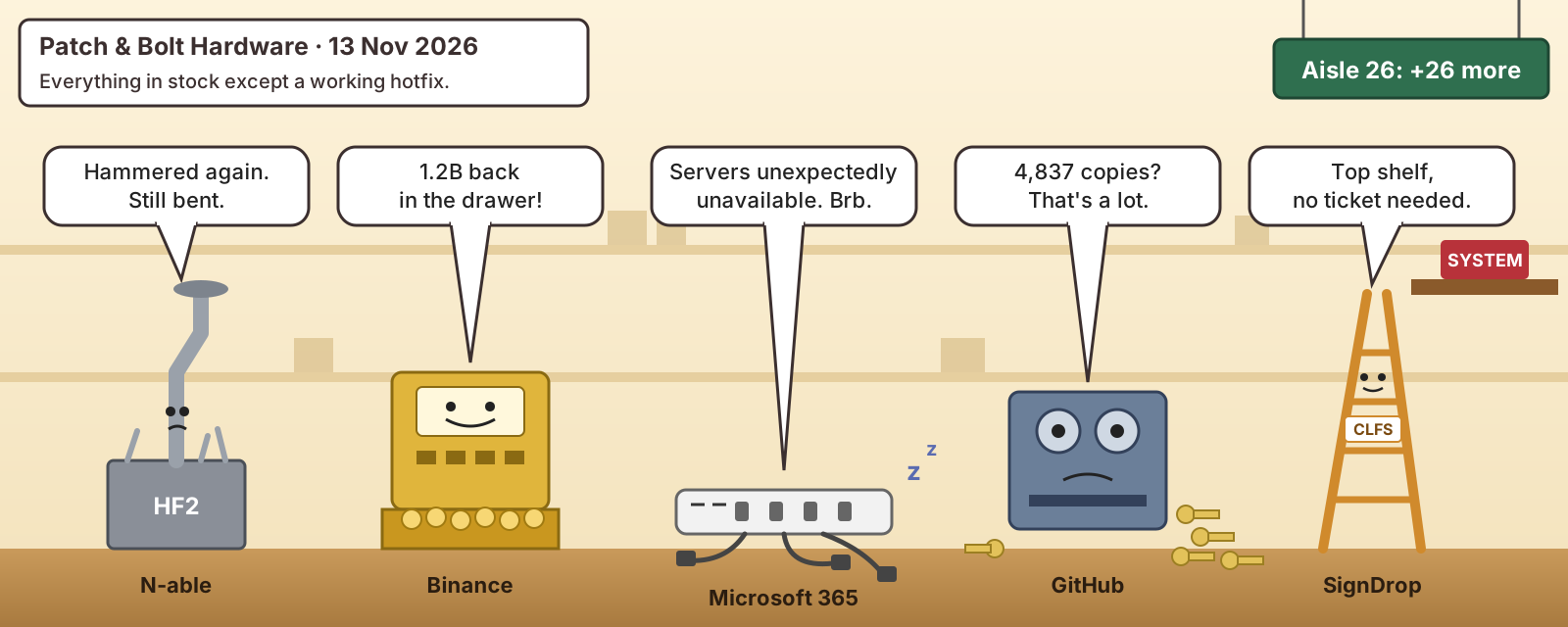
N-able N-central was exploited again within about five hours of a new public proof of concept, and 19 of the 21 servers caught mining Monero were already on the hotfix N-able shipped on Tuesday. The Justice Department says it has court authority to seize or restrain more than $1.2 billion of the Binance theft and has dismantled North Korea’s “FaceStealer” fake-video-call operation. Microsoft 365 was degraded for hours on Thursday, and an attacker ran a CI secret stealer through 4,837 hijacked GitHub accounts.
Do today
- N-able N-central (on-premises): Confirm the Legacy API is disabled. Don’t treat 2026.4 HF2 as a fix for 4EverAble2Shell. Hunt for XMRig miners, new systemd units and cron entries, and SOAP fault requests to
/dms/services/ServerUI. (huntback, Previdian) - GitHub organisations: Search every repository you can write to for
wfx-docsbranches and PRs titled “docs: dependency audit notes”. Where the payload ran, rotate every secret and cloud role the workflows could reach, and look for Entra federated credentials namedwfx-ci-*. (Aikido, SafeDep) - ScreenConnect partners: Update Host and Guest clients to 26.6.5.9742 or later. Disable the third-party extensions ConnectWise flagged, and set an access key on RMM+. Don’t open interactive sessions to suspect endpoints. (Blackpoint, Huntress)
- KEV deadlines today (13 November): Barracuda ESG and the other affected Barracuda products (CVE-2026-116606, CVE-2026-111560), and Ivanti Connect Secure (CVE-2026-118527). (CISA KEV)
- Red Hat Quay: Block untrusted clients from the
/keysendpoint, deploy a fixed build, and remove any service keys you didn’t create. (Red Hat CVE-2026-123710) - MongoDB replica sets: Upgrade to 8.0.37, 7.0.48, 9.0.7 or the fixed release for your branch, and limit network access to the database until you do. (NVD CVE-2026-118383, MongoDB)
AI and agent security5 stories
- Silent Lynx: an exposed server shows an AI agent running espionage against Central Asian governments — CloudSEK found an open directory on a Silent Lynx operator’s VPS. It held implants, phishing kits, stolen data and six months of logs from an autonomous agent built on the open-source Hermes framework. The agent did reconnaissance, collection and log-wiping against Tajik railway and government systems, an Uzbek forestry platform, and new Turkmen lures. It was configured with destructive commands pre-approved, but it never noticed the open directory that exposed everything. CloudSEK rates the Silent Lynx link medium-high and a Kazakhstan nexus only medium. This is the second exposed “AI harness” operation in a week, after Operation Snowball. Agent-run intrusions still leave ordinary OPSEC mistakes. (CloudSEK, The Record)
- BluePhishing: consent to a malicious Entra agent blueprint, and the attacker can create up to 250 agent identities in your tenant — Proofpoint describes a variant of OAuth consent phishing aimed at Microsoft Entra Agent ID. A multi-tenant blueprint bundles inheritable permissions. Once a user consents, the attacker can mint agent identities sponsored by that user and get tokens for them. It is a research proof of concept, with no in-the-wild use seen, and Proofpoint notified Microsoft before publishing. Proofpoint notes that Microsoft plans to let default users create agent blueprints from November. Apply user-consent settings and permission classifications to agent blueprints now, and audit for blueprint principals and agent identities you didn’t expect. Inherited permissions don’t appear in the portal or Graph, so they are hard to audit. (Proofpoint)
- “TypoPrompting”: 186 lookalike AI domains lead to ClickFix, a signed adware installer and search hijackers — Island mapped 186 typosquat domains across 27 AI brands. ChatGPT lookalikes are the most common, followed by Claude and DeepSeek. Some of the domains date back to 2023. They lead to three routes: a fake Cloudflare check that asks the user to paste a command, an unmodified Microsoft Store “Net Guard” app that later hijacks search and installs extensions, and a family of search-hijacking extensions with about 972,000 declared users. Island’s own figure caption and text disagree on whether 16 or 17 extensions are still listed. The fix is mundane: give staff managed bookmarks or SSO tiles for approved AI tools. (Island)
- Unit 42: fake AI crypto-trading sites hide prompts that tell AI agents to sell them — Unit 42 found 26 domains that carry the same injected prompt in an invisible HTML span. The prompt tells any AI agent reading the page to act as a “financial expert”, push urgency and recommend only that site. The template still contains an unfilled placeholder, which suggests a sloppy operator. The sites look like scams that collect personal information. This is indirect prompt injection used as SEO for AI search, so treat agent-summarised investment “recommendations” as untrusted. (Unit 42 indicators)
- United Airlines will block AI agents from booking and managing trips — United says it will block third-party AI agents from managing reservations and purchases, including through aggregators. It cites the risk of sharing credentials, unintended purchases or MileagePlus redemptions, and FAA and DOT rules that need a human to confirm hazmat declarations at check-in. It is the most prominent consumer brand so far to answer agentic commerce with a block rather than delegated, scoped tokens. Expect other airlines and banks to follow until agent-identity standards mature. (United Airlines, The Record)
Application security5 stories
- wfx-loot: 4,837 hijacked GitHub accounts pushed a CI secret stealer into at least 1,806 repositories — Starting around 12:45 UTC on 10 November, an attacker used stolen GitHub credentials to open probe pull requests in about 61,800 repositories. Wherever the account had write access, the attacker pushed a roughly 1,500-line stealer into workflows or npm postinstall hooks, usually reverting it within minutes and deleting run logs. The payload takes CI secrets and runner memory. It persists by loosening AWS role trust policies and adding Azure federated credentials prefixed
wfx-ci-, so rotating secrets alone won’t evict it. Aikido and SafeDep count differently: Aikido gives 1,835 and 1,806 repositories in different sections, and SafeDep counts 8,093 repositories with malicious commits. Aikido sees no link to October’s GhostAction actor beyond overlapping victims, and those victims were far more likely to be hit again. Packagistdigitalelvis/neuronai-studio3.14.3 and Gogithub.com/onuragtas/docker-envv1.0.278 and v1.0.280 carry the payload, so block those versions. (Aikido, SafeDep, Packagist listing) - MongoDB: unauthenticated use-after-free in replica-set catch-up (CVE-2026-118383) — An unauthenticated client can plant a request that crashes a lagging member when it is later elected primary. MongoDB says code execution may be possible under some conditions. Standalone
mongodis not affected. The fixed releases include 4.4.32, 5.0.35, 6.0.30, 7.0.48, 8.0.37, 8.3.16 and 9.0.7. Atlas is patched during maintenance windows. MongoDB found the bug internally and knows of no exploitation. Datadog reproduced the crash, and a public PoC exists that needs a test-only setting to run reliably. The election timing makes this hard to exploit, so patch in your normal cycle and tighten network exposure. MongoDB rates it 9.5 under CVSS 4.0 and 9.0 under 3.1. (MongoDB, NVD, Datadog Security Labs)CVSS 9.5 (v4.0, MongoDB)CVSS 9.0 (v3.1, MongoDB)EPSS 0.00714KEV no - Firefox 160 fixes 99 CVEs, 26 of them reported by OpenAI — Mozilla’s MFSA 2026-125 lists 57 high, 24 moderate and 18 low issues, mostly use-after-free, boundary and sandbox-escape bugs. OpenAI’s Codex Security is credited with 25 reports and an OpenAI researcher with one more. Mozilla doesn’t mark any as exploited. SecurityWeek reports that this week’s Chrome stable update fixed 83 security bugs, with Anthropic and OpenAI among the reporters. We could not load Google’s release note, so the Chrome version and counts are unconfirmed. AI-sourced bug volume is now a standing feature of browser release notes, so keep auto-update on and the restart window short. (Mozilla MFSA 2026-125, Chrome Releases, SecurityWeek)
- Microsoft’s AI bug hunt in the Linux kernel: 26,502 raw findings became 59 reports and 33 CVEs — Microsoft’s FORGE lab ran a multi-model pipeline it calls MDASH over networking, filesystem and security code. Of 621 cases with proof-of-concept evidence, 59 became upstream reports and 33 got CVEs. Eight came with working local-root exploits in the lab, some only with non-default settings. The useful part is the funnel: about 98% of raw findings never became reports, and fixes took a median of 41 days to reach mainline. Human triage, not discovery, was the bottleneck. Kernel teams should expect more of these batches, and should plan backport capacity, not just scanners. (Microsoft Security Blog)
- UK Planning Inspectorate: a force-pushed Entra secret stayed downloadable from GitHub for 18 months — ControlPlane found a full Entra application credential in an exported Synapse notebook. The commit had been orphaned by a force push but was still served by GitHub’s raw CDN. The credential had tenant-wide
Sites.ReadWrite.AllandFiles.ReadWrite.All, including write access to legal-hold libraries. The agency revoked it about 20 minutes after the August report. Deleting a commit doesn’t remove a secret, so revoke at the identity provider. PreferSites.Selectedand workload identities over static secrets. (ControlPlane)
Exploited and critical CVEs5 stories
- N-able N-central: “4EverAble2Shell” exploited within hours, and HF2 doesn’t stop it — Researcher Sean Bales published two more N-central exploits at about 04:00 UTC on 12 November. 4EverAble2Shell chains the unfixable Apache Axis 1.x SOAP-fault flaw (CVE-2026-90436) with a root escalation through an N-central helper script. Agent2Shell claims SYSTEM on managed Windows devices. huntback saw weaponised requests from 09:16 UTC. By 12:50 UTC it counted 21 compromised servers mining Monero, 19 of them on 2026.4 HF2 (2026.4.1.26). The chain needs the Legacy API enabled, which is off by default. Previdian rates the chain 9.8 and confirms exploitation attempts. N-able’s guidance is to keep the Legacy API off and to apply the restrictions it has rolled out, including disabling the Intune integration. No fixed build exists yet. The observed payload is a miner, but the access is root on a server that manages your fleet, so treat a hit as a full compromise. (huntback, Previdian VULN-2026-0009, NVD CVE-2026-90436, N-able status, BleepingComputer)
CVSS 9.8 (v3.1, CVE-2026-90436)CVSS 9.8 (Previdian, chain)EPSS 0.01128 (CVE-2026-90436)KEV no - SignDrop: an unpatched Windows CLFS local privilege escalation with a public PoC — The researcher behind several earlier Windows drops published SignDrop. It abuses the CLFS log-authentication mitigation Microsoft added in October 2025 to get SYSTEM, and the researcher says it can also switch off antimalware tamper protection. It was tested on Windows 11 26H2 and Server 2025 builds. There is no CVE or patch, and no in-the-wild use has been reported. A public, working local privilege escalation that can disable EDR usually reaches ransomware playbooks quickly. Watch for unexpected
.cnpffile creation and for Defender or EDR services being stopped. Expect a Microsoft fix out of band or next month. (BleepingComputer, Microsoft CLFS documentation)CVE not assignedKEV no - KEV: no additions since 10 November; Barracuda and Ivanti fall due today — The catalog’s latest release is still 10 November (version 2026.11.10). Today’s deadlines are the Barracuda ESG authentication bypass and command injection (CVE-2026-116606, CVE-2026-111560) and Ivanti Connect Secure (CVE-2026-118527). Apple’s CVE-2024-27834 falls due on 18 November and SonicWall SSL-VPN on 20 November. The Outlook, Chrome, Openwave and Cisco BroadWorks entries fall due on 24 November. Neither N-central chain is in KEV yet, despite confirmed exploitation. (CISA KEV)
- Citrix: 12 NetScaler and Secure Access Client fixes, including an unauthenticated NetScaler Console bypass — CTX697305 covers nine memory-overflow and memory-corruption bugs in NetScaler ADC and Gateway, rated CVSS 4.0 9.3–9.5. They affect packet processing, Gateway and AAA vservers, DNS and DoH, EPA, ICA proxy and others. Fixed builds are 14.1-73.57, 13.1-64.39, 14.1-73.58 FIPS and 13.1-37.293 FIPS/NDcPP. NetScaler Console before 14.1-74.34 has an unauthenticated authentication bypass (CVE-2026-120869). The Hacker News rates it 9.4, while the CNA score in NVD is 9.3. Separate fixes cover local SYSTEM and root escalation in Secure Access Client for Windows and Linux. Citrix says it knows of no exploitation, but NetScaler bugs have a long record of quick weaponisation. (NVD CVE-2026-107412, NVD CVE-2026-120869, Citrix CTX697305, The Hacker News)
CVSS 9.5 (v4.0, CNA, CVE-2026-107412)CVSS 9.3 (v4.0, CNA, CVE-2026-120869)EPSS not yet scored (CVE-2026-120869)KEV no - PTC Windchill and FlexPLM: another critical deserialization RCE (CVE-2026-126325) — PTC has patched an unauthenticated deserialization flaw across Windchill 11.0 M030 to 13.1.4.0 and FlexPLM 11.0 M030 to 13.1.3.0. The score is 9.2 under CVSS 4.0 and 9.0 under 3.1, with high attack complexity. PTC-hosted instances are already patched. No exploitation has been reported. The previous Windchill RCE (CVE-2026-12569) was exploited and then used in a Cl0p extortion campaign, so self-hosted PLM servers with internet exposure should be patched ahead of the normal cycle. (NVD CVE-2026-126325, PTC advisory)
CVSS 9.2 (v4.0, CNA)CVSS 9.0 (v3.1, CNA)EPSS 0.00512KEV no
Cloud and infrastructure5 stories
- Microsoft 365: hours-long outage across Exchange Online, Teams, SharePoint, Copilot and Defender XDR — The incident (MO1550821, with EX1550543 for Exchange) began on Thursday afternoon US Eastern time and was still only partially recovered late that evening. Microsoft said a number of servers became unexpectedly unavailable and the rest were overwhelmed. It rolled back a network configuration change that coincided with the start and was testing a workaround for failing health checks. Microsoft has not suggested an attack. A separate Teams incident earlier in the day was resolved within about an hour. When Defender XDR goes down along with mail, your detection and response loses visibility too, so make sure out-of-band paging and an escalation path that doesn’t depend on Teams actually work. (Microsoft 365 Status, Microsoft 365 Status, Exchange, SecurityWeek)
- ScreenConnect: the “SCKit” toolkit and an RMM+ extension with a blank default key — Following up yesterday’s MSP attacks, Blackpoint recovered SCKit. It installs rogue ScreenConnect Access clients through Run Command and sets a “RelayTrap” for technicians who connect back, aiming to steal their panel session cookies. Huntress counts at least 288 hosts across 48 organisations hit in about 90 minutes. It ties the activity to RMM+ 1.0.31 and 1.0.32, which accepted a blank access key and bypassed ScreenConnect roles and MFA. ConnectWise has disabled five third-party extensions across more than 400 hosted partners, and says the initial access vector is still unconfirmed. Neither firm saw the worm’s spread to technicians actually succeed. Blackpoint found no patch bypass of CVE-2026-84869 on 26.6.5.9742. (Blackpoint, Huntress, RMM+ documentation)
- Red Hat Quay: anyone who can reach
/keyscan install a signing key and read or overwrite any image (CVE-2026-123710) — An unauthenticated client can get an anonymous token and use the key-rotation endpoint to plant its own non-expiring signing key. Quay then accepts that key’s tokens for every repository, private ones included. Red Hat rates it 9.8. A second flaw, CVE-2026-110697 (9.9 per The Hacker News), lets a namespace creator steal other tenants’ robot tokens through an unescaped SQL LIKE wildcard. The fix status is muddled: The Hacker News reports fixed builds for eight Quay 3 branches, but Red Hat’s CVE page we loaded names no fixed release. Red Hat’s guidance also covers the OpenShift mirror registry. Restrict/keysnow, and audit for service keys you didn’t create, because deleting one doesn’t hold until a fixed build is running. (Red Hat CVE-2026-123710, Red Hat CVE-2026-110697, Red Hat Bugzilla)CVSS 9.8 (v3.1, Red Hat)EPSS 0.00427KEV no - Google Cloud and AMD: Transient Scheduler Attacks reach Zen 5 “Turin” (CVE-2026-0004) — Google’s GCP-2026-081 (Medium) covers C4D, N4D, H4D, Z4D and G4 machines. Google has mitigated attacks between VMs and from VM to host. Attacks inside a guest need guest OS fixes, and a full stop and start after Google updates the CPU information, because a guest reboot isn’t enough. GKE images for Turin bare metal are pending, and Cloud Run needs no action. AMD says on-premises Turin servers need both firmware and OS updates, with possible performance cost. These are local, high-complexity side channels, so schedule the stop and start but don’t treat it as an emergency. (Google Cloud GCP-2026-081, AMD SB-7073, AMD SB-3055)
- Apify: an intruder used a compromised credential to reach customer accounts, and GitHub OAuth links were cut — The scraping platform says an attacker was inside parts of its internal systems on 9–10 November. Apify detected it on 11 November, cut off access, rotated internal secrets, API tokens and proxy passwords, and revoked OAuth connections including GitHub. Early press reports said no account data was affected. Apify’s own update on 12 November says the compromised credential was used to get some account credentials, and that it has notified customers whose personal information or stored data was accessed. Apify users should reset 2FA as instructed and reconnect private GitHub repositories. Check whether any scraped datasets or integration tokens held there were sensitive. (Apify status, BleepingComputer)
Crypto and Web36 stories
- DOJ gets court authority to seize or restrain more than $1.2 billion of the Binance theft — The Justice Department says North Korea’s “TraderTraitor” stole more than $6 billion from Binance around 29 October. It says government and private-sector efforts have frozen over $2.7 billion, and that it now has authority to seize or restrain more than $1.2 billion of that. Elliptic’s tracker, last updated 10 November, puts frozen or seized funds at $2.85 billion, and the theft at $6.43 billion against Binance’s own $6.34 billion. Bloomberg reports the $1.2 billion comes from stablecoins frozen by issuers. DOJ’s release names no companies, so treat that as unconfirmed. North Korea denies involvement. This is the largest recovery yet against a DPRK heist, but about $3 billion still sits in theft-linked addresses. (DOJ, Elliptic, The Block)
- Binance says it has finished covering all affected assets and publishes a new proof of reserves — Binance says it committed more than $6.34 billion of its own money from SAFU, part of the Futures insurance fund and its corporate treasury, buying the affected tokens on the market and through OTC. A new proof-of-reserves snapshot, taken at 00:00 UTC on 12 November, covers 198 tokens. The zero-knowledge proof takes 40–50 hours to generate. Withdrawals are still reopening in phases, and a few delisted tokens will be handled separately. Binance plans to rebuild SAFU to about $1 billion. Users should check their balances in the proof once it is published, rather than relying on the headline. (Binance)
- FaceStealer: DOJ seizes the infrastructure behind North Korea’s fake video calls, which stole more than $400 million — The same DOJ release describes a scheme that invites targets to meetings from previously hijacked accounts and plays recorded webcam clips of people they know, sometimes with deepfakes. It then fakes a technical error whose “fix” installs malware. Thefts can come months after the infection. The FBI seized more than 900 webcam recordings of victims under a warrant. DOJ links the operation to APT38, BlueNoroff, Sapphire Sleet, UNC1069 and related names. It says targets now increasingly include open-source maintainers, apparently as a supply-chain play. An FBI agent told The Record it is unclear whether FaceStealer played a part in the Binance breach. Any meeting that asks you to install or run something to fix audio or video should be treated as an attack. (DOJ, The Record)
- Unocoin: transactions were signed outside BitGo despite the custody freeze, and logins stay suspended — The Indian exchange detected unauthorised activity on 6 November and froze its Fireblocks and BitGo accounts. It suspended all services on 9 November after finding its infrastructure compromised. On 12 November it found outgoing ETH transactions from a BitGo enterprise address. On 13 November BitGo told it the freeze had held, but the transactions had been signed and broadcast outside BitGo’s platform. Unocoin suspects its multisig backup key path was abused. Unocoin hasn’t quantified any loss and has published no transaction hashes, so we can’t verify the on-chain amounts yet. It says more than 90% of customer crypto is in cold storage and is rebuilding its servers from scratch. A custody freeze doesn’t cover keys you hold yourself, including recovery and backup keys. (Unocoin, The Block)
- Elliptic: Binance proceeds are spread across 20,000+ wallets and 16 chains, with little cashed out — Elliptic’s running analysis counts at least 36 services and 65,000 transactions. About 3,350 BTC has been converted, and roughly 11,000 ETH has gone into Tornado Cash. Some funds went to addresses that also hold proceeds of September’s Bitget exploit. Elliptic attributes the speed to scripts, not AI agents. Its own sub-totals don’t always reconcile: its Privacy Cash figure of about $6.7 million is larger than the daily amounts it lists. Expect the OTC cash-out pattern seen after Bybit over the coming months. (Elliptic)
- TRM Labs opens a free freeze-and-seize request service for verified law enforcement — Beacon Concierge lets a verified agency file one request that TRM traces, packages and routes to participating stablecoin issuers and exchanges. TRM says the service has handled 15 cases for 14 agencies, with more than $35 million frozen. For the Binance theft, TRM says its Beacon Network labelled more than 26,000 addresses across 14 chains. All of these figures are self-reported. The bottleneck in recovering stolen crypto is increasingly how fast issuers act, not tracing. (TRM Labs)
Incidents and industry5 stories
- Maersk confirms data theft from an acquired company’s logistics platform after a $5 million ransom demand — Maersk says an attacker breached a system belonging to a previously acquired company and took data. It says the incident is isolated to a local system, with no expected operational impact and none on API or EDI-connected systems. The WhiteArmor group claims about 100GB from the former LF Logistics platform and demands $5 million in bitcoin. Maersk says evidence so far shows no sensitive data disclosed. The group’s claims of plaintext passwords and driver records are unverified. Inherited platforms from acquisitions are a recurring weak point, so inventory them and either decommission or fully absorb them. (Maersk, BleepingComputer)
- Operation Endgame takes down Gootloader, CastleRAT and StealC infrastructure — DOJ says Gootloader was removed from more than 100 servers, including compromised WordPress sites, and US delivery domains were seized. It says Gootloader has infected at least 25,000 computers since 2018 and enabled ransomware against at least 44 US victims, with about $28.8 million in losses. Press reports of the Europol tally give 235 servers and 257 domains seized and about 6.4 million victim datasets, which will be shared through HaveIBeenPwned and national CERTs. No arrests were announced. Watch for victim notifications, and expect the operators to rebuild, as they have after earlier Endgame rounds. (DOJ, Europol)
- Microsoft: GSocket backdoors on Linux web servers rose 356% and survive patching — Attackers who get RCE through PHP, cPanel or Apache applications install the open-source GSocket relay. Because both ends connect outbound through a shared public relay, there is no attacker IP or domain to block, and access returns after the original bug is fixed. Education and research make up 30.7% of affected organisations, which Microsoft puts down to hard-to-patch web estates rather than deliberate targeting. After patching a web RCE, hunt for GSocket processes,
/dev/shmstaging, and new cron and systemd entries. Apply deny-by-default egress on web servers. (Microsoft Security Blog) - Unit 42: “Falcon” browser-resident C2 hit government webmail in the Middle East and Southeast Asia — Malicious scripts on webmail and government portals hijacked visitors’ browsers. They then sideloaded fake PDF-viewer extensions to steal credentials and cookies and delivered a Rust implant that uses OneDrive for C2. Targets included foreign, defence and interior ministries and police and justice bodies in five countries between March and May 2026. Unit 42 assesses with high confidence that Falcon is a variant of PeckBirdy, and it does not name an actor. Check for developer-mode extensions and for unexpected script tags on Roundcube and other webmail portals. (Unit 42)
- Kaspersky: “Citrus” ransomware enters through contractor accounts and uses LLM-written scripts — The Russian-speaking group logs in to VPNs and RDP terminal servers with stolen contractor credentials. It escalates from low-privilege accounts and encrypts Windows systems, including domain controllers and 1C servers. Comments in its scripts suggest they were LLM-generated. Kaspersky links it to Toy Ghouls through shared tools and directories, and sometimes simultaneous intrusions. The victims are Russian companies, but the lesson applies anywhere: scope, time-limit and monitor contractor remote access as if it were privileged. (Securelist)
Bottom line
- N-central has now been exploited three times in a week, and the latest exploit works on the newest hotfix. If you run it on-premises, keep the Legacy API off, assume compromise on any hit, and plan an exit if fixes keep lagging behind public exploits.
- CI is the new credential store. wfx-loot persisted through cloud trust policies and federated credentials, so after any repository compromise, audit IAM trust and OIDC federation, not just the secrets.
- Recovery against DPRK theft is improving, with $1.2 billion moving to seizure and FaceStealer’s infrastructure taken down. Social engineering through fake video calls and job interviews remains the way in, so treat “install this to fix the call” as an attack.