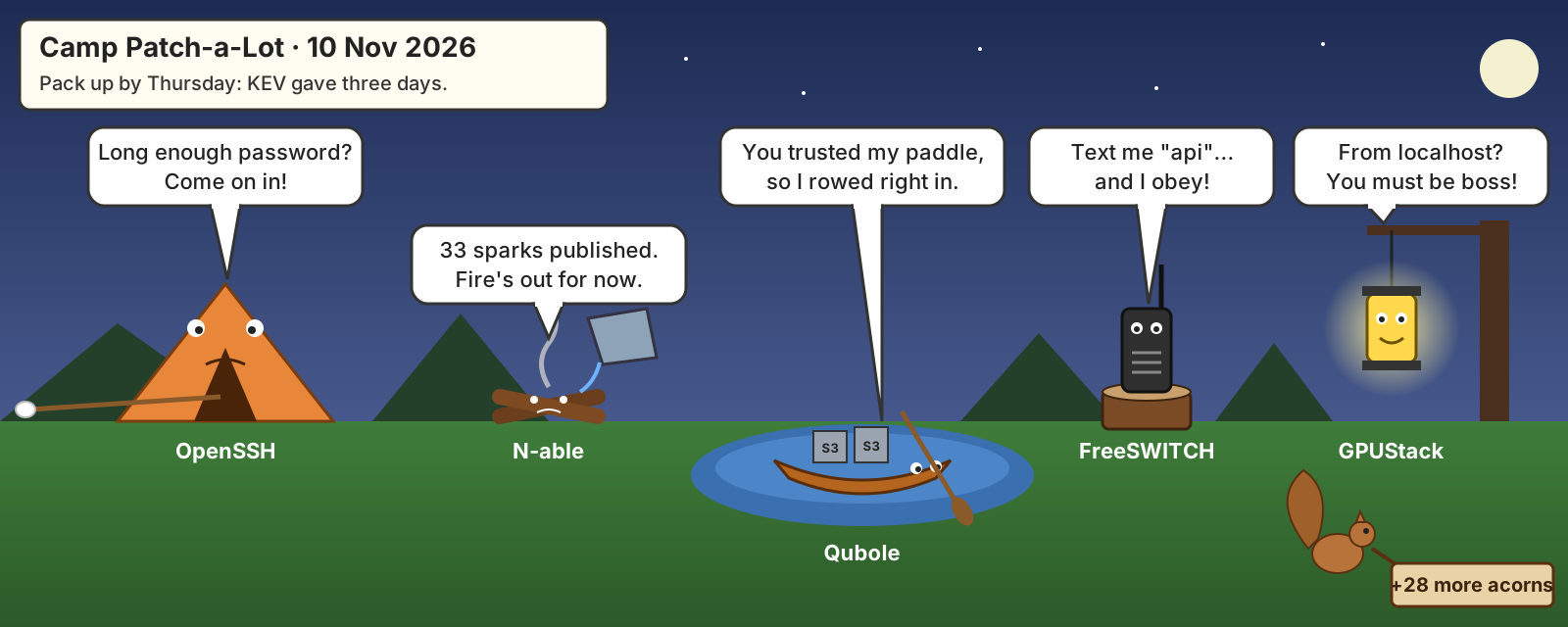
CISA added four actively exploited flaws to KEV on 9 November and gave agencies until Thursday 12 November to fix them: OpenSSH’s “sshole” bug on musl systems, FreeSWITCH, IBM Aspera Faspex and GPUStack. N-able took its hosted N-central platform offline and told on-premises customers to shut down their servers too, after a researcher published 33 alleged zero-days with working exploit chains. Wiz describes an attacker who used the identity of Qubole, a data-lake vendor, to assume roles in customers’ AWS accounts and copy secrets and whole S3 buckets.
Do today
- OpenSSH, FreeSWITCH, IBM Aspera Faspex, GPUStack: the KEV deadline for all four is 12 November. Install OpenSSH 10.6p2 (or Alpine 3.21.10, 3.22.8, 3.23.8 or 3.24.4), FreeSWITCH 1.11.3, Faspex 5.0.19 PL1 and GPUStack 2.2.0. (CISA KEV catalog, NVD CVE-2026-123158)
- N-able N-central on-premises: take servers offline now and keep them offline until N-able confirms a hotfix. Review login and authentication logs from 8 November onward. (Huntress analysis, N-able status page)
- AWS accounts that ever integrated Qubole: search CloudTrail from 1 October for AssumeRole calls by account 805246085872 from non-AWS addresses. Remove unused Qubole roles, rotate every secret those roles could read, and revoke active sessions. (Wiz)
- Adobe Commerce and Brotli: today is the KEV deadline for CVE-2026-48356 and CVE-2026-111497. On AKS, rebuild and redeploy container images that bundle a vulnerable Brotli decoder, because updating the node OS does not fix them. (CISA KEV catalog, AKS-2026-0008)
- @ethersphere/bee-js and Swarm Desktop: if bee-js 13.3.0 or Swarm Desktop 0.56.2 was ever installed, treat the machine as compromised. Rotate secrets from a clean device and move node-wallet funds to a new key. (GHSA-hh7j-5m3j-23pf, Socket)
AI and agent security5 stories
- GPUStack: loopback-equals-admin auth bypass is now in KEV (CVE-2026-102895) — GPUStack, a platform for running model-inference clusters, treated any request that appeared to come from 127.0.0.1 as the built-in administrator when
force_auth_localhostwas false, which is the default. A same-host reverse proxy or a spoofedX-GPUStack-Real-IPheader was enough to get unauthenticated admin access, which leads to credential disclosure and code execution. The GHSA, first published 31 July, says attackers exploited a 2.1.1 deployment by creating custom backends that opened reverse shells. CISA added it to KEV on 9 November with a 12 November deadline. Our take: inference clusters often sit behind a convenience proxy on the same box, which is exactly the setup this bug punishes. Upgrade to 2.2.0, or setforce_auth_localhost=trueand strip the header at the edge. (GHSA-gj9m-f8ph-pmhr, NVD CVE-2026-102895)CVSS 9.8 (v3.1, GitHub CNA)EPSS 0.0033KEV yes, due 12 Nov - Acronis: one person in Taiwan ran a 12-agent “attack mesh” against 11 countries — Acronis TRU assesses with high confidence that a single operator, “bossjy”, built a mesh of 12 AI agents and loaded up to 13 MCP servers at peak. The main attack agent cycled through at least nine models in 19 days. TRU counts about 10 targets with confirmed data theft or system access, including patient-care records from a Taipei fire-department platform and case records from a 119 dispatch API, and about 15 more that were attacked without confirmed compromise. The report notes that the agents invented vulnerabilities, including a fake Apache RCE, and that commercial models mostly refused explicit offensive requests, so the operator relied on abliterated open-weight models. Our take: the agents succeeded where authentication was missing and failed where it held. That argues for basic API hygiene, not AI-specific controls. (Acronis TRU)
- mittwald: an attacker came in through the hoster’s MCP server and reached 56 customer projects — German agency hoster mittwald says an attacker tested a flaw in the MCP server that connects AI assistants to its mStudio platform on 21 October. The attacker then registered an account on 27 October and exploited the flaw within minutes. Mittwald found the intrusion on 4 November, took the MCP server offline, and treats all data from 27 October onward as compromised. It says the speed of some steps in its logs suggests AI tooling, but it has published no other evidence and has not said whether the bug was in its own code or an open-source MCP library. A detailed report is promised for this week. Our take: an MCP endpoint is a production API with an agent in front of it. Give it the same threat model, authentication and logging as the rest of the control plane. (mittwald incident post)
- Google DeepMind: agents cut the cost of attacking 1024-bit RSA signatures — DeepMind published two papers produced by AI agents working with cryptographers from UC San Diego and Inria. One describes an attack on PKCS#1 v1.5 signing when an attacker controls about half or more of the signed block. Reported figures put a re-run of an earlier forgery attack at 391 core-years instead of 1,380. The second paper claims batch factoring makes each additional 1024-bit key about 30 times cheaper after one key’s worth of up-front work, but that method has not been implemented. The signature attack does not recover private keys, needs about four billion signing queries, and fails against devices that hash internally. Our take: this matters only to estates still holding 1024-bit keys behind raw-signing HSM or PKCS#11 interfaces, but those are exactly the systems that are hardest to find. (DeepMind paper: Faster Affine Root, DeepMind paper: Fan Factories, SecurityWeek)
- JFrog: five chained flaws give root on the Reachy Mini AI robot — JFrog’s 3 November write-up chains five CVEs in Pollen Robotics’
reachy-mini-daemon, the service behind the open-source companion robot. Someone on the same network can install an app that runs code through pip, then reach root through passwordless sudo. A browser variant lets a malicious web page trigger the install, and a Bluetooth chain works from close range. JFrog says an attacker could then drive the motors, camera and microphone, and could steal Hugging Face tokens. It recommends v1.11.0 and notes that one advisory was still in draft in July. Our take: hobby robots on lab networks are now agent endpoints holding cloud tokens. Put them on an isolated VLAN. (JFrog)
Application security6 stories
- bee-js 13.3.0 and Swarm Desktop 0.56.2 were backdoored through the project’s own release pipeline — On 9 November an attacker using two compromised GitHub accounts committed a remote loader into bee-js’s version script. The project’s trusted-publishing workflow then shipped it to npm as
latestfor about 75 minutes. A signed and notarized Swarm Desktop 0.56.2 went out through the auto-updater and stayed public for about 8.5 hours. Socket says the payload steals Swarm Desktop’s plaintext node password andswarm.key. It then installs a Go backdoor on macOS and Linux, or a ScreenConnect client on Windows. Socket links the C2, which is stored in an Ethereum contract, to the SleepyDuck/EtherDuck Open VSX campaign, and names the loader domain frameworkmetrics[.]xyz. Our take: trusted publishing proves where a package was built, not that the commit was benign. Watch for changes to build scripts and newpostinstallhooks. (GHSA-hh7j-5m3j-23pf, Socket, Swarm Desktop 0.56.3 release) - MIT Kerberos 1.22.3 fixes 21 CVEs, most of them unauthenticated KDC crashes — MITKRB5-SA-2026-001, published 9 November, lists 17 denial-of-service CVEs that unauthenticated attackers can trigger against the KDC, kadmind and GSS-API servers. It also lists three authorization bypasses, involving forged CAMMAC or PAC data and the
lockdown_keysattribute, and a GSS-RPC issue that can expose incremental propagation data in plain text. There are also Windows client buffer overflows. The project credits the jump in volume to researchers using large language models and makes no claim of exploitation. Our take: patch KDCs first, since one crashing KDC can stop logins across the realm. (MITKRB5-SA-2026-001, oss-security announcement) - Apache Airflow 3.4.0 ships 18 security fixes, including forged Celery callbacks — Apache posted 18 Airflow advisories to oss-security on 9 November. The most serious, CVE-2026-68982 (rated important), let anyone with write access to the Celery broker queue a forged deadline-alert callback that ran arbitrary code on every CeleryExecutor worker, without Airflow credentials. Others cover scheduler-side deserialization paths, secrets-masker gaps that leak values into logs, and API authorization slips. Our take: brokers like Redis and RabbitMQ are often treated as internal plumbing. Until you are on 3.4.0, restrict who can write to them, because this bug turns broker access into code execution on the workers. (CVE-2026-68982 advisory, oss-security 9 Nov index)
- Home Assistant: researcher says refresh-token secrets sit in cleartext and survive password changes — A post to oss-security against core 2026.11.0 says refresh-token secrets and their JWT signing keys are stored unhashed in
.storage/auth, while passwords are bcrypt-hashed. According to the post, long-lived tokens never expire, none of the four password-change paths revokes existing tokens, and backups carry the auth store and a plaintext backup password. The reporter says this is not a network flaw and needs read access to the config directory or a backup. List members questioned whether the project was told first, and no maintainer has replied. Our take: treat Home Assistant backups as credentials, and after a suspected compromise revoke tokens yourself instead of relying on a password reset. (oss-security thread) - Apache Storm 3.1.0: an unset allowlist meant “any class” in Nimbus (CVE-2026-82440) — Nimbus instantiates whatever class a topology names in
topology.scheduler.strategy. Its allowlist treated an unset value as allow-all, and the shipped defaults never set it. An authenticated submitter could load any no-argument class on the classpath and exhaust the daemon with leaked threads and sockets. Apache rates it moderate, and a separate Storm client advisory on state-store deserialization (CVE-2026-82436) came out the same day. If you run out-of-tree strategies, add them to the allowlist before upgrading or those topologies will be refused. (CVE-2026-82440 advisory) - PyPI adds a Security tab that shows each release’s provenance — PyPI’s redesign, live since 6 November, adds a per-project Security tab. It shows whether each file carries a PyPI Publish attestation or SLSA build provenance, and warns when provenance is incomplete or inconsistent, or changes or disappears between releases. PyPI stresses that missing attestations do not mean a file is malicious. Our take: the “loss of provenance” warning is the useful one. A project that used to publish attestations and suddenly stops is exactly the pattern a hijacked release pipeline leaves behind. (PyPI blog)
Exploited and critical CVEs5 stories
- KEV: four additions on 9 November, all due Thursday — Catalog version 2026.11.09 adds OpenSSH CVE-2026-123158, FreeSWITCH CVE-2026-116779, IBM Aspera Faspex CVE-2026-123218 and GPUStack CVE-2026-102895, each with a three-day deadline of 12 November. Adobe Commerce CVE-2026-48356 and Brotli CVE-2026-111497 are due today. VMware ESX CVE-2026-41709 is due tomorrow and Ivanti Connect Secure CVE-2026-118527 is due Friday. EPSS for the four new entries ranges from 0.0033 to 0.0130, which shows how far behind real exploitation the model runs. (CISA KEV catalog, FIRST EPSS API)
- OpenSSH sshole is in KEV, and GreyNoise counts 16 successful chains (CVE-2026-123158) — Since this was last covered on 7 November, CISA has listed the flaw, which lets a password of 256 to 1,024 characters log in to some accounts on musl systems without PAM, such as Alpine. GreyNoise logged 16 successful exploitation chains from six source IPs. It saw attackers query cloud metadata, try to read shadow files and root keys, and edit
authorized_keys, and in one case install a Python agent it calls TAC Agent. NVD lists 10.6p2 and Alpine 3.21.10, 3.22.8, 3.23.8 and 3.24.4 as fixed. Our take: patching does not remove a key an attacker has already added. Auditauthorized_keyson every musl host that allowed password authentication. (NVD CVE-2026-123158, Alpine advisory, GreyNoise sshole data)CVSS 8.1 (v3.1, MITRE)EPSS 0.0101KEV yes, due 12 Nov - N-able N-central: 33 alleged zero-days published, hosted service offline worldwide — Late on 8 November a researcher published 33 alleged vulnerabilities in N-central with proof-of-concept exploits, tested against appliance 2026.4.0.31. Huntress says they form four chains, three to remote code execution and one to root. N-able took its hosted environments in the Americas, Europe and Asia-Pacific offline, told on-premises customers to shut their servers down, and said it had seen no active exploitation and was working on a hotfix. The researcher says he went public because unrelated bugs he reported months earlier had not been fixed. N-able did not respond to that claim. Our take: an RMM server can push code to every endpoint it manages, so a public exploit chain needs no confirmed exploitation to be treated as an emergency. Hunt for unexpected scripts, remote sessions and admin accounts downstream. No CVEs have been assigned yet. (Huntress, N-able status page, BleepingComputer)
- FreeSWITCH: a SIP MESSAGE can run API and OS commands, exploited in the wild (CVE-2026-116779) — Before 1.11.3, FreeSWITCH split the To user of an inbound SIP MESSAGE on “+” and let the left side choose a chat protocol. Choosing “api” passed the input to command execution with the daemon’s privileges. Inbound chat is on in the stock internal and external profiles. The advisory says the stock
defaultdirectory user means no credentials are needed, and that turning off system API commands is not enough. Upgrade, or setenable-chat=falseon every profile that does not need inbound chat. (GHSA-mg63-h38w-8p9p, NVD CVE-2026-116779)CVSS 9.8 (v3.1, GitHub CNA)EPSS 0.0130KEV yes, due 12 Nov - IBM Aspera Faspex admin takeover is now in KEV (CVE-2026-123218) — Covered on 8 November as a patch-now item, the flaw lets a crafted message take a Faspex 5.0.0–5.0.19 user to full administrator. CISA now lists it as exploited. IBM’s bulletin lists 5.0.19 PL1 as the fix, with no workaround. Check that the faspex-core image reports Fix Pack 1. Sources disagree on the attacker’s starting point: IBM’s text describes an “authorized user”, while the CVSS vector it supplied says no privileges are required. (IBM bulletin, NVD CVE-2026-123218)
CVSS 9.8 (v3.1, IBM)EPSS 0.0040KEV yes, due 12 Nov
Cloud and infrastructure6 stories
- Wiz: an attacker used Qubole’s AWS identity to raid customer accounts — Wiz says that between 14 and 26 October an actor used credentials for AWS account 805246085872, which Wiz associates with Qubole, to assume integration roles that customers had set up to trust that account. Each request included a valid External ID and succeeded, even though most of the roles were otherwise unused. Once inside, the actor collected secrets from Lambda environment variables, Secrets Manager and SSM, tested them with TruffleHog, and sometimes downloaded entire S3 buckets. Wiz, which worked with Sentra and Mandiant, also found separate activity from 8 to 11 October using customer-owned keys probably created for Qubole. Neither Qubole nor its owner Idera had commented when Wiz published. Our take: Wiz says a source-IP condition alone would have blocked every role assumption it saw. Audit every trust policy that names an external account. (Wiz)
- Default
admin:adminon a ForgeRock console let researchers unlock and start two automakers’ cars — Sam Curry and Shubham Shah describe encoding URL paths so the ForgeRock edge treated requests as static files while the backend routed them to a hidden Apache Felix console. That console still used default credentials. From there they reached code execution on the production identity servers, could take over any customer account, and could unlock and start connected cars. They tested only on vehicles they had permission to use. Both automakers, who are not named, fixed the issue about two hours after the report and rotated credentials. Our take: this was hardening debt rather than a product CVE. Ping’s guide says to remove the development consoles in production. (Sam Curry and Shubham Shah, PingIDM hardening guide) - AKS: Brotli KEV deadline is today, and node updates won’t fix your containers — Microsoft’s AKS-2026-0008 says AKS node components and managed Istio are not exposed to CVE-2026-111497. Customer workloads that decompress untrusted Brotli data can be. The fix is to rebuild and redeploy container images. The Azure Linux 3.0 node image 202610.23.0 carries the fix, and Microsoft expects the Ubuntu SecurityPatch channel to reach all regions by 12 November. Our take: this is the general pattern for library CVEs on Kubernetes. Scan images, not nodes. (AKS security bulletins)
- SecurityScorecard: hijacked refrigeration controllers send spam and relay proxy traffic — SecurityScorecard’s STRIKE team found nine IPs, three of them confirmed Copeland/Dixell XWEB controllers, sending outbound-only mail to overlapping target lists. Two other controllers were serving as a tunnel gateway and a residential-proxy exit. STRIKE confirmed six exposed XWEB interfaces running firmware vulnerable to the pre-auth bypass CVE-2026-25085. It did not link the botnet to the supermarket sabotage in Europe. Our take: a controller that sends SMTP without receiving any is an easy detection on egress logs. (SecurityScorecard)
- AWS: path traversal in the Braket SDK and ParallelCluster log export — Bulletin 2026-175 fixes CVE-2026-124034 in the Braket SDK, where crafted S3 keys let a user with write access overwrite files (fixed in 1.127.7). It also fixes CVE-2026-124035 in Braket Schemas, where a crafted result document could run code on the machine fetching results (fixed in 1.32.2). Bulletin 2026-174 fixes CVE-2026-124033, which let
export-cluster-logsandexport-image-logsin ParallelCluster CLI write outside the export directory, in 3.16.0. All three require write access to an S3 location, so tight bucket policies are the interim control. (AWS 2026-175, AWS 2026-174) - Beget recovery: VPS binary backups gone, and its .ru domain accreditation is suspended — Beget’s later updates on its official channel say more than 60% of shared hosting and 40% of managed dedicated servers were back by 6 November. Only about half of VPS customers will get file backups, and the cloud platform is being rebuilt. The newest post says the national domain coordinators have temporarily suspended Beget’s accreditation for .ru, .su and .рф. Beget says domains will not be deleted, but new registrations in those zones are unavailable. Our take: when a provider’s control plane is wiped, its registrar role is at risk too. Keep registrar and hosting with separate companies. (Beget official channel)
Crypto and Web35 stories
- Elliptic: Binance launderers are minting throwaway meme coins on NEAR — Elliptic’s 9 November analysis says the network laundering the Binance theft created six meme tokens on NEAR between 5 and 7 November, each for about 25 NEAR. It paired each with NEAR in a liquidity pool and pushed about 117,000 NEAR (around $430,000) through them before abandoning them on 8 November. It also traced a home-made Tron token on 2 November and swaps through thinly traded Solana tokens on 3 November. About 11.8 million NEAR (around $43.7 million) had not moved when Elliptic published. Our take: Elliptic’s warning that funds from a liquidity pool are not automatically clean is a direct instruction for exchange compliance teams. Look at what went into the pool, and re-screen past deposits as new labels appear. (Elliptic)
- Ankr’s Ethereum bridge paid out five forged withdrawals — Blockscout shows sender 0x9A88…D703 making five successful
withdrawcalls to the Ankr Bridge proxy (CrossChainBridge_R2) between 08:09 and 08:12 UTC on 9 November, with the funds going to 0x119D…1Aa6. Three of those transactions alone moved about 82.91 ankrETH, about 7.98 million ANKR and 0.82 aETHb. SlowMist lists the loss at $304,500, and press reports citing Blockaid say about $292,000, so the figures differ. Reports say the attacker had deposited a small amount of ankrETH via Optimism on 3 November. How the bridge came to accept the withdrawal authorizations is not yet explained. Ankr has not published a statement we could find. (Blockscout sender transactions, Blockscout withdrawal transaction, SlowMist Hacked) - ACryptoS loses about $665,000 from 77 vaults and shuts down — SlowMist’s incident entry says a missing length check in
depositMultilet a tiny single-token deposit mint most of a vault’s shares and withdraw a proportional slice of both tokens. The attack hit 77 vaults on Arbitrum, BSC, Polygon, Base and Optimism. The project disabled deposits, left withdrawals open, offered a 10% bounty, and says it is ceasing operations. We could not check the amount on-chain because no attacker address or transaction has been published. If you still have funds in ACryptoS vaults, withdraw them. (SlowMist Hacked, ACryptoS docs) - LNbits tells every operator to shut down after extension attacks — On 8 November the LNbits project first told operators to disable its Paywall extension. About 80 minutes later it told them to shut down LNbits servers entirely, and it switched off its hosted service. One operator reported 2,285,545 sats (about 0.023 BTC) withdrawn, and SlowMist records the loss as $1,700. The extension involved has not been named and no fixed release was out when we checked. The project said patches would take 24 to 48 hours. The notice covers LNbits servers only, not Lightning nodes. (LNbits shutdown notice, SlowMist Hacked, LNbits releases)
- Ukraine and Germany dismantle a crypto-investment call-centre ring that took over €4.3 million — Ukraine’s Cyber Police say operation “Trade”, run with German authorities through a joint investigation team, found fake brokers who steered 135 German victims onto bogus trading platforms. In some cases the brokers also got into victims’ online banking. Police carried out 56 searches in August and September and seized more than $90,000, nearly UAH 600,000, hardware wallets and phones. Four suspects, including the organiser, are in pre-trial detention and face up to 12 years. (Cyber Police of Ukraine)
Incidents and industry6 stories
- France attributes the October refrigeration sabotage to two IRGC cyber units — On 9 November France’s interministerial cyber crisis centre published CERTFR-2026-CTI-009. It attributes the 11–12 October attacks on industrial refrigeration controllers to the Shahid Kaveh and Shahid Shoostari units of the IRGC’s Electronic and Cyber Centre. It also ties those units to the 2023 Charlie Hebdo attack and a 2024 attack linked to the Paris Olympics. The foreign ministry issued a formal attribution, and press report that Paris summoned Iran’s ambassador and that prosecutors are seeking international arrest warrants. Our take: the attribution covers October’s wave, not the early-November attacks across Europe, which remain unattributed. (CERT-FR CTI-009, The Record)
- Vanderbilt: an active incident takes most university systems offline — Vanderbilt’s 9 November updates told staff and students to shut down university devices and leave campus Wi-Fi. By evening Wi-Fi was back but most systems and applications were still restricted, and the university said it was working with government agencies. The BYOD ransomware group claims to have encrypted databases and stolen data, including more than a million SSNs. Vanderbilt has not confirmed ransomware or data theft. (Vanderbilt updates, BleepingComputer)
- SEGA: 2.2 million newsletter addresses exposed through mailing vendor Arara — SEGA says an intrusion at Arara, its newsletter provider, exposed 2,196,044 email addresses, 92,273 of them with extra distribution data that is still being assessed. SEGA says names, addresses, card data and passwords were not involved, and SEGA Account addresses use a separate system. Arara disclosed on 2 November that its breach affects about 77 million addresses across nearly 380 corporate clients. Our take: expect convincing brand phishing aimed at Japanese consumers for weeks. (SEGA notice, Arara disclosure)
- Amplifon Americas: hearing-care records taken over three weeks in early 2026 — Amplifon’s notice says an outside party took files between 18 January and 8 February, and that its review only found affected personal data on 6 October. The data includes contact details, dates of birth, ID numbers, hearing and other health information, insurance IDs, and for some people financial data or SSNs. Amplifon does not give a count. State filings seen by the press total about 87,000 people, and law-firm figures of 1.33 million are unconfirmed. (Amplifon notice, The Record)
- York University: department web forms going back to 2007 were stolen — York says an intruder accessed online forms on 14 departmental websites and stole some of the submissions, with collection on some sites dating back to 2007. Most of the data is contact details and York IDs, but some forms include health, disability, financial, criminal-background and demographic information. York found the intrusion on 25 October, reported it to Ontario’s privacy commissioner, and is emailing the small number of people whose government ID or financial data was exposed. Our take: old form back-ends are a common place for sensitive data to pile up without anyone owning it. (York University incident FAQ)
- Fortinet: Bitter adds PapRAT, in C++ and Rust, to its South Asia toolkit — FortiGuard Labs attributes a campaign against South Asian organisations to Bitter with high confidence. The new RAT, PapRAT, executes commands, moves files and takes screenshots, and its Rust build adds PowerShell execution. Delivery uses three chains: an LNK that abuses
ftp.exe, a VHDX that silently runs an MSI, and a URL shortcut over WebDAV that also drops WmRAT. Our take: blocking VHDX and remote URL-file shortcuts at the mail gateway removes two of the three chains. (Fortinet FortiGuard Labs)
Bottom line
- Four KEV entries are due Thursday and two are due today. OpenSSH on musl, FreeSWITCH, Aspera Faspex and GPUStack all have exploitation confirmed and EPSS scores near zero. Patch to the KEV date, not the score.
- N-central should stay offline until N-able ships and confirms a hotfix. For the Qubole case, the lasting fix is in IAM: every vendor trust relationship needs source conditions, least privilege and an owner who removes it when the integration ends.
- Release pipelines and agent endpoints keep becoming the way in. bee-js was shipped through trusted publishing and mittwald was breached through its MCP server, so treat build scripts and MCP endpoints as production attack surface.