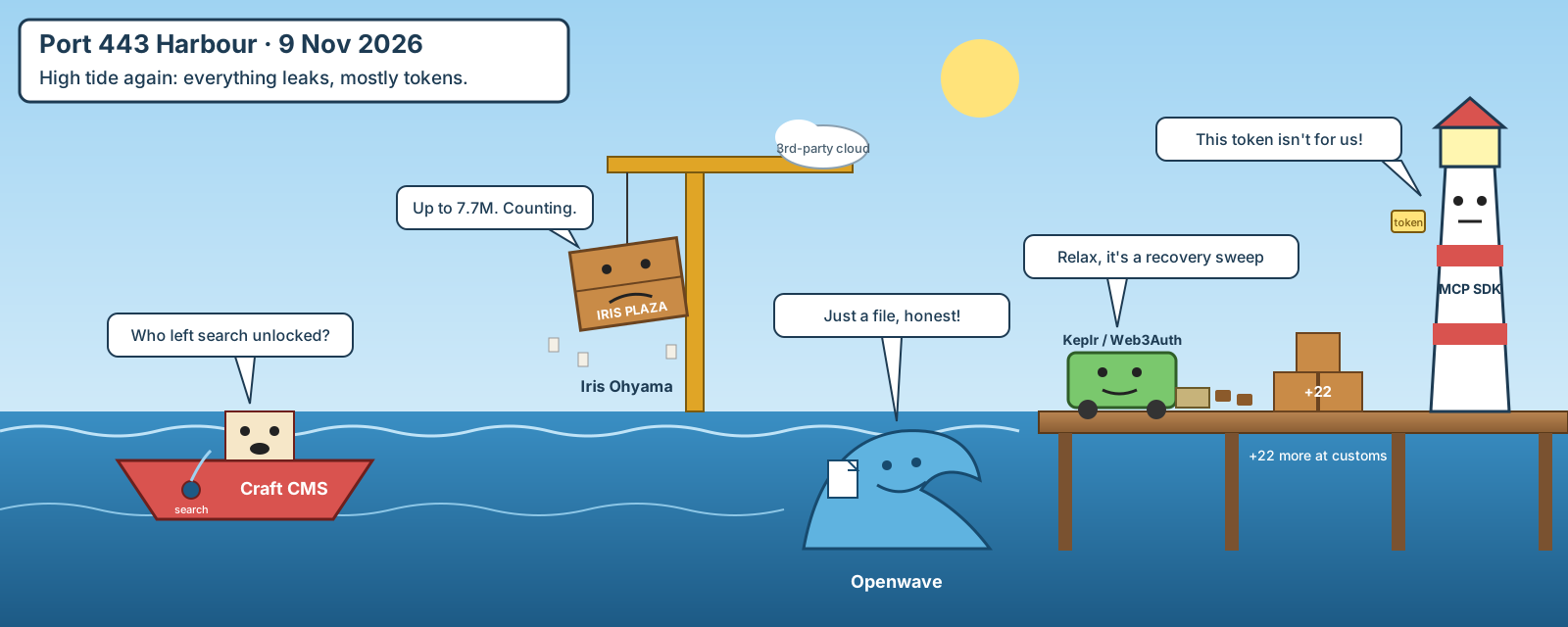
Japanese manufacturer Iris Ohyama says its Iris Plaza shop kept data on about 7.7 million people in an outside cloud service that intruders reached, and it cannot yet say how much was taken. Craft CMS has fixed an unauthenticated SQL injection that can hand an attacker the admin account. The official MCP TypeScript SDK and the Go mcp-go library both ship token-handling fixes, and Web3Auth’s login breach led to sweeps of Keplr wallets created with Google or Apple sign-in. CISA has added nothing to KEV since 6 November, so this week’s work is the deadlines, starting with Adobe Commerce and Brotli on Tuesday.
Do today
- Craft CMS: upgrade 4.x to 4.18.9 and 5.x to 5.11.2. The element search endpoint takes unauthenticated SQL that can overwrite admin password hashes. If you can’t upgrade today, restrict that endpoint to logged-in users. (GHSA-qcvp-ggx3-97r6, NVD CVE-2026-123488)
- KEV deadlines: Adobe Commerce CVE-2026-48356 and Brotli CVE-2026-111497 are due tomorrow, 10 November. VMware ESX CVE-2026-41709 follows on 11 November and Ivanti Connect Secure CVE-2026-118527 on 13 November. (CISA KEV feed mirror)
- Openwave Webtop Media Transcoder: the vendor reports attacks against CVE-2026-111793, so move to 1.1.22.0 or later. (JVN JVNVU#93403064)
- Kyverno: upgrade to 1.19.2 on any cluster where namespace tenants can write policies. (NVD CVE-2026-124440, GHSA-39w8-hv5g-f73w)
- Ubuntu and Debian on AWS: update APT on running hosts and rebuild container images. AWS’s dated list shows which managed images are still waiting for a refresh. (AWS bulletin 2026-172-AWS)
AI and agent security5 stories
- MCP TypeScript SDK: three auth and isolation flaws in the official packages — On 5 November the MCP TypeScript SDK maintainers published three advisories. In CVE-2026-111771, bearer-token checks don’t enforce the token’s audience, so a server accepts tokens issued for other services. In CVE-2026-111770, a server instance or stateless transport shared between clients can deliver one client’s response to another. In CVE-2026-111769, HTTP clients keep custom headers and request bodies when a 307 or 308 redirect goes to another origin, which can leak credentials. Fixes are in SDK 1.32.0, plus server 2.3.0, client 2.3.0, express 2.0.2 and server-legacy 2.3.1. Our take: this SDK sits under a large share of MCP servers, so expect the audience fix to break deployments that were quietly accepting the wrong tokens. Update anyway, and check your lockfiles for transitive copies. (NVD CVE-2026-111771, GHSA-rvq5-wwqv-78pq, GHSA-jm63-cq47-j5jp, GHSA-6prh-2h8m-c8cw)
CVSS 6.8 / 7.7 / 6.5 (v3.1, GitHub)EPSS 0.0054 (CVE-2026-111771)KEV no - mcp-go and ChatCLI: a malicious MCP server can collect tokens meant for other servers — VulnCheck published matching flaws on 5 November in two MCP OAuth clients. In mark3labs
mcp-gov0.48.0 to before v1.2.1 (CVE-2026-123272), a server can claim any RFC 8707 resource, so the client mints a token for a different server and hands it over for replay. ChatCLI v1.159.0 to before v1.215.2 (CVE-2026-123271) trusts resource metadata supplied by the server in the same way. Fixed versions are v1.2.1 and v1.215.2. Our take: a protocol designed to stop token mix-ups only works if the client checks what the server claims to be. Pin your MCP clients to the fixed releases and keep agents off unvetted remote servers. (NVD CVE-2026-123272, GHSA-xf6j-693p-wqxx, NVD CVE-2026-123271)CVSS 8.0 (v3.1, VulnCheck)EPSS 0.0020 (CVE-2026-123272)KEV no - Poisoned tool descriptions and an open
/mcpendpoint: OpenHuman and fast-agent — OpenHuman before 0.57.13 lets tool descriptions from a malicious MCP server push the model into calling other tools (CVE-2026-54140), which GitHub rates 8.3. Separately, fast-agent before 0.7.21 exposes an unauthenticated HTTP/mcpendpoint on 0.0.0.0:8000. When started with--shell, that endpoint allows OS command execution (CVE-2026-102610, 6.4). Our take: tool-description poisoning is now getting CVEs and patches, not just research papers. Bind agent servers to localhost by default, and never run--shellmodes on a reachable interface. (NVD CVE-2026-54140, GHSA-g6j9-89xv-v752, NVD CVE-2026-102610)CVSS 8.3 (v3.1, GitHub, CVE-2026-54140)EPSS 0.0055KEV no - Repository content keeps steering coding agents: DeepSeek-Reasonix, Vikunja’s veans and Jan — Three new CVEs this week cover project content that ends up in an agent’s instructions. DeepSeek-Reasonix up to 2.52.0 loads repository documentation into prompts without neutralising it, and a public advisory shows this leading to command execution through an AGENTS.md file (CVE-2026-123653, fixed in 2.53.0). In Vikunja’s veans before 2.7.1, project members with write access can plant instructions in project titles or task text, which the coding agent loads at SessionStart and PreCompact (CVE-2026-123498). Jan 0.8.5 to before 0.8.8 lets a malicious repository use dangling symlinks to write files outside the workspace (CVE-2026-122235). All three are rated low to medium. Our take: the scores reflect how hard exploitation is, not how often it happens. Any tool that feeds repository or ticket text into an agent’s system prompt needs the same review as code that runs on install. (NVD CVE-2026-123653, NVD CVE-2026-123498, NVD CVE-2026-122235)
CVSS 6.3 / 3.7 / 4.7 (v3.1, VulDB and VulnCheck)EPSS 0.0022 (CVE-2026-123653)KEV no - Linux 7.4-rc2: Torvalds says AI-found fixes are now routine, and BPF may be catching up — Announcing 7.4-rc2 on 8 November, Linus Torvalds said much of the release came from various AI-driven fixes. He added that he will stop pointing this out, because it is now simply expected. He also passed on a claim from BPF lead Alexei Starovoitov that BPF fixes now arrive faster than new reports. Torvalds called that a possible turning point, and said most other subsystems are not there yet. Our take: a fix backlog that is starting to shrink is the first good news in months of AI-found kernel bugs. Distribution kernels will still lag behind mainline, so the backport queue, not discovery, is what to watch. (LKML: Linux 7.4-rc2, The Register)
Application security5 stories
- strutil-core: a RubyGem descended from Shai-Hulud steals credentials and plants an MCP server — Socket reports that
strutil-core1.0.1, pushed to RubyGems on 1 November after a clean 1.0.0, ran an install-time payload. In a sandbox, it read 51 credential stores, including cloud, registry, Kubernetes, Vault and AI coding-tool auth files. Inside GitHub Actions, it also tried to read secrets from the runner’s process memory. It adds a malicious MCP server namedworkspace-toolsand session-start hooks to local AI tools. With stolen Git credentials, it commits similar agent instruction files and a VS Code folder-open task into repositories. Socket lists paleasbest[.]top as the exfiltration host. RubyGems removed both versions about five hours after release. Our take: removing the gem doesn’t clean up the files it committed to repositories. Search your repositories for unexpected.vscode/tasks.json, MCP configuration and agent instruction changes since 1 November. (Socket) - OpenEMR 8.3.0 and 8.4.0: four critical fixes, including file write and patient-portal takeover — Four OpenEMR advisories published on 8 November are rated critical. Two path-traversal bugs in the fax/SMS module’s
disposeDocumentlet authenticated users read configuration files and write arbitrary files, which can lead to code execution (CVE-2026-124450 at 9.9, CVE-2026-124490 at 9.1). A Fee Sheet SQL injection exposes patient data and password hashes (CVE-2026-124469, 9.9). These three are fixed in 8.3.0. The one-time-auth flow in 8.4.0 fixes token replay and PIN brute force that could open patient-portal sessions (CVE-2026-124445, 9.8). Our take: three of the four need only a low-privileged login, and clinics hand those out widely. Go straight to 8.4.0. (NVD CVE-2026-124450, GHSA-wf4w-mx2w-j4vv, NVD CVE-2026-124445, NVD CVE-2026-124469)CVSS 9.9 (v3.1, VulnCheck, CVE-2026-124450)EPSS not yet scoredKEV no - imgproxy 4.0.16: a crafted ICO file triggers a heap overflow (CVE-2026-123614) — An integer overflow in imgproxy’s ICO loader becomes a heap buffer overflow when it processes a crafted image. VulnCheck rates it 9.8, and versions from 4.0.0 to before 4.0.16 are affected. imgproxy usually takes URLs or images from untrusted users by design, so the input is attacker-controlled. Our take: if you can’t upgrade straight away, drop ICO from the allowed source formats. Image-processing services should run without credentials or network reach they don’t need. (NVD CVE-2026-123614, GHSA-hff9-5pqw-6w9f)
CVSS 9.8 (v3.1, VulnCheck)EPSS 0.0066KEV no - Red Hat Keycloak: client managers can upload JavaScript policies that run on the server (CVE-2026-120984) — Red Hat says an unsanitised session attribute in Red Hat Build of Keycloak and Red Hat SSO 7 lets an authenticated user with client-management rights upload malicious JavaScript policies that execute on the server. Red Hat scores it 9.1. The NVD record we checked lists no fixed build, so treat the fix version as unconfirmed until Red Hat’s errata name one. Our take: client-manager is a role often given to application teams, not identity admins. Until a fix is confirmed, review who holds it and whether script upload is enabled. (Red Hat CVE page, NVD CVE-2026-120984)
CVSS 9.1 (v3.1, Red Hat)EPSS 0.0042KEV no - JetBrains Junie GitHub Action: HTML-encoded text slipped past the prompt-injection filter (CVE-2026-123851) — JetBrains says versions of the Junie GitHub Action before 1.6.4 could have their prompt-injection protection bypassed with HTML-encoded characters. JetBrains rates it 5.4. In a CI action, injected text in an issue or pull request can steer an agent that holds a repository token. Our take: deny-list filters for prompt injection will keep losing to encoding tricks. Limit the token’s permissions in the action rather than trusting the filter. (JetBrains fixed issues, NVD CVE-2026-123851)
CVSS 5.4 (v3.1, JetBrains)EPSS 0.0025KEV no
Exploited and critical CVEs5 stories
- Openwave Webtop Media Transcoder: the vendor reports attacks (CVE-2026-111793) — JPCERT/CC published a JVN advisory on 9 November, reported by Openwave Messaging itself. It covers an incorrect-resource-transfer flaw in Webtop Media Transcoder before 1.1.22.0. An authenticated attacker who uploads a crafted file in a particular way may obtain sensitive information. The developer says attacks exploiting the flaw have been observed, and the only remediation listed is the vendor patch. JVN labels it critical but publishes no score, so CVSS is unconfirmed. The flaw is not in KEV. Our take: this product sits in carrier and ISP webmail stacks, and the attack needs only a user login. If you run it, patch and review upload logs. (JVN JVNVU#93403064)
CVSS unconfirmedEPSS 0.0024KEV no - KEV: no additions since 6 November, and five deadlines fall in the next 11 days — The KEV feed’s latest version is still dated 6 November. Adobe Commerce and Magento CVE-2026-48356 and Google Brotli CVE-2026-111497 are due 10 November. VMware ESX CVE-2026-41709 is due 11 November, Ivanti Connect Secure CVE-2026-118527 on 13 November, and Apple CVE-2024-27834 on 18 November. SonicWall CVE-2026-19868 is due 20 November. For Brotli, Google Cloud’s 5 November bulletin repeats Broadcom’s position: SDDC Manager in VMware Cloud Foundation 9.1.x still has workarounds only, with the patch pending. Our take: for VCF, the KEV due date will arrive before a patch. Record the workaround and network isolation as your compensating control. (CISA KEV feed mirror, Google Cloud GCP-2026-079, VMSA-2026-0008)
- Craft CMS: unauthenticated SQL injection to admin, plus a GraphQL scope bypass — In Craft CMS 4.0.0 to before 4.18.9 and 5.0.0 to before 5.11.2, the element search endpoint inserts the
attributeparameter straight into SQL. Emulated PDO prepares then allow stacked statements, so an unauthenticated attacker can read and write the database, including setting the admin flag or replacing password hashes (CVE-2026-123488). A second bug lets anonymous GraphQL clients read entries outside their schema scope through prev/next fields (CVE-2026-124427, fixed in 5.11.2). Both are rated 9.8 by VulnCheck. No exploitation has been reported. This is a different bug from March’s authenticatedElementSearchControllerinjection, CVE-2026-31858. Our take: unauthenticated SQL injection in a popular CMS is usually exploited quickly once the patch diff is public. Upgrade now, and check the users table for new or changed admin accounts. (GHSA-qcvp-ggx3-97r6, NVD CVE-2026-123488, NVD CVE-2026-124427)CVSS 9.8 (v3.1, VulnCheck)EPSS 0.0048 (CVE-2026-123488)KEV no - OpenAM 16.1.4: three unauthenticated criticals, including live session tokens on a WebSocket — The OpenIdentityPlatform fork of OpenAM fixed three flaws published on 8 November. Anonymous clients could read live session tokens from the notification WebSocket and hijack sessions (CVE-2026-123551, 10.0). The SAML service provider accepted unsigned assertions on some bindings, so sessions could be forged (CVE-2026-123550, 9.8). Self-registration ignored the allowed-attributes list, so anonymous users could add themselves to admin groups (CVE-2026-123549, 9.8). All three are fixed in 16.1.4. Our take: any one of these gives an attacker a login to every application behind the SSO. Upgrade, then revoke active sessions and audit group memberships. (GHSA-5c3q-hp86-xjr8, GHSA-3j2f-qhrc-rjfj, NVD CVE-2026-123551)
CVSS 10.0 / 9.8 / 9.8 (v3.1, VulnCheck)EPSS 0.0043 (CVE-2026-123551)KEV no - More unpatched router criticals: an end-of-life D-Link DIR-878 and a Tenda AC19 — VulDB assigned CVE-2026-124560 on 9 November to a remotely triggerable heap overflow in the DIR-878’s HNAP
GetCAPTCHAsettinghandler (firmware 1.20B05). The product is no longer supported, so no fix is expected. On 7 November it also published CVE-2026-123966, a heap overflow in the Tenda AC19’s parental-control handler, rated 10.0, with no vendor fix listed. Both have public write-ups. Our take: these are bot-recruitment bugs, not targeted attacks. Replace end-of-life routers and keep management interfaces off the WAN. (NVD CVE-2026-124560, NVD CVE-2026-123966)CVSS 9.8 / 10.0 (v3.1, VulDB)EPSS not yet scoredKEV no
Cloud and infrastructure5 stories
- Kyverno 1.19.2: namespace tenants can reach cluster scope through
apiCall(CVE-2026-124440) — A bypass in Kyverno’s apiCall namespace restriction lets a tenant who can write namespaced policies make cross-namespace and cluster-scoped API requests. That can lead to cluster admin. VulnCheck rates it 9.9, and it is fixed in 1.19.2. Our take: Kyverno’s service account often holds broad read and write permissions, so this turns a policy author into a cluster admin. Patch, then check recent namespaced policies for apiCall URLs that point outside their own namespace. (NVD CVE-2026-124440, GHSA-39w8-hv5g-f73w)CVSS 9.9 (v3.1, VulnCheck)EPSS not yet scoredKEV no - AWS lists the managed images still exposed to the APT install bug (CVE-2026-109518) — Updated on 6 November, AWS’s bulletin covers self-managed Ubuntu and Debian on EC2 and container images. It also names Deep Learning and Neuron AMIs, ParallelCluster, Parallel Computing Service, Cloud9, SageMaker HyperPod, SQL Server on Ubuntu and Lightsail. The fixed APT builds are 2.4.15ubuntu0.1, 2.8.4ubuntu0.1 and 3.2.1ubuntu0.1, and Debian’s are in DSA-6607-1. AWS estimates refreshed images between 6 November (Cloud9) and 16 November (ParallelCluster 3.16.3). Neuron AMIs on Ubuntu 20.04 need Ubuntu Pro to get the fix. Our take: a refreshed image doesn’t patch nodes already running. Update APT in place now, and add an upgrade step at node start for clusters that scale out from old AMIs. (AWS bulletin 2026-172-AWS)
- Microsoft will auto-apply security updates to on-premises Exchange, SharePoint and Skype for Business — Microsoft’s 5 November on-premises initiative confirms that critical and important fixes for these servers now ship outside Patch Tuesday when needed. In the first quarter of 2027, connected Exchange, SharePoint and Skype for Business Server environments will start applying security updates automatically after a fixed period. Emergency Mitigation Service 2.0 arrives in December for Exchange and Skype for Business, enabled by default, and reaches SharePoint in January. Hardened default configurations and drift detection are also due in the first quarter. Our take: for the most-attacked on-premises servers, automatic patching changes the trade-off. Decide now whether your change process can live with it, rather than switching it off later. (Microsoft Tech Community)
- IBM’s weekend bulletins: Concert command execution and critical Cloud Pak and data-platform flaws — On 8 November IBM published two 9.8 command-execution flaws in IBM Concert 1.0 through 3.0.1.1 (CVE-2026-15266 and CVE-2026-6715). The same day it published an absolute-path traversal in DataStage on Cloud Pak for Data 5.4.0.0 (CVE-2026-107331, 9.9) and an access-control flaw in Process Mining 2.0.0 to 2.2.1 (CVE-2026-114464, 9.3). WebSphere eXtreme Scale and Optim also got 9.1 fixes. The NVD records list no fixed builds, so take the remediation from each IBM bulletin. Our take: this adds to the API Connect batch from earlier in the week. Concert is an operations hub that holds credentials for the systems it watches, so put it first. (IBM Concert bulletin, IBM DataStage bulletin, IBM Process Mining bulletin)
CVSS 9.8 (v3.1, IBM, CVE-2026-15266)EPSS not yet scoredKEV no - IBM ContextForge MCP Gateway: tool names that normalise to the same slug can knock tools offline (CVE-2026-18484) — IBM says ContextForge MCP Gateway 1.0.0 through 1.0.11 normalises tool slugs badly, so two tools can collide on one name and cause a denial of service. IBM rates it 6.5, and the NVD record lists no fixed version. Our take: in a shared gateway, a name collision is also a way to get a different tool called than the one intended. Watch for duplicate slugs when tenants register tools. (IBM bulletin, NVD CVE-2026-18484)
CVSS 6.5 (v3.1, IBM)EPSS not yet scoredKEV no
Crypto and Web32 stories
- Web3Auth’s login breach led to sweeps of about 44,700 Keplr social-login wallets — Web3Auth’s status page put its Login Service into maintenance on 7 November because of a security incident. Bitquery’s timeline puts the first sweep at 20:52 UTC on 6 November and Keplr’s warning at 04:38 UTC on 7 November, when Keplr paused Google and Apple logins. Bitquery counts at least 44,041 affected wallets on seven Cosmos chains plus 7,603 on Injective, about 44,700 after removing overlaps. It also traced 1.96 million staked ATOM moved as share tokens, which skips the 21-day unbonding period. The loss figure is disputed. SlowMist’s database lists $6.01 million, but Bitquery has corrected its own report: that $6.01 million sits in addresses Web3Auth says are its recovery wallets. Neither company has said how much the original attacker took. Keplr says wallets made with a recovery phrase or a hardware device were not affected. Our take: an embedded-wallet provider is a custodian in practice, whatever its terms say. Teams that integrate one should know how fast they can pause logins and whose keys a recovery sweep uses. (Web3Auth status, Bitquery investigation, SlowMist Hacked)
- Former FBI supervisor pleads guilty to taking about $2.47 million from wallets in 35 investigations — Patrick Steven Yaroch pleaded guilty on 5 November in the Eastern District of Virginia to wire fraud and money laundering. The court filings say he searched FBI systems, including a classified database, for wallet credentials. He then made about 100 transfers from at least 79 wallets, some belonging to crime victims and at least one funded by the FBI. He agreed to at least $2.4 million in restitution and to forfeit about 1.38 million SUI. Sentencing is set for 4 March 2027. The figures have grown: coverage of the August charges put the theft near $1 million. Our take: seized-asset and evidence wallets are insider-risk targets. Any agency or exchange holding them needs two-person control over key material and alerts when it is accessed. (Statement of facts, CourtListener, DOJ OIG on the August arrest, The Block)
Incidents and industry5 stories
- Iris Ohyama: data on about 7.7 million people sat in an outside cloud service that intruders reached — Iris Ohyama says it found unauthorised access on 28 October and shut down the Iris Plaza online shop and related systems. It reported to police and Japan’s Personal Information Protection Commission on 29 October. Its 5 November update says data in the outside cloud service may have leaked. That store held records on about 7.7 million people, which BleepingComputer breaks down as 5.8 million current and former members and 1.9 million non-members, and the actual number affected is still under investigation. Exposed fields may include names, addresses, phone numbers, email addresses, gender, dates of birth and encrypted passwords. Former members have no stored password. Card data was not in the service, and the company reports no misuse so far. Our take: 7.7 million is the most that could be affected, not a confirmed leak count. Expect credential-stuffing and delivery-themed phishing in Japan, and reset any password reused from an Iris Plaza account. (Iris Ohyama notice, 5 November, BleepingComputer)
- Japan approves an emergency cyber package and wants critical-infrastructure incidents reported the same day — At a ministerial meeting on 6 November, Prime Minister Takaichi set out a four-pillar emergency package. Its pillars are basic measures including AI, information gathering, investigation capacity, and a strategic response with support for victims. The cabinet approved about ¥10 billion (約100億円) from reserve funds that morning. The ministers were told to consider amending the active cyber defence law. They should also shorten reporting, with critical-infrastructure operators ideally reporting within hours and at least the same day. They will study monitoring of suspicious traffic involving private companies and examine supply-chain risk across government systems. AP reports that METI will set up an AI-assisted expert team by the end of November. Our take: same-day reporting will put pressure on suppliers’ incident clauses as well as on operators. Firms with Japanese operations should check their contracts now. (Prime Minister’s Office of Japan, SecurityWeek/AP)
- SDNY charges three over AI voice and video impersonation of CEOs and lawyers worth more than $100 million — Federal prosecutors in Manhattan have charged Jacob Soall, Sharon Hazan and Guy Sheetrit in a scheme that used AI impersonation to get finance staff to wire money. Prosecutors say Soall mainly posed as UK attorneys while the other two laundered the proceeds. Soall and Hazan were arrested in Spain in June and August, and Sheetrit in the UK in September, and extradition is pending for all three. Each faces seven counts, including wire fraud, aggravated identity theft and money laundering. The release says more than $100 million, while press reports, citing the same office, put it at $129 million. Victims included hospitals and a bank. Our take: voice and video can no longer authorise a payment. Require call-backs to known numbers and second approvers for new or changed beneficiaries. (US Attorney’s Office, SDNY, The Record)
- Elastic: eight minutes from infostealer to login, and attackers working through AI desktop tools — Elastic Security Labs’ 4 November report covers confirmed intrusions from April to September. Across 27 infostealer cases, attackers on average logged in with the stolen credentials about eight minutes after infection. ClickFix-style paste-and-run lures were the most common way in (12 cases), and Elastic confirmed 23 cases of remote-management tool abuse, with ScreenConnect named most often. It also saw attackers run commands through Claude Code’s VS Code extension on Windows and the ChatGPT desktop app on macOS. It found no flaw in either product. One agent-driven intrusion packed about 17,600 actions into four days. Our take: eight minutes is faster than most manual triage. Infostealer detections need automatic session revocation and password resets, and AI desktop apps belong in your process-lineage rules. (Elastic Security Labs, Help Net Security)
- CISA, ASD’s ACSC and NSA publish post-quantum questions to ask vendors — On 5 November the three agencies published vendor-neutral questions, with a quick-reference list, for judging whether suppliers are ready to move to post-quantum cryptography. The questions test whether a vendor understands quantum risk, is open about how it uses cryptography, and can support a timely, affordable transition. The guidance singles out embedded systems such as industrial controllers and IoT, which are hard to update after deployment. Our take: send these questions with renewals and new tenders. A vendor that can’t list where it uses public-key cryptography won’t migrate on time. (CISA)
Bottom line
- Iris Ohyama’s 7.7 million figure is the most that could be affected, not a confirmed leak. The likely follow-on is credential reuse and phishing, so watch for logins from passwords that match Iris Plaza accounts.
- MCP security is moving from papers to patches. The official TypeScript SDK,
mcp-goand several agent tools fixed token-audience, response-routing and tool-poisoning bugs this week, so update MCP dependencies the way you would update an OAuth library. - KEV has been quiet since Friday, but Adobe Commerce and Brotli are due tomorrow. Finish those, then the unauthenticated Craft CMS and OpenAM fixes, before Microsoft’s Patch Tuesday lands on top.