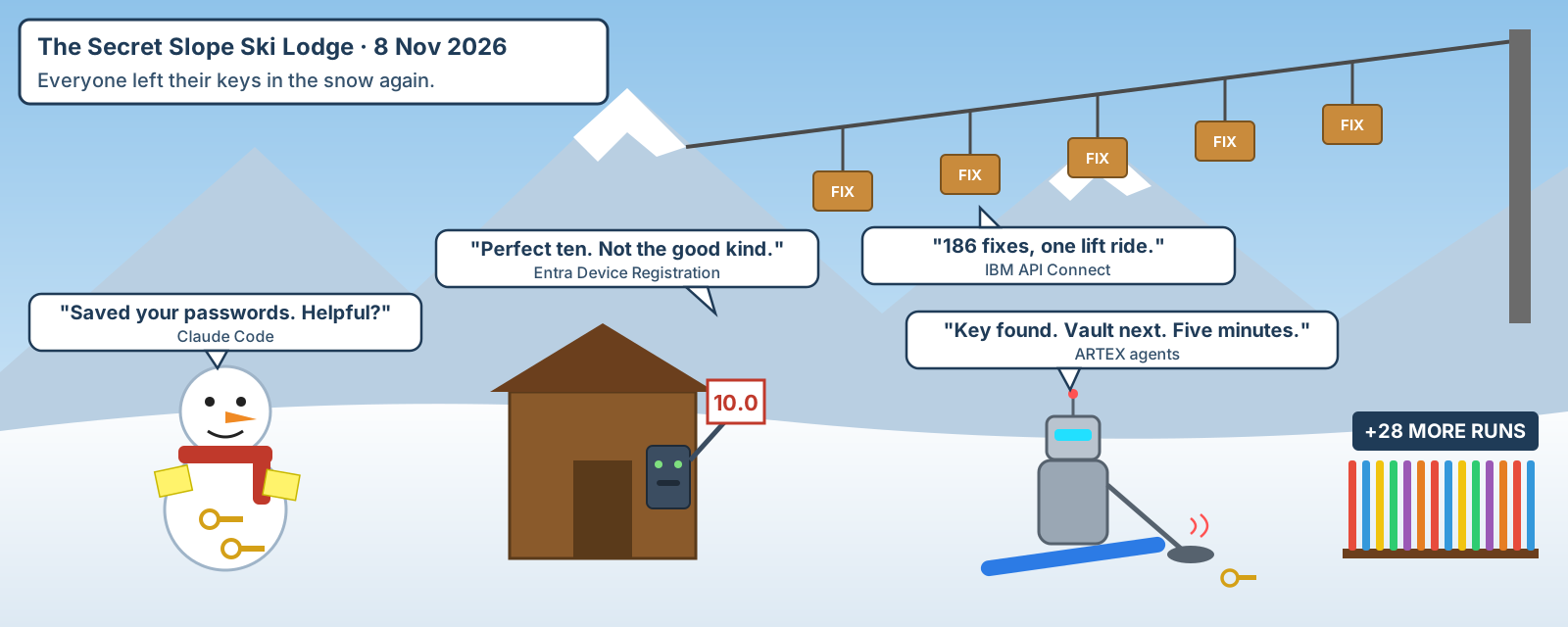
Secrets are this weekend’s theme. Apiiro found more than a thousand public repositories where Claude Code’s local permission file had saved passwords and tokens in plain text. Microsoft separately describes ARTEX-driven agents that search GitHub for leaked app secrets and reach Azure Key Vault about five minutes later. IBM’s bulletins for API Connect fix well over a hundred CVEs, dozens of them critical, and Microsoft has given a CVSS 10.0 Entra Device Registration flaw a CVE. The KEV catalog has had no additions since SonicWall on 6 November, so next week’s deadlines are the patching priority.
Do today
- IBM API Connect: upgrade 10.0.8.x to 10.0.8.13 and V12 OnPrem to 12.1.1.3. IBM lists no workarounds for the batch, which includes unauthenticated authentication bypasses rated 9.8. (IBM bulletin, V10, IBM bulletin, V12)
- Repositories using coding agents: search your organisation and its git history for
.claude/settings.local.jsonand.claude/settings.json. Rotate any credential you find before you clean up, then add the local file to.gitignoretemplates. (Apiiro research, Claude Code issue #5544) - Entra ID workload identities: Microsoft lists 199.19.77[.]84 and 199.19.77[.]18 as infrastructure in an agent-driven secret-abuse campaign. Search service-principal sign-in logs for both, treat a burst of AADSTS7000215 or AADSTS7000222 failures followed by a success as urgent, and rotate the client secrets on any app that matches. (Microsoft Threat Intelligence)
- IBM Aspera Faspex 5.0.0–5.0.19: move to 5.0.19 PL1. IBM lists no workaround for the admin-takeover flaw. (IBM bulletin)
- KEV deadlines this week: Adobe Commerce CVE-2026-48356 and Brotli CVE-2026-111497 are due Tuesday 10 November, VMware ESX CVE-2026-41709 on 11 November, and Ivanti Connect Secure CVE-2026-118527 on 13 November. (CISA KEV feed mirror)
AI and agent security5 stories
- Claude Code “don’t ask again” rules leak live credentials into public repositories — Apiiro looked at more than 104,000 copies of
.claude/settings.local.jsonin public repositories. When a user approves a command permanently, Claude Code stores that exact command line, so any password or token typed into it is saved as well. 1,122 of the files contained at least one secret, 1,379 secrets in all, and more than a third of them were database credentials. Counting the shared settings file, git history and saved chat logs, Apiiro reaches 2,539 secrets across 1,994 repositories. Common scanners each missed a large share: gitleaks flagged 564 files and TruffleHog 643, and 215 were flagged by neither. The bug was first reported in August 2025, and a bot closed the issue as “not planned” in January for inactivity, not on its merits. Our take: treat every agent configuration directory (.claude/,.cursor/,.gemini/and the like) as a place secrets end up. Add those directories to pre-commit and CI secret scanning, put credentials in environment variables, and approve command patterns rather than exact commands. (Apiiro research, Claude Code issue #5544, Claude Code permissions docs) - Microsoft: ARTEX agents go from a GitHub secret search to Key Vault exfiltration in about five minutes — Microsoft Threat Intelligence says the framework began sending large volumes of GitHub secret-search queries in August. Service-principal sign-ins from the campaign’s IPs began on 28 October. Once in, the agents list Azure subscriptions and take storage keys, connection strings and Key Vault contents. They also search mail and SharePoint through Graph and use Run Command on VMs. They retried failed ARM calls with corrected requests within about 28 to 80 seconds. Microsoft also saw a compromised multitenant vendor app used against downstream tenants. The IP 199.19.77[.]84 is the same one Todyl reported on 6 November, so this is now confirmed by a second, independent source. Our take: deleting a leaked secret from a repository does nothing. Rotation does, and moving OAuth apps to managed identities removes the secret altogether. (Microsoft Threat Intelligence)
- Microsoft: Storm-3358 is using ARTEX against banks — Microsoft says Storm-3358, a financially motivated cluster it places in Cambodia, has used ARTEX against financial organisations since October. Its targets are mostly in Southeast Asia, plus some large institutions elsewhere. The agents exploit anonymous file upload and SSRF bugs, drop web shells, and use curl and netcat to install the WISP, vshell and AdaptixC2 RATs. Microsoft listed 91.92.240[.]238 as an ARTEX server first seen on 4 November. Its advice leans on deception: honeypots, tarpits and fake successes keep autonomous agents busy and away from production. Our take: user-agent blocks won’t hold, because agents change fingerprints easily. Rate-of-change detections work better, such as bursts of varied requests and quick retries of the same technique. (Microsoft Security blog)
- Claude Enterprise adds a security posture page, GA inference hooks and EDR inside Cowork — Anthropic’s 5 November update adds a beta security center that compares an organisation’s chat, Cowork and Claude Code settings with Anthropic’s recommended baseline and exports the result for auditors. Inference hooks are now generally available. They pass prompts and pending tool calls to existing DLP or security tools before anything runs. New beta controls let admins sign a member out through the Admin API, manage IP allowlists, block personal accounts on managed machines and limit which workspace folders Claude can use. Admins can also run their own EDR sensor, in detection mode, inside the Cowork VM. Our take: the pre-tool-call hook is the useful part, since it puts an enforcement point in front of agent actions. A posture page only scores the vendor’s own baseline. (Anthropic)
- Open WebUI: researcher says the Windows installer’s session key can be recovered in seconds — A post to oss-security says Open WebUI’s Windows start script creates
WEBUI_SECRET_KEYwith a Crand()seeded by the install time in seconds. The author reports recovering the key in about 2 seconds from one ordinary user token, then forging an admin token. They say all 178 release tags build the key this way, and that only v0.12.0 and later add a per-account stamp that blocks forging tokens for other accounts. The issue was filed earlier as CVE-2025-15603, which the vendor disputed and which was rejected in June. These are the researcher’s claims and have not been independently confirmed. Our take: if you run Open WebUI on Windows, set your own randomWEBUI_SECRET_KEYinstead of relying on the installer’s. (oss-security post)
Application security8 stories
- Apache Axis2/Java 2.0.2 fixes XXE, two SSRFs and several resource-exhaustion bugs — The Axis project published seven advisories on 6 November, all fixed in 2.0.2. CVE-2026-120761 is an XXE in WSDL and XSD imports that can read local files when a client builds a service from an untrusted WSDL. CVE-2026-123753 lets an unauthenticated caller set a WS-Addressing ReplyTo or FaultTo address that the server then connects to. CVE-2026-120832 is a second SSRF through schema import resolution. The rest cover unbounded JSON and multipart request bodies, metadata routes that ignore
exposeServiceMetadata, and XSS in the Swagger UI page. Starting with 2.0.2, Axis2 refuses decoupled replies unless an operator explicitly allows them. Our take: if you have old SOAP services, they probably run this stack, so look for it in build manifests as well as running hosts. (oss-security: CVE-2026-120761, oss-security: CVE-2026-123753) - Apache James 3.9.1: WebAdmin exposed without authentication in the official Docker files, plus six more fixes — The project’s own docker-compose files exposed the WebAdmin REST API without authentication (CVE-2026-74756). James rates that low, and 3.9.1 now sets a random credential by default. Other fixes cover a JMAP path that ignores IMAP deny rules (CVE-2026-49939), cross-user path traversal in ManageSieve, an SSRF filter bypass in JMAP push subscriptions, a missing JWT audience check in OAUTHBEARER, and two MIME parsing denial-of-service bugs. Our take: if you built James from the official Docker files, check whether WebAdmin is reachable. James rates the bug low, but on an exposed deployment that is a full admin API with no login. (oss-security: CVE-2026-74756, oss-security: CVE-2026-49939)
- zlib 1.4 ships a long list of memory-safety fixes — The 1.4 release fixes CVE-2026-85091, a buffer overflow in non-blocking
gzwrite(), and CVE-2026-4738, out-of-bounds pointer arithmetic ininfback9. The release notes say the critical rating on CVE-2026-4738 overstates it. There are also several fixes without CVEs, some from a Trail of Bits audit. The largest is ininflateGetDictionary(), which in 1.3.1 and 1.3.2 could write up to 8 MB past a 32 KB buffer. Others fix overruns ininflateSync,inflatePrimeanddeflatePrime, and minizip bugs including a double free and directory traversal inminiunzon Windows. Our take: zlib is vendored almost everywhere, so most exposure will come through bundled copies that distributions and SBOM tools don’t track. (oss-security: zlib 1.4) - CPython generic types give a way out of the Jinja sandbox — Sybil researchers reported a sandbox escape that abuses how CPython handles generic types. It works through objects present in every Jinja template, even with an empty sandbox context. A fix has been submitted as CPython PR 155761, but it will not be backported to security releases, and no CVE is listed. Our take: if you render untrusted templates, including LLM prompt templates that users can edit, don’t rely on the Jinja sandbox alone. Run that rendering in a separate, unprivileged process. (oss-security: CPython sandbox escape)
- Go 1.27.4 and 1.26.11 are due Tuesday 10 November with 12 private security fixes — The Go team pre-announced fixes to the standard library and toolchain under CVE-2026-97033 through CVE-2026-97043 and CVE-2026-97054. It gave no severities or package names. Node.js releases for 22, 24 and 26 are also expected on or after 11 November. Our take: plan one rebuild for both toolchains, including base images and statically linked Go binaries, which pick up the fixes only when rebuilt. (oss-security: Go pre-announcement)
- InfiniteWP Client: researcher says the NOSSL signing key has about 31 bits of secret — Another oss-security post describes a weaker signing mode, NOSSL, in the InfiniteWP Client WordPress plugin (version 1.13.10). A panel setting can select it, and its signing key comes from PHP
rand(). The author says they recovered a key offline in under five minutes from one captured request and forged amaintain_sitecommand that the site accepted. Only sites enrolled through NOSSL are exposed, and their number is unknown. No patch, vendor response or CVE is mentioned. Our take: if you manage WordPress fleets with InfiniteWP, check how each site was enrolled and re-enroll any using NOSSL. (oss-security post) - Two WooCommerce plugins with unauthenticated file-write RCE rated 9.8 — Wordfence published CVE-2026-93754 in the payever Checkout gateway, all versions through 4.8.0. Three API callbacks have no authentication, so an attacker can make the plugin save a remotely fetched PHP file into uploads, and a separate flaw allows its identity to be overwritten using hard-coded credentials. CVE-2026-19803 affects Printcart Store through 2.13.2. A crop-image handler writes attacker-controlled PHP outside uploads when the Advanced Upload Popup is enabled, and the required nonce is exposed on a public page. Fixed versions are not confirmed in the records we checked. Our take: if a fixed release isn’t installed, disable the plugin. (NVD CVE-2026-93754, NVD CVE-2026-19803)
CVSS 9.8 (v3.1, Wordfence)KEV no - RubyGems:
gem listcan run someone else’s code, and five old malicious gems are still listed — Aikido points out that gems run code at install time, and that plugins load even on read-only commands such asgem list. While testing new detections it found five gems from 2013–2015 that phone home or take a silent macOS screenshot on install. It reported them on 30 October, and they were still available on 4 November. RubyGems and Bundler 4.1.0.beta3 add settings to turn off native-extension builds and plugin loading, but they are off by default and stable 4.0.x doesn’t have them. Our take: the old gems matter less than the default. Unpack and inspect new gems in a throwaway environment, and turn on the new settings once you’re on a release that has them. (Aikido)
Exploited and critical CVEs5 stories
- IBM API Connect: well over a hundred CVEs fixed at once, dozens of them critical — IBM’s 5 November bulletins cover about 135 CVEs for V10 (fixed in 10.0.8.13) and about 186 for V12 OnPrem (fixed in 12.1.1.3), with the two lists likely overlapping. NVD added dozens of critical records on 7 November, rated 9.0 to 9.9. They include an unauthenticated authentication bypass through signature verification (CVE-2026-17301), hard-coded admin credentials (CVE-2026-17360), OS command injection, LDAP injection with cross-tenant admin access, and many SSRF and path-traversal bugs. IBM lists no workarounds. The affected ranges differ between the bulletin text and its metadata, so scope from the “Affected Products” section. No exploitation is reported. Our take: API gateways handle tokens for everything behind them, and several of these flaws cross tenants. Patch in this cycle, not the next quarterly one. (IBM bulletin, V10, IBM bulletin, V12, NVD CVE-2026-17301)
CVSS 9.8 (v3.1, IBM, CVE-2026-17301)EPSS 0.0044KEV no - IBM Aspera Faspex 5.0.0–5.0.19: a crafted message gives full admin rights (CVE-2026-123218) — IBM fixed an authorization bypass in 5.0.19 PL1 and lists no workaround. IBM’s description says an authenticated user is needed, but the CVSS vector says no privileges are required. That gap matters on internet-facing Faspex, where self-registration or external user invites exist. Our take: file-transfer appliances have been ransomware targets before, so move this ahead of routine patches. (IBM bulletin, NVD CVE-2026-123218)
CVSS 9.8 (v3.1, IBM)EPSS 0.0040KEV no - Apache Axis 1.x: unauthenticated class loading from SOAP faults, and no release will fix it (CVE-2026-90436) — Every Axis 1.x through 1.4 loads the class named in an inbound fault’s
exceptionNamebefore checking its type. That runs static initialisers and can lead to remote code execution, depending on what is on the classpath. It happens before any service-level authentication handler runs. The project rates it critical, has published a patch commit for teams that build Axis themselves, and recommends migrating away. Our take: Axis 1.4 is often still bundled inside old vendor appliances and middleware. Ask your suppliers whether it is in their products, because you won’t see it in your own dependency tree. (oss-security: CVE-2026-90436)EPSS 0.0057KEV no - KEV: no additions since SonicWall on 6 November; four deadlines this week — The catalog is at version 2026.11.06. Its newest entry is still SonicWall SonicOS SSL-VPN CVE-2026-19868, due 20 November. Adobe Commerce CVE-2026-48356 and Brotli CVE-2026-111497 are due Tuesday 10 November, VMware ESX CVE-2026-41709 on 11 November, and Ivanti Connect Secure CVE-2026-118527 on 13 November. No entry in the window is marked as used in ransomware. Our take: the Brotli fix lands in many runtimes and libraries, not one product, so inventory is the slow part. Confirm that last week’s runtime updates actually reached your deployed images. (CISA KEV feed mirror, CISA alert, 6 November)
- TOTOLINK CA300-PoE: four buffer overflows, public exploit, no vendor fix listed — VulDB published CVE-2026-123957 through CVE-2026-123960 on 7 November against firmware 6.2c.884. They are overflows in the
setIpQosRules,setLanConfig,setLanguageCfgandsetWanConfighandlers ofcstecgi.cgi, and each needs a low-privilege login. The records say exploit details are public, and they cite no vendor advisory or fixed firmware. This follows the run of unpatched TOTOLINK and WAVLINK router records covered last week. Our take: this is a ceiling-mounted access point, so management access should be restricted to a management VLAN. If you can’t do that, plan to replace the device. (NVD CVE-2026-123957)CVSS 9.9 (v3.1, VulDB)EPSS 0.0047KEV no
Cloud and infrastructure5 stories
- Entra Device Registration: a CVSS 10.0 authorization bypass now has a CVE (CVE-2026-109469) — Microsoft published the CVE on 6 November as a network-reachable privilege escalation through a user-controlled key (CWE-639), with no privileges or user interaction required and a changed scope. NVD tags it as an exclusively hosted service. Microsoft usually fixes those on the server side, but we couldn’t load the MSRC FAQ to confirm whether customers need to do anything. No exploitation is reported. Our take: the fix may be server-side, but device registration is a trust anchor for Conditional Access. Check device-join and registration audit logs for unexpected registrations over the past few weeks. (MSRC CVE-2026-109469, NVD CVE-2026-109469)
CVSS 10.0 (v3.1, Microsoft)EPSS 0.0067KEV no - Xen XSA-526, 527 and 528: guest-triggered use-after-free in Linux netback and blkback — Three advisories were published on 6 November without an embargo, because a closely related issue was already public. A guest can trigger freed-memory reads in xen-netback’s statistics (Linux 4.11 and later) and multicast lookup (Linux 4.3 and later), and in xen-blkback’s statistics. The likely result is a host crash, and information leaks can’t be ruled out. Patches are attached. The workaround is a userspace PV network backend or a network driver domain for each guest. XSA-527’s patch is marked for 5.5 through 7.4-rc, so check older kernels with your distributor. Our take: this is a host denial-of-service risk on multi-tenant Xen, not a guest escape, so schedule it with your next kernel rollout. (XSA-526, oss-security: XSA-527)
- ingress-nginx: a mirror-target annotation can take down the data plane, and no upstream fix is coming (CVE-2026-116472) — The Kubernetes project disclosed that a user who can create an Ingress can use the
mirror-targetannotation to deny service on the controller and possibly redirect other Ingresses’ traffic. It rates this low (CVSS 2.7) because creating Ingresses already requires high privileges. Upstream maintenance ended in March 2026, so the only fixed build named is SUSE’s 1.15.2-prime1 fork. The mitigation is an admission rule that rejects the annotation, or settingannotations-risk-levelto Medium or Low. Our take: the bug is minor. What matters is that new bugs in ingress-nginx now stay unpatched, so put a migration date in writing. (Kubernetes advisory on oss-security)CVSS 2.7 (v3.1, Kubernetes)KEV no - AWS: GluonTS tar extraction writes outside its directory, and an Amplify map library has stored XSS — AWS bulletin 2026-171 covers CVE-2026-119083. GluonTS before 0.17.0 follows symlinks and hard links in crafted tar archives, so it can write files anywhere the extracting process can. The fix is 0.17.0, and Python 3.14’s default tar filter blocks the technique. Bulletin 2026-167 covers CVE-2026-121652 in
maplibre-gl-js-amplify4.0.2 and earlier, which puts GeoJSON properties and geofence IDs into popups through innerHTML. It is fixed in 4.0.3, and AWS says there is no full workaround. AWS gave neither a CVSS score. Our take: shared model and dataset archives are untrusted input, the same as user uploads. (AWS bulletin 2026-171, AWS bulletin 2026-167) - Veeam Software Appliance 13.1+ can kernel-panic at boot on some AMD EPYC hosts — Veeam KB4960 says a FIPS-mode jitterentropy self-test fails intermittently during early boot on some EPYC parts, including the 7262, 7302 and 7F72, and the kernel panics. There is no kernel fix yet. Veeam suggests moving the appliance to a host with a different CPU, or turning off automatic updates and watching each manual update through its reboot. If it panics, power-cycle the VM, because a guest restart won’t recover it. Our take: this is not a vulnerability. It does put backup availability at risk, so test restores after each appliance update. (Veeam KB4960)
Crypto and Web34 stories
- Polygon: Binance and Polymarket propose a hard fork to move 70.49M frozen POL out of attacker addresses — A PIP posted on 4 November would zero the native POL balances of five blocked attacker addresses at a set block and credit the same amounts to recovery wallets. About 23.86M POL would go to Polymarket from four addresses and about 46.63M POL to Binance from one. Total supply stays the same and no transactions are rolled back. Press estimates put the value at roughly $6.5M to $6.8M, depending on the price used. The proposal still needs governance approval, Bor engineering sign-off, a rehearsal on the Amoy testnet, proof that the victims control the recovery wallets, and upgrades by most validators. It also says the attacker has offered validators cash to unblock a transaction. Our take: moving funds out of addresses by changing the protocol, without their keys, is a precedent for any chain with a block list. Anyone who depends on finality should read the validator debate closely. (Polygon forum PIP)
- Gnosis Pay: customer data taken from the legacy card platform — Gnosis Pay says it detected unauthorised access to the system behind its own-brand cards on 3 November and began containment within two hours. It replaced the affected credentials, fixed the vulnerability, and made 3D Secure mandatory for online payments until the system is retired on 20 December. It says customer funds and its white-label enterprise platform were not affected. It hasn’t said publicly which data was taken or how many customers were affected, but has emailed affected customers the details for their own accounts. Our take: leaked card and wallet-holder records lead to targeted phishing and physical threats. Gnosis Pay’s warning about scam calls and letters that quote real account details should be taken seriously. (Gnosis Pay notice)
- SEAL: the Binance intruders were probably inside for about eight weeks — The Security Alliance places the Binance intrusion in TraderTraitor’s 2026 pattern of long, tailored operations. It sets this apart from the broader “Contagious Interview” lures and estimates about eight weeks of access before the 29 October theft. It gives comparable figures for LayerZero (about six weeks), Bitget (about six) and AFX (about three). SEAL lists citalab[.]net, citalab[.]com, bitfit[.]io and oddium[.]io as 2026 front-company domains. Its recommendations include removing standing production access, running interview code in disposable VMs and checking withdrawal instructions over a separate channel. Our take: weeks of dwell time leave room for detection. Test which lateral-movement and session-anomaly alerts actually fire on developer endpoints. (SEAL Radar)
- Elliptic: about $175M of Binance loot has now been swapped into bitcoin, and little has been cashed out — Elliptic’s update as of 7 November puts about 2,300 BTC (about $175M) of converted altcoins in new bitcoin addresses. That is on top of the bitcoin stolen directly. About $3.13B remains in linked addresses, mostly ETH and BTC, and $2.85B is frozen or seized. The laundering has used more than 20,000 wallets, 16 chains and at least 36 services. Press coverage of the same report a day earlier cited $124M swapped, so the figure has risen. Elliptic still judges that only a negligible amount has reached spendable fiat. Our take: the expected next step is small ETH-to-BTC batches through OTC desks. Screening teams should keep watching cross-chain swap services as well as exchanges. (Elliptic)
Incidents and industry5 stories
- Unit 42: refrigeration attacks reached 10 more countries, and more than 5,000 controllers are exposed — Unit 42 counts two overnight waves: about 700 French supermarkets on 11–12 October, then 100 to 115 sites in at least ten more European countries on 1–2 November. Some units were driven to 50°C, and French medical facilities were also affected. Between 5 and 6 November it found more than 5,000 internet-exposed controllers from the manufacturers named by CERT-FR. Exposure in France fell from 1,853 devices in early October to 316. Pro-Russian hacktivist groups claimed the attacks on Telegram, but the claims are unverified, and how the attackers got in is still unconfirmed. Our take: the falling French numbers show that removing controllers from the internet works. Finish that step before buying new tooling. (Unit 42, CISA joint fact sheet)
- UK plans powers over “loss of control” incidents involving AI agents — A government factsheet updated on 3 November sets out four measures under the Cyber Security and Resilience Bill: security requirements for agent deployments, notifying other organisations an agent affected, preserving evidence of what the agent did, and ministerial post-incident reviews by government technical experts. Each would need secondary legislation approved by Parliament after consultation. Our take: operators of essential services and managed service providers should start keeping agent action logs now, because preserving evidence is the measure least likely to change. (GOV.UK factsheet, Bill progress)
- EU preliminarily finds TikTok’s “For You” feed breaches the DSA — On 6 November the Commission said TikTok had not adequately assessed the risk that its feed pulls users into repetitive streams about mental-health struggles and body image. It also found the safeguards ineffective, since viewing time outweighs users’ stated choices. It wants recommendations to rely more on explicit preferences and less on viewing time. A final decision could bring a fine of up to 6% of worldwide turnover. TikTok can respond to the findings. Our take: this is the first DSA case against a major platform’s engagement-based recommender, and other platforms’ risk assessments will be compared with it. (European Commission press release)
- Microsoft Q3 email data: phishing volume up, QR lures down, security overrides let much of it through — Microsoft counted about 7.3 billion email threats in Q3, with September 41% above August. QR-code phishing fell 67% from Q2. CAPTCHA-gated phishing came back, driven by SVG attachments. Credential theft was the goal of about 95% of payload attacks. In September, admin overrides applied to 63% of messages that had a recorded security outcome, which let many messages that failed authentication reach inboxes. Malicious Teams calls now mostly use personal names rather than help-desk identities. Our take: audit tenant-level allow rules and spoofing exceptions, since they let a lot of this mail through. (Microsoft Security blog)
- CrowdStrike to buy Fiddler and Dreadnode for agent observability and AI red-teaming — CrowdStrike announced both deals on 3 November. Fiddler adds a record of what AI agents did and why. Dreadnode adds automated security testing of models, applications and agents before deployment. Our take: security vendors are buying in agent observability and testing as products. Buyers should ask what the tools can block before an agent acts, not only what they log afterwards. (CrowdStrike: Fiddler, CrowdStrike: Dreadnode)
Bottom line
- Leaked secrets are now found and used within minutes. Agent configuration files are a new place they leak, and Microsoft shows agents searching for them at scale. Rotate anything that has been exposed, and scan agent directories in CI.
- Fix IBM API Connect and Aspera Faspex this cycle. Both have critical, network-reachable flaws and no workarounds.
- Crypto recovery is moving to the protocol layer. Polygon’s proposed hard fork would move frozen funds without the attacker’s keys, and the validator vote will set a precedent for future thefts.