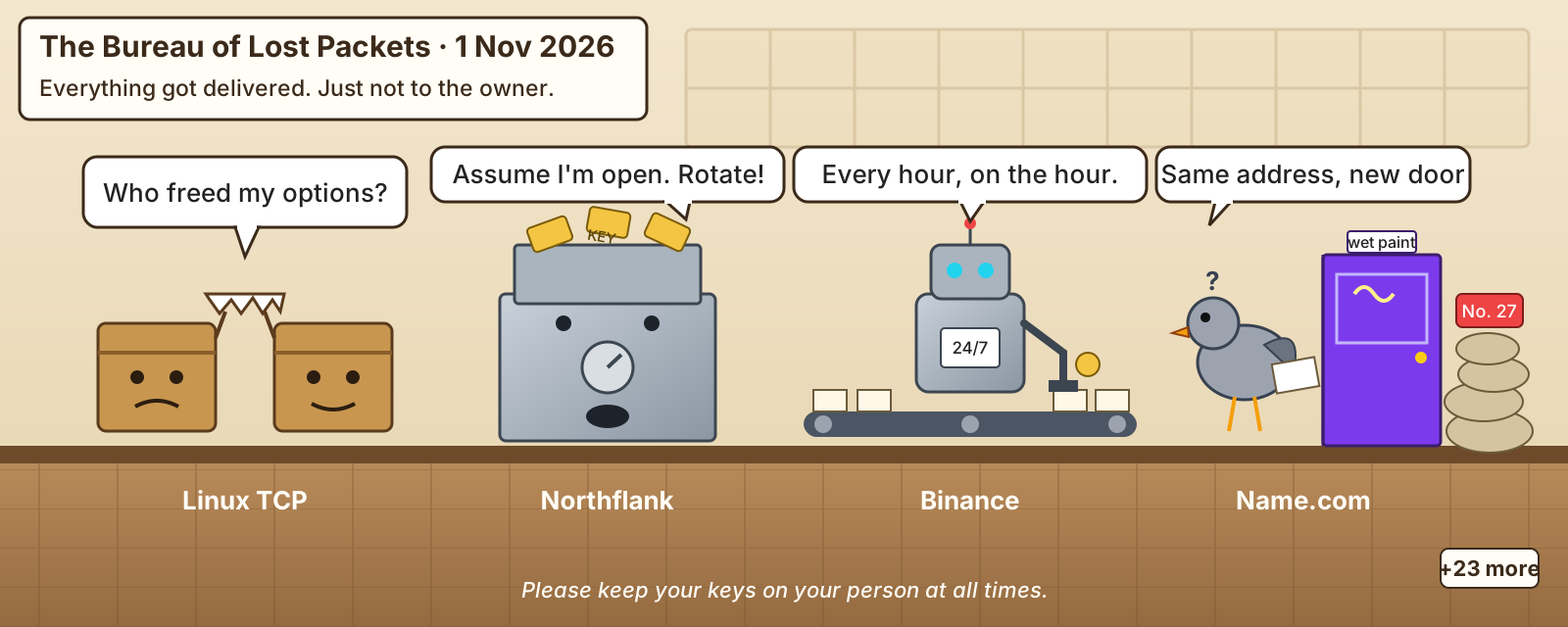
Fixes for the Linux IPv4 TCP use-after-free (CVE-2026-98432) are now rolling out across AWS, with dates running from 1 to 3 November. Red Hat’s CVE page now rates it Critical, but Ubuntu still has no fixed kernel for any supported release. Northflank told customers to assume every environment variable was decrypted after an attack that Wiz counts as one of nine against AI developer platforms this month. Elliptic finds Binance’s stolen funds being laundered by software, hour after hour, and on Friday night attackers hijacked a dozen DeFi front-ends registered with Name.com.
Do today
- Linux kernel (CVE-2026-98432): on Amazon Linux, update the kernel and reboot, and move EKS and ECS nodes to the 20261031 AMIs. On Ubuntu, and on RHEL until errata ship, drop IPv4 packets that carry IP options at the edge, and keep database ports off the internet. (AWS bulletin 2026-160, Ubuntu tracker)
- Northflank and other AI developer platforms: rotate every user-provided secret, revoke AI provider keys at the provider, check AI usage and billing logs, and disable public access to add-ons. (Northflank status, Wiz)
- GitLab and Cisco ASA/FTD: today is the federal KEV deadline for CVE-2026-97229 and CVE-2026-76418. Ivanti Connect Secure CVE-2026-111357 is due tomorrow. (CISA KEV feed mirror)
- DeFi front-ends: turn on registrar lock and account MFA, and set up alerts for DNS and nameserver changes. Users who connected a wallet to Flap, Kintsu, Pickle, Origami, FluxBeam, Echelon, StonkFun or StakePoint on Friday night should revoke token approvals. (Vercel bulletin)
- WordPress: remove or update WP Project Manager (4.1.1 and older) and PDF Invoice for WooCommerce (7.1.1 and older) until you’ve confirmed you’re on a fixed release. (NVD CVE-2026-116512, NVD CVE-2026-109220)
AI and agent security4 stories
- Wiz: nine AI developer platforms breached in October, and stolen keys used within 30 minutes — Wiz’s “Black October” report, published on 30 October, lists incidents at Fireworks AI, Andromeda, Zeabur, Lightning AI, OpenCode, Railway, Warp, CommandCode and Northflank. It finds no single shared vulnerability. The common thread is attackers hunting for stored environment variables, especially AI provider keys. Each stolen enterprise key was first used within half an hour, in a one-minute sweep across several organizations. In two Amazon Bedrock cases, about 2.5 million calls ran for 13 to 30 hours and likely cost more than $100,000 at list price. Wiz notes that a key restricted to US inference profiles was throttled far more than one allowed global profiles. Our take: these platforms hold your keys in plain reach, so scope each AI key to the models and regions it needs, and alert on the first call from a new network. (Wiz)
- Northflank: assume every environment variable was decrypted — Northflank’s status page says a Wiz alert at 11:43 UTC on 30 October started an incident. Within hours the company told customers to assume all environment variables were decrypted and to rotate everything. Later that day it confirmed that several customers had seen unauthorized use of AI API keys stored on the platform. Since then it has turned on audit logs for every account, including free tiers, and added secret rotation for Postgres, MongoDB, MySQL, Redis, MinIO and RabbitMQ. The last of these came at 23:31 UTC on 31 October. It hasn’t disclosed the entry point or how many customers were affected. Our take: rotating secrets on the platform isn’t enough. Revoke the keys at each provider as well, because copies already taken stay valid until you do. (Northflank status, BleepingComputer)
- ChatGPT: a shared chat link could run code in the viewer’s session — Parameter reported to OpenAI on 18 October that a malicious public share link could run attacker code in the signed-in session of anyone who opened it. The code could read their private conversations and act on their account. OpenAI raised the report to P1, fixed both web frontends by 26 October and paid $5,000. Parameter published its write-up on 28 October. The cause was a third-party math-input component that accepted a settings message without checking who sent it, combined with frames that inherited the chatgpt.com origin. The fix is server-side, and Parameter saw no use in the wild. Our take: shared AI chats are now a way to deliver attacks, and third-party UI widgets inside them can bypass the protections the host app has. (Parameter)
- Sophos: GOLD OGRE built its Aur0ra agent framework itself, then handed it to affiliates — Sophos’s Counter Threat Unit says, with high confidence, that the group behind Aur0ra ransomware tested evasion in a Cursor-based framework and then gave affiliates similar tooling. The post carries no date and was picked up by roundups on 30 October. Operators supplied VPN credentials and objectives. Agents then ran Active Directory discovery, Kerberoasting, NTLM relay and lateral movement with little human oversight, while people kept control of initial access and ransomware deployment. Sophos says operators got past model safeguards by describing the work as authorized red teaming. The models involved were Anthropic’s at first, with xAI, Moonshot and Cursor’s Composer added later. Our take: the defences are the same ones that stop human operators, namely phishing-resistant MFA on VPNs, tiered admin accounts and segmented backups, but the window to respond is shorter. (Sophos)
Application security5 stories
- Android “SMS of Death”: a single data SMS crashes the phone process, and Android 12 and 13 stay unpatched — Researcher Mark Blah disclosed on 29 October a zero-click denial of service in Android’s WAP Push decoder. A crafted data SMS crashes
com.android.phone, which drops active calls, including emergency calls. Redelivered or stored messages can put devices into reboot loops, and in one case a factory reset was needed. Google’s fix (“Fix remote DoS in decodeWapPdu”, committed 5 August) shipped in the October 2026 update for Android 14 through 17. Android 12 and 13 are outside the support window and get nothing. Press reports use CVE-2026-58882, but NVD has no record yet, and the researcher says the fix isn’t listed in October’s bulletin. A public PoC exists. Our take: for corporate fleets, set the October 2026 patch level as the minimum, and treat Android 12 and 13 devices as a safety-of-life issue, not just a hygiene one. (researcher write-up, AOSP commit)CVSS unconfirmedEPSS not yet scoredKEV no - WP Project Manager: unauthenticated code execution through route validation (CVE-2026-116512) — Wordfence’s record, published to NVD on 31 October, says weDevs Project Manager through 4.1.1 passes an unsanitized
idparameter into dynamically dispatched PHP functions during validation. That gives unauthenticated attackers code execution. The record names no fixed version, but a changeset to the validator is linked. Our take: with no EPSS signal yet and no KEV entry, this goes in the normal patch cycle, but unauthenticated RCE in a common plugin attracts scanners quickly. (NVD, Wordfence)CVSS 9.8 (v3.1, Wordfence)EPSS 0.0058KEV no - PDF Invoice for WooCommerce: object injection from the checkout note (CVE-2026-109220) — The addonsorg plugin through 7.1.1 deserializes the
customer_notecheckout field. Wordfence rates this as unauthenticated PHP object injection that can lead to code execution. The record links a 7.2.0 download but doesn’t say that version fixes the flaw, so treat the fixed version as unconfirmed. Our take: anyone who can place an order can reach this, so storefronts should move first. (NVD, Wordfence)CVSS 9.8 (v3.1, Wordfence)EPSS 0.0052KEV no - Uncanny Toolkit for LearnDash: log in to unverified or suspended accounts (CVE-2026-119096) — Through 3.8.2, the plugin’s
uo_login_action()trusts the email parameter in a way that lets attackers log in to accounts that should be blocked, Wordfence says. No fixed version is named, but a code change is linked. Our take: learning sites that suspend accounts for compliance reasons should check their audit logs as well as patching. (NVD, Wordfence)CVSS 9.8 (v3.1, Wordfence)EPSS 0.0046KEV no - SimpleForm and three more WordPress plugins with critical records on 31 October — SimpleForm through 3.10.2 lets a trailing-dot filename get past its extension and MIME checks, which allows arbitrary file upload (CVE-2026-118235, 9.8). Wordfence’s other critical records that day were these. Our take: the Popup Builder and SimpleForm records don’t require a login. Inventory your plugins against this list. (NVD CVE-2026-118235, Wordfence)
CVSS 9.8 (v3.1, Wordfence)EPSS 0.0074KEV no- Popup Builder through 4.4.5: unauthenticated trashing of every published popup (CVE-2026-89270, 9.1). (NVD)
- Acadlix LMS through 1.1.9: arbitrary file deletion that can take out
wp-config.php(CVE-2026-103882, 9.1). (NVD) - WP Booking System through 2.1.0.5: any subscriber can delete calendar notes (CVE-2026-116557, 9.1). (NVD)
Exploited and critical CVEs5 stories
- Linux TCP use-after-free: Red Hat now rates it Critical, and Ubuntu still has no fixed kernel (CVE-2026-98432) — When this was covered on Friday, vendors disagreed on severity. Red Hat’s CVE page now shows a preliminary 9.8 and a Critical rating. It still notes that reliable exploitation needs precise heap control, and it lists no errata yet, pointing to bulletin RHSB-2026-016 for mitigations. Ubuntu’s tracker, updated 30 October, shows every supported release from 16.04 to 26.10 as vulnerable. Fixes are in progress for 22.04, 24.04, 26.04 and 26.10, with none for 20.04 and older. NVD hasn’t scored it. Anthropic’s researchers reached remote root on a server with an MPTCP listener, and remote code execution without MPTCP hasn’t been shown publicly. There’s no KEV entry or confirmed exploitation. Our take: the low EPSS score reflects the absence of a public exploit, not low risk. Prioritise internet-facing Go services, which turn on MPTCP by default from Go 1.24. (Red Hat, Ubuntu)
CVSS 9.8 (v3.1, Red Hat, preliminary)EPSS 0.0046KEV no - KEV: no additions since 30 October; GitLab and Cisco due today, Ivanti tomorrow — The feed is still at catalog version 2026.10.30. Today, 1 November, is the deadline for GitLab CVE-2026-97229 and Cisco ASA/FTD CVE-2026-76418. Ivanti Connect Secure CVE-2026-111357 is due on 2 November. After that come Adobe Commerce CVE-2026-48356 and Brotli CVE-2026-111497 on 10 November, VMware ESX CVE-2026-41709 on 11 November, and Ivanti CVE-2026-118527 on 13 November. Our take: the Ivanti pair are links in one root chain, so patching only the item due tomorrow leaves the chain partly open. (CISA KEV feed mirror)
- Jpom: a crafted token header gives unauthenticated super-admin access (CVE-2026-120201) — VulnCheck’s advisory, published on 31 October, says Jpom 2.10.0 through 2.11.12 passes the
JPOM-USER-TOKENheader into Hutool query parsing, where it can be read as an operator. That bypasses authentication and leads to super-admin access and script execution. No fixed version is stated. Our take: Jpom is a deployment and operations console that runs scripts on managed servers, so take it off the internet until a fix is confirmed. (VulnCheck, NVD)CVSS 9.8 (v3.1, VulnCheck)CVSS 9.3 (v4.0, VulnCheck)EPSS not yet scoredKEV no - AJ-Report: a hard-coded JWT secret lets attackers forge share tokens and reach code execution (CVE-2026-120209) — AJ-Report through 1.7.1 signs share tokens with a fixed secret, VulnCheck says, so attackers can forge them offline. A forged token reaches an endpoint that compiles Groovy, which gives unauthenticated RCE. No fixed version is stated. It’s the third published-default-key flaw in a self-hosted tool in two days, after OpenDeepWiki and MuseBot. Our take: in any self-hosted dashboard, search the configuration for signing keys that ship with the product, and replace them. (VulnCheck, NVD)
CVSS 9.8 (v3.1, VulnCheck)CVSS 9.3 (v4.0, VulnCheck)EPSS not yet scoredKEV no - D-Link DIR-505 and three WAVLINK devices: public exploits, no fixes listed — VulDB published CVE-2026-120189 overnight. It’s a stack overflow in the DIR-505’s TFTP upload filename handling on firmware 1.10B02, scored 10.0, with a public exploit. CVE-2026-120195 (10.0) is an unauthenticated command injection in WAVLINK WL-WN579A3-A. CVE-2026-120196 and CVE-2026-120197 (9.9) are command injections in two more WAVLINK models that need a low-privileged login. None of the records gives a fixed firmware. Our take: these are consumer and travel routers, so the risk falls on unmanaged home and branch networks. Replace them rather than wait for firmware. (VulDB CVE-2026-120189, VulDB CVE-2026-120195)
CVSS 10.0 (v3.1, VulDB)EPSS not yet scoredKEV no
Cloud and infrastructure4 stories
- AWS sets a three-day rollout for the Linux TCP fix, and says a reboot is the only full remedy — AWS bulletin 2026-160, first posted on 30 October and updated on 31 October, lists EC2, Lightsail, EKS, ECS, Fargate, Bottlerocket and Network Load Balancer TCP listeners as affected or needing action. So are PrivateLink, VPC Lattice, RDS, Aurora, Neptune, Redshift, Storage Gateway, Cloud9 and GameLift. Patched Amazon Linux 2 and 2023 kernels are out, and EKS and ECS AMIs dated 20261031 are available. Fargate tasks launched after 06:00 PDT on 1 November get the fix. Bottlerocket and Redshift follow on 2 November, and RDS, Aurora and Storage Gateway on 3 November. Cloud9 waits on Canonical. AWS says WAF, ALB, CLB, CloudFront and API Gateway were fixed at the infrastructure level, and Lambda is not affected. Our take: managed services cover only the fleet AWS runs. Self-managed instances behind those front doors still need a kernel update and a reboot within 30 days. (AWS bulletin 2026-160)
- Cloud Exposure Index: 484,142 publicly listable buckets, and 54,317 .env files written this year — Ransomnews indexed publicly listable buckets as of 7 October without opening any files. It found about 18.05 billion files, 321,058 of them credential- or key-type files, and published the index on 27 October. S3 made up 71.9% of open buckets, Azure Blob 14.2% and Google Cloud Storage 11.0%. Azure was over-represented among buckets named for backups, exports and HR or payroll, which the authors offer only as a hypothesis. They also stress that many of these buckets are public on purpose, and that the key counts are an upper bound that includes certificates and test fixtures. Our take: two-thirds of the listed .env files were written in 2026, so this isn’t old debris. Run a public-listing check on every bucket you own. (Ransomnews)
- Cloudflare Q3: 18.2 million network-layer DDoS attacks, with more short bursts and fewer giants — Cloudflare’s report, published on 29 October, counts about 8,226 network-layer attacks an hour and 14.4 trillion HTTP DDoS requests in Q3. That’s 38% more network-layer attacks than Q2’s 13.2 million. Attacks above 1 Tbps fell from 805 to 251, while short attacks under 10 minutes and 1 Gbps rose 208%. DNS amplification rose 215%. Our take: short, small bursts finish before a human can react, so mitigation has to be always on, not something an analyst switches on. (Cloudflare)
- Windows 11 Always On VPN fixed in the 28 October preview update — KB5127936 (builds 26200.9818 and 26300.9818) fixes Always On VPN connections that hung at “Connecting” or failed after the September security update. It applies where automatic protocol selection or fallback between IKEv2 and SSTP is set. It’s a non-security preview, so organizations that skip previews keep the problem until the November cumulative update. In the meantime, pinning profiles to IKEv2 only or SSTP only avoids it. Our take: VPN failures push users toward unmanaged workarounds, so if you’ve deferred September patches because of this bug, that reason no longer applies. (Microsoft KB5127936)
Crypto and Web35 stories
- Binance: the stolen funds are being laundered by software, every hour — Elliptic’s 31 October update (data as of 08:11 UTC) puts the 29 October theft at about $6.43 billion across 11 chains, with $2.85 billion verified frozen. About $93.5 million has left the main Tron distribution wallet to roughly 150 wallets. It has sent funds every hour for 31 hours, at up to $3–7 million an hour overnight. Repeated swap amounts and automatic re-sends after a bridge rejected deposits lead Elliptic to call the laundering software-driven. Traced routes include THORChain (about $25 million), SunSwap ($5.3 million) and Bitget Swap ($1.8 million). The figures still disagree: TRM gives $6.36 billion across ten chains and about $2.7 billion frozen, as of 00:30 UTC on 30 October. Our take: one-off address screening isn’t enough when funds keep moving, so re-screen deposits continuously against the updated blocklists. (Elliptic, TRM Labs)
- A dozen DeFi front-ends hijacked through Name.com, about $138,000 traced — On Friday night, 30 October, attackers took over the domains of DeFi projects registered at Name.com and pointed them to wallet-drainer pages. Affected projects include Flap, Kintsu, Pickle Finance, Origami, FluxBeam, Echelon, StonkFun and StakePoint. Vercel’s bulletin says Name.com is investigating a domain-takeover campaign aimed at DeFi companies. It says 10 of the affected domains were tied to Vercel, and that Name.com has restored them. Blockaid flagged 12 sites, and Name.com’s own count is 15 customer domains. The Block traced about $138,000 across three EVM wallets, excluding Solana and Aptos. We could not check that figure on an explorer, so treat it as a lower bound reported by the press. No root cause has been published. Our take: protect your registrar account as carefully as your contract admin keys, with registry lock, hardware MFA and monitoring of nameserver changes. (Vercel bulletin, The Block)
- TRM: North Korea has taken $12.8 billion since 2017, $7.4 billion of it this year — TRM Labs’ 30 October tally attributes about $12.8 billion across 100 incidents to North Korea. That includes $7.4 billion in 2026, or 85% of this year’s hack losses, up from 7% in 2020. Five incidents (Binance, Bybit, Ronin, Bitget and DMM Bitcoin) account for about $9.1 billion. Only 13 of the 100 were smart-contract exploits, and the rest hit keys, servers and signing systems. TRM notes that no government has yet attributed the Binance theft. Our take: for exchanges and custodians, the main threat is social engineering of engineers and their laptops, not contract code. (TRM Labs)
- zkLink Nova: a forged batch root drained the Ethereum escrows, about $783,000 — One transaction at 22:21:35 UTC on 28 October emptied zkLink Nova’s Ethereum ERC-20 bridge. The explorer record shows 245.74 pufETH, 18,113 USDC, 3,361 USDT and smaller amounts of ezETH, rsETH, STONE, mstETH, mswETH, wstETH and WBTC sent to the attacker. Analyses also cite 22.43 ETH taken from the escrow. SlowMist puts the loss at $783,100, and pricing-based estimates range from about $743,000 to $805,000. The analyses describe a transient-storage validation value that was never cleared, which let a relayer call get a forged root accepted. No key was compromised. Our take: transient storage lasts for the whole transaction, not just the call, so code that uses it as a one-shot check needs to be reviewed. (Blockscout transaction, SlowMist Hacked)
- TranchePool on Avalanche: 1.01M USDC withdrawn twice across the UTC day rollover — The vault contract sent 1,013,353.61 USDC out at 00:00:03 UTC on 28 October. Three minutes earlier, a matching transfer had gone out and come back within a single transaction. That fits SlowMist’s description of settlement logic that paid the same amount twice across midnight UTC. Blockaid’s alert described share inflation funded by a flash loan instead. Its “about $1.01 million” matches the on-chain figure, though the two firms describe the mechanism differently. Blockaid linked the vault to Valinor Digital and Fence, without saying who runs it. Our take: logic that depends on a date boundary needs tests that run across midnight. (Snowtrace transaction, Unchained)
Incidents and industry4 stories
- Syrian Electronic Army hacker sentenced to 42 months — The Justice Department says Ahmad Umar Agha (“Th3Pr0”) was sentenced on 29 October in the Eastern District of Virginia after more than a decade as a fugitive. The conspiracy ran from 2011 to 2014 for the Assad government and hit about 47 targets in media, business, NGOs and government. It included the 2013 hijack of a news agency’s Twitter account to post a false report of explosions at the White House, which briefly erased $136 billion from Dow stocks. Co-defendant Firas Dardar remains at large. Our take: the hijack worked because one news account was trusted by trading systems as well as readers. Keep MFA and change alerts on high-trust social accounts. (DOJ)
- Charité: attackers reached contact data through its web server — Berlin’s university hospital said on 30 October that a cyberattack on the web server hosting its website exposed personal contact data. The data belongs to employees, students and outside people who used the website’s contact form, for example to book appointments. Charité says patient care was not affected, the cause has been fixed, and affected people will be told individually. It gives no number, though press reports put it at about 140,000. It also says the attack is unrelated to the PHP flaw that led it to take the site offline the week before. Our take: a contact form can hold years of appointment requests, so it carries health-adjacent data. Give it a retention limit. (Charité)
- Egypt: a hacked international ad platform put disturbing footage on roadside screens — Egypt’s Interior Ministry said on 29 October that a digital billboard in Giza showed disturbing footage after attackers breached the website of an international firm that supplies ads to the local operator. It says the same footage appeared on similar screens in several other countries at the same time. Broadcasts were halted and legal proceedings opened. The ministry did not name the platform. Our take: billboard networks are content-delivery systems, and one compromised upstream account reaches every screen downstream. (Egyptian Ministry of Interior)
- Poryadok: Russian home-goods chain still partly closed after a cyberattack — The 48-store retailer’s website still says some stores are temporarily closed because of a “technical failure”, and that orders are delayed and loyalty bonuses aren’t showing. The Record reports that the company confirmed a cyberattack on its VK page, and that services were still down on 30 October, about five days after the outage began. No group has claimed it, and nothing has been said about customer data. Our take: losing stores, the app and the loyalty system together points to shared back-end infrastructure that recovery plans should separate. (Poryadok, The Record)
Bottom line
- CVE-2026-98432 has the largest blast radius on this page. AWS fixes land between today and Tuesday, but self-managed Ubuntu and RHEL hosts are still exposed, so filter IPv4 packets with IP options at the edge until kernels ship.
- AI developer platforms are now a common way to steal keys. Wiz saw stolen keys used within 30 minutes, so revoke at the provider, scope every AI key, and alert on first use from a new network.
- In crypto, the weak points this week were the registrar, the laptop and the midnight rollover, not the contract math. Lock registrar accounts, harden engineer devices, and test logic that depends on time boundaries.